| Release List | Reviews | Price Search | Shop | Newsletter | Forum | DVD Giveaways | Blu-Ray/ HD DVD | Advertise |

| Reviews & Columns |
|
Reviews DVD TV on DVD Blu-ray International DVDs Theatrical Reviews by Studio Video Games Features Collector Series DVDs Easter Egg Database Interviews DVD Talk TV DVD Talk Radio Feature Articles Columns Anime Talk DVD Savant HD Talk Horror DVDs Silent DVD
|
 DVD Talk Forum |
|
|
| Resources |
|
DVD Price Search Customer Service #'s RCE Info Links |
|
Columns


|
 |
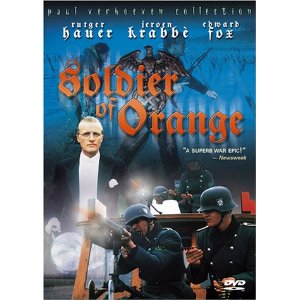
Soldier of Orange
|
||||
Paul Verhoeven's directorial stock has sunk rather low lately (even though Savant admires Starship Troopers). Anchor Bay would appear to be starting a series of Verhoeven's earlier films in much the way they are making Werner Herzog's films available. Soldier of Orange is a superb movie, a grand show that might be considered a Dutch National Epic if its depiction of collaboration during WW2 did not make it controversial in some circles. A story of high adventure with more incident and crazy wartime irony than Operation Crossbow and Five Fingers put together, it manages to show the full panorama of a country overrun by Nazis and display the courage of a minority of naïve, patriotic resistance agents in-depth, and with stirring conviction.
A group of college boys in Leiden are thrown into the war by a German invasion that takes Holland by surprise. Some join the resistance, others become victims, and one signs up with the German SS. For Eric (Rutger Hauer) the war is a dangerous and eye-opening adventure, one that finds him doing cloak & dagger work for the British and attempting a desperate undercover mission for his own Queen Wilhelmina (Andrea Domburg), who spends the duration ruling in exile from London. If this is the true story of Eric Hazelhoff Rolfzema, then he must have led the charmed life of the century. Verhoeven has made it into a sprawling, detail-filled puzzle of espionage twists and character ironies. The fates of Eric's pals range from horrible doom to vengeful martyrdom to ignominious shame, yet we see how each of them is drawn totally involuntarily into their personal vortex. Alex (Derek de Lint) becomes an SS officer by being true to his Mother's lineage. Robby (Eddy Habbema) is one of the first to voluntarily resist the Nazis, but is put into a position where not collaborating with them is practically impossible. For 'Mr. Particular' Nico (Lex van Delden) who becomes an efficient resistance leader, and the unimaginative Jacques (Dolf de Vries) who remains passive, the war is an entirely different experience. But Jack isn't in denial like Robby's girlfriend Esther (played beautifully by Belinda Meuldijk, a hungry-eyed version of Jean Simmons), who both collaborates and resists. Esther eventually concludes that simply surviving is enough of a positive outcome. Eric makes a good central character because he understands the choices his friends make. Hollanders claiming the film to be biased need to revisit Eric's sympathy for Alex and his refusal to turn against him personally because of his choice to join the German army. Or maybe they were offended by the hint that socialists and communists were intended to be the beginning of a postwar democracy promised by Wilhelmina. Or perhaps the film's depiction of a Holland in which even the heroes possess the taint of anti-Semitism. Or maybe they disliked the film's claim that only 50 young Dutchmen made it to England to fight in exile. Can this be accurate? It's my understanding that thousands of Poles did this. Finally, the movie has the guts to suggest that all of the espionage that Eric and his friends risk their lives for is only a diversionary tactic for the English, and not some 'crucial' effort that won the war. This might have hurt Dutch pride. Savant tends to agree with the suggestion that mighty wars are waged by amateurs that don't know what they're doing, directed by generals who must treat them as expendable chessmen. The valor is in the bold character of the young men, not what they accomplish. Savant hasn't seen all of Verhoeven's films yet, but the quality of the direction in this one is remarkable. There are crowd scenes and plenty of naval and army hardware when needed, but smaller details carry the tone: 'Red Sails in the Sunset' on the Victrola; the way Queen Wilhelmina stiffly bows; the crucial substitution of zinc for silver in Dutch dimes. The ironies are well handled, giving the film dozens of funny moments. Eric and Guus (Jeroen Crabbe), dressed in tuxedoes and riding motorcycles, must pronounce the 'sch' in several Dutch words to prove they're not German to suspicious Dutch soldiers. To walk through German checkpoints, Eric uses an unaltered British naval uniform for a disguise. It's so similar to the German Navy's that nobody calls him on it. Edward Fox's 'jolly good' Brit officer will be familiar to those who have seen A Bridge Too Far, but he's still funny. Most of the big scenes are dazzling set pieces: the panic on the Leiden streets during an air raid ... the fascist-like fraternity hazing ... the fluid-camera parties at the beach hotel, where Alex and Eric do the tango surrounded by Nazis and their sympathizers. Verhoeven lets the historic details come into the story naturally. Returning from England, Guus sees the 'Rot Jood' signs on the closed Jewish shops. Somewhere in this country, we remind ourselves, Anne Frank is hiding in an attic. The Dutch resistance is completely outclassed by their professional, ruthless Nazi opponents who have rooms in which nightmare tortures are conducted. German paratroops are so courteous that they're often welcomed, even after Rotterdam is utterly destroyed by bombers. Dutch girls are seen dating the occupiers almost immediately. Eric and Gus have time for liaisons with smoldering Esther and saucy British secretary Susan (Susan Penhaligon), affairs that carry Verhoeven's slightly nasty edge (biting fingers, etc.). The nudity on display stops just short of being commercial pandering. Eric Rolfzema's memoirs may not have included all the sack time Rutger Hauer enjoys here, but heck, an adventure's an adventure. The unpleasant details (brief gore, writing with excrement) have a ring of believability about them. There's even a time-warp echo to Starship Troopers ickiness when Susan nonchalantly crushes a housefly on a windowsill. It dies in close-up among about a hundred of its friends. Anchor Bay's DVD of Soldier of Orange is a delight, one for which Savant's been Sav-alivating for over a year. It's worth the wait. The color is excellent and the framing wide. The older laser disc cropped the ending 'e' entirely from the 'SOLDAAT VAN ORANJE' main title. The DVD also restores the intermission that the laser omitted with a crude splice. The movie is just long enough to need it, and it arrives at a jumping-off point into high adventure that gives it the thrilling feel of a serial cliffhanger. The track is clear, and there are several clean reprises of the stirring music score for those of us in the states that couldn't get it on record. The English subtitles are removable for the Dutchies among us (Savant has a Holland-educated lawyer friend who rhapsodizes over the movie). The movie uses unequal parts Dutch, German and English. If it were all dubbed to English, big sections would make no sense at all. The translation is definitely different from the laser disc, and would appear to be more accurate. There was a piece of a scene that I thought might be new, but more likely than not, the newly translated subtitles made it appear to be new. Verhoeven contributes his usual excited commentary, which at least is under more control than his scream-fest on Starship Troopers. He still has a bad habit of blurting out staccato reactions to individual shots ("That's another shot of the real Eric, next to the Queen in that newsreel shot"), and would seem to be confused about some dates. He talks about shooting the movie in 1977 and 1978, when it was released in Holland in 1977. Quibbles aside, hearing him narrate the details of this unusually big-scale European production is fascinating. The extra background he provides on the historical facts and the changes between Rolfzema's book and the movie are as intriguing as his own personal take on the relative morality of his characters. He makes the cogent point that Jacques' quietly waiting out the war may have been the right thing to do: Jacques became a respected Dutch judge, whereas Eric helped get a lot of his friends killed, accomplished little, and left the country soon after the war. Soldier of Orange is one of the few 'war' movies my wife enjoys, as it's about people and not shooting guns, per se. Its complicated drama is absorbing and rewarding. We're so used to seeing war tales told with a bias toward action and grandiosity, that the personal scale of Verhoeven's Dutch National epic is compelling. This is one of Savant's favorites, which he can recommend to everyone.
On a scale of Excellent, Good, Fair, and Poor,
Review Staff | About DVD Talk | Newsletter Subscribe | Join DVD Talk Forum |
|

| Release List | Reviews | Price Search | Shop | SUBSCRIBE | Forum | DVD Giveaways | Blu-Ray/ HD DVD | Advertise |