|
|
|
|

|
|
|
|
Looking For 007 -
Predecessors, Antecedents, and Inspirations
Some interesting thoughts, and less-than-scholarly observations, on the cultural
genesis of James Bond, the world's most popular screen hero
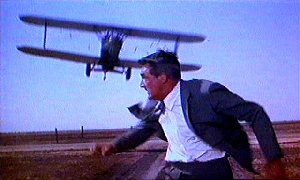
Robin Wood, in his insightful book Hitchcock's Films, does a great job capturing the genius of the Master of Suspense. He praises North by NorthWest (1959) as superior cinema partly by comparing its famous Cary Grant / crop duster biplane scene favorably to the similar James Bond / helicopter duel in the second Bond adventure From Russia With Love (1963). Wood contrasts the depth of irony and playful absurdity in the Hitchcock sequence, with the structurally mechanical and arbitrary Helicopter chase. There is no helicopter chase in the original Ian Fleming From Russia book, and Wood tries to make case that the filmmakers were deliberately cribbing Hitchcock. Well ...
What weight should be given similarities in films? Does anybody really 'copy' anyone else, or is the word 'influence' more appropriate? This game is played so often by critics of lesser repute than Robin Wood, that it is not uncommon to read that a film was 'influenced' by another made several years later. This writer saw the James Bond films with everyone else of his generation, was completely captivated by their style, their violence, their excitement, and especially by what seemed to be a rewriting of the rules of screen heroics. This James Bond was, politically, a new animal entirely, a hero for a new '60's cold-war world. From his inception in the 1953 book Casino Royale, the 007 character evolved from opposing ordinary gangsters and international criminal types, to dealing with outlandish villains and conspiracies of a comic-book grandeur only comparable to those cartoony archenemies to be found in Republic serials, or Batman.
Much has been said about Bond being the cultural intersection of Playboy magazine, high technology and reactionary British Empire nostalgia. But not much, outside of fairly arcane film genre writing, has been written about the movie sources Ian Fleming tapped when writing the Bond stories. It's been said that when Sam Peckinpah reinvented the Western in the 1960's, he pulled in the entire genre and recast every convention and stereotype in his personal mold. Ian Fleming, apparently excited by Film Noir and detective cinema, united them with his own knowledge of real espionage, and concocted a Super-spy genre of his own.
Many sources track the Bond character back to Bulldog Drummond, a British fiction and film thriller hero dating back to the 1920's who's a straight shooter in the name of the law, but also likes nothing better than using his fists in a tight spot. My vote is for Mickey Spillane's Mike Hammer. Bond's unshakeable dedication to Queen and Country, for whom he has a 'license to kill' whenever he chooses, seems similar to the personal code Hammer uses to justify his brutal murders of those criminals and commies he considers beneath contempt. If Hammer is judge and jury, a one-man lynch mob, then Bond's equally sadistic way with those who cross his path has the same dimension of paranoid vigilantism. Mike Hammer sneeringly dispatching some gunsel with a .45 and an offhand insult, and James Bond shooting down unarmed men with a casual quip or two, are different only in style. In other words, under the tuxedo, Bond is basically as much of a bully and a thug as is Hammer (Sean Connery is especially good at communicating this).
Mike Hammer also seems to have provided the model for Bond's sex life. Unlike the Spillane (book) character's typically squalid surroundings, 007 drifts from one ultra-chic Playboy-like bachelor pad to another. But both men have the same macho virility, the mythical sex-magnet kind that every male dreams of. 'Boy, this Mike Hammer has a way with dames', says a character in Paddy Chayefsky's Marty (1955), and he could be saying the exact same thing about James Bond. Both Fleming's and Spillane's literary worlds seem to be populated exclusively with drop-dead gorgeous women of every description, just so long as they are statuesque, full-bosomed lookers with sensual lips.
And don't forget available and willing. The loopiest aspect of the Spillane series is the way these women all but throw themselves naked at Hammer's feet. And the most dated fixture of the Bond films are his constant, absurdly casual sexual conquests. In both fictional bloodlines, the females can be roughly separated into the deadly femme fatales and those judged trustworthy enough to survive the last chapter. There isn't much difference between a Spillane dame (typically a hypersexed gunmoll) and a Bond gal (slightly more variety here; either a hypersexed jet-set seductress, or some variation on the animal-like nature woman). The most convincing description of Bond is still the one where the new 'M' calls him a misogynist dinosaur. It's a conservative fantasy at work. In both Spillane and Fleming, if you find a cold-mannered attractive woman with shortish hair, who rebuffs the hero's cozy advances, she's either a frustrated lesbian, or a psycho obsessed with destroying Men. There's almost no middle ground.
Robert Aldrich in Kiss Me Deadly (1955) altered the Mike Hammer character by introducing the Playboy-bachelor pad/sexy sports car mystique. But Aldrich's basic modus operandi was to criticize the Hammer ethos; hence the revelation of Playboy Mike as functionally a drone, for whom sex is just another angle with which to extort a payday. When faced with a really terrifying Atomic challenge (the kind Bond confronts daily) Hammer collapses into a crybaby wailing for his Velma (read: Mama). I find it telling that the Bond character's literary adventures expand into the realm of comic-book overstatement (grotesque villains threatening the world) only after Aldrich added the cosmic Armageddon element to Hammer in Kiss Me Deadly.
Am I really expecting anyone to believe that Mike Hammer books and movies so heavily influenced Fleming? Yes and no. But take a look at other similarities between Bond stories and some other classic Noir thrillers that preceded them by a few years.
Consider this plot: An agent finds himself on a cross country train surrounded by enemies, his associate murdered, with nothing but his own wits and fists to protect himself and the woman his enemies want to kill. Does he jump the train with the woman, or stick it out? The woman must stay hidden in her sleeper compartment most of the time. Halfway through the journey a particularly nasty enemy agent boards the train and contacts our hero, pretending to be an ally but really a killer like the others. One of the climaxes of the claustrophobic train ride is a truly brutal no-holds-barred fistfight between the hero and one of the enemy agents in a tiny compartment, where they crash about in deadly combat, smashing against the cabinets and the plumbing....
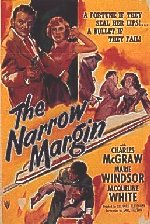 From Russia With Love, right? No, I'm describing Richard Fleischer's 1952 Noir thriller The Narrow Margin. It's strikingly similar to the Orient Express section of From Russia, right down to nervous meals in the dining car, and the hero's conspiring with the conductors to conceal the mayhem from the rest of the passengers.
Or how about this: an agent uses an elaborate ruse to get near an extremely successful criminal, to learn more about a grandiose crime the criminal is hatching. Just when it seems that the agent's cover is blown, the criminal, instead of killing him, takes the agent along on
the caper itself, which involves the invasion of a large building complex with elaborate security safeguards, using a military timetable of precise coordinated activity. The agent's main problem is that he cannot communicate to his superiors that the crime caper is going down, even though he tries by cleverly concealing a written note. Forced to go along on the caper without hope of outside aid, the agent finds out that the super-criminal now intends to kill him after all. Luckily, the message to the authorities has indeed gotten through, and the super-criminal's assault on his objective is thwarted by a last-minute counterstrike - a horde of armed men overruns the criminal's comparatively meager band of criminals, frees the agent, and foils the caper.....
From Russia With Love, right? No, I'm describing Richard Fleischer's 1952 Noir thriller The Narrow Margin. It's strikingly similar to the Orient Express section of From Russia, right down to nervous meals in the dining car, and the hero's conspiring with the conductors to conceal the mayhem from the rest of the passengers.
Or how about this: an agent uses an elaborate ruse to get near an extremely successful criminal, to learn more about a grandiose crime the criminal is hatching. Just when it seems that the agent's cover is blown, the criminal, instead of killing him, takes the agent along on
the caper itself, which involves the invasion of a large building complex with elaborate security safeguards, using a military timetable of precise coordinated activity. The agent's main problem is that he cannot communicate to his superiors that the crime caper is going down, even though he tries by cleverly concealing a written note. Forced to go along on the caper without hope of outside aid, the agent finds out that the super-criminal now intends to kill him after all. Luckily, the message to the authorities has indeed gotten through, and the super-criminal's assault on his objective is thwarted by a last-minute counterstrike - a horde of armed men overruns the criminal's comparatively meager band of criminals, frees the agent, and foils the caper.....
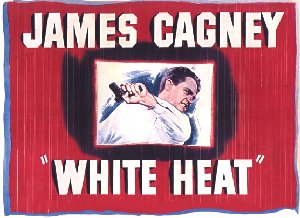 Goldfinger? No, try White Heat (1949), with Oedipal madman Cody Jarrod invading, not Fort Knox, but an oil refinery. The parallels are all there: Fleming has lifted the entire caper mechanism, including the 'homing device' Treasury Agent Fallon cobbles together from Virginia Mayo's 'bedside radio', to the note scrawled on the restroom mirror, which becomes the mini-note lost to the car-crushing machine.
Other parallels are either more generic or less compelling, so I'm not
going to make any hyperbolic claims that Fleming truly lifted anything from anybody - after all, who cares? Both White Heat and Goldfinger are supreme accomplishments. So what if the hero-villain relationship in the black & white Cagney film is compellingly credible, compared to the I'm-going-to- keep-you-alive- so-you-can- foil-my-perfect-crime illogic of the Bond epic. Savant remembers being on the edge of his seat with tension in both pictures. And yes, Mr. smarty-Savant, in Aldrich's World for Ransom (1954) the villains do sort of pull a nuclear extortion plot like Thunderball (1965), but the comparison doesn't go very far.
The other major 50's touchstone of cultural influence seemingly predating the James Bond movies is the incredibly successful Hammer Horror and Science Fiction films of the 1950's. If James Bond and the Beatles made England the cultural center of the world for a few years in the '60's, then the modest Hammer studios at Bray was the first English studio to export an all-British film product successful in every movie market on the planet. Before Bond started an international 007-wannabe race to make Spy spoof takeoffs, Hammer films could boast that horror producers on three continents were doing their best to imitate the Technicolored monsters, sex, blood and gore formula of Britannia's own Hammer boys.
Goldfinger? No, try White Heat (1949), with Oedipal madman Cody Jarrod invading, not Fort Knox, but an oil refinery. The parallels are all there: Fleming has lifted the entire caper mechanism, including the 'homing device' Treasury Agent Fallon cobbles together from Virginia Mayo's 'bedside radio', to the note scrawled on the restroom mirror, which becomes the mini-note lost to the car-crushing machine.
Other parallels are either more generic or less compelling, so I'm not
going to make any hyperbolic claims that Fleming truly lifted anything from anybody - after all, who cares? Both White Heat and Goldfinger are supreme accomplishments. So what if the hero-villain relationship in the black & white Cagney film is compellingly credible, compared to the I'm-going-to- keep-you-alive- so-you-can- foil-my-perfect-crime illogic of the Bond epic. Savant remembers being on the edge of his seat with tension in both pictures. And yes, Mr. smarty-Savant, in Aldrich's World for Ransom (1954) the villains do sort of pull a nuclear extortion plot like Thunderball (1965), but the comparison doesn't go very far.
The other major 50's touchstone of cultural influence seemingly predating the James Bond movies is the incredibly successful Hammer Horror and Science Fiction films of the 1950's. If James Bond and the Beatles made England the cultural center of the world for a few years in the '60's, then the modest Hammer studios at Bray was the first English studio to export an all-British film product successful in every movie market on the planet. Before Bond started an international 007-wannabe race to make Spy spoof takeoffs, Hammer films could boast that horror producers on three continents were doing their best to imitate the Technicolored monsters, sex, blood and gore formula of Britannia's own Hammer boys.
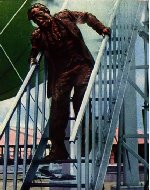 Hammer's Quatermass 2 (a.k.a Enemy From Space,1957) plays like a hybrid of Invasion of the Body Snatchers (1956), with a Bond film structure. Forgetting the movie's theme of creeping bureaucracy, Quatermass 2 has a hero in a high-tech setting discover an apocalyptic conspiracy that could conquer the Earth, all centered in an ominous and remote military/industrial installation of indefinite purpose. When loyal government officials, the Media and Scotland Yard all fail to solve the mystery, it is up to the Bond-like Quatermass to sneak into the secret base in disguise. Using a pitched machinegun battle as cover, he destroys the menace practically single-handed. Quatermass 2 has some of the pulp tension of the Bond films, in its fusion of the mundane and the outlandishly fantastic. It insists that horribly violent conspiracies are ready to leap out of ordinary reality. It suggests that post-atomic man must fight to save the world, and must be completely ruthless if he hopes to defeat his implacable and inhuman foes.
Hammer films also share with James Bond movies an Anglocentric refusal to admit the postwar decline of the British Empire. Many early Hammers identify their monsters as being of colonial or Third-World origin (The Mummy (1959), The Plague of the Zombies (1966), The Reptile(1966)). Usually the supernatural threat is initiated when the Brits meddle in ancient cultures or religions, like Voodoo or Egyptian idolatry. When the monster or other supernatural threat erupts into staid English surroundings there seems to be some moral retribution at work: the stiff, hypocritical Brits are paying with their lives for the colonial crimes of their Empire builders. Then, contradicting this logic, each film ends with the supernatural element being suppressed with vigorous self-righteousness, the status quo restored and the world once again made safe for Queen and Country.
Similar contradictions run wild in Hammer's non-supernatural horror films The Stranglers of Bombay (1959) and The Terror of the Tongs (1960). Both establish reasonably accurate pictures of entire continents of subjugated Asians so powerless under colonial rule, that the terror cult and political murder sprees against the European occupiers seem an entirely logical, even moral, reaction. Then the actual adventure plot mechanisms of each film kick in and the films turn out to be completely reactionary, using the 'primitive barbarism' of the 'subhuman' Asian fanatics to justify redoubled repression - those childish savages just seem to need the paternal leadership of the Empire, after all.
Interestingly, actor Burt Kwouk of Tongs turns up time and again in Bond films, usually representing evil Chinese agents (Mr. Ling in Goldfinger) or screaming Mao-styled fanatics (a manic missile controller in You Only Live Twice (1967)). While relegating Asian characters to stereotypes no longer considered p.c. in the United States, James Bond movies are forever casting England the nation as consistently central to world affairs. The U.S. fields agents like the amiable but unimaginative Felix Leiter, who defers to every Bond whim as if 007 were the protector of America as well. England is constantly placed in a mediating position between the Russians and the Americans, both of which, if represented at all, are usually depicted as boorish & hostile warmongers (best example: You Only Live Twice). In a general sense, what the James Bond movies do is to essentially take Cold War reality, the dull but real economic and ideological strife between America and the Soviet Union, and trivialize it with an Anglocentric fantasy. Both superpowers are reduced to irrelevant pawns, and the real conflict, being fought on a higher battlefield, is between Her Majesty's Knight Errant James Bond, and whatever new version of Fu Manchu can be concocted as an alien threat.
Politically, the mindset of the Bond films hasn't been altered in three decades. In Goldfinger, special care is taken in the dialog to stress that Auric Goldfinger's awful Auschwitz-like nerve gas has been smuggled in from outside the United States, as if it were essential to dissociate America and chemical weapons one from another. That this kind of hypocrisy goes unremarked upon is typical of the politically vacant nature of audiences: smuggling Nerve Gas into America is like smuggling Snow into Alaska. Throwing audiences' taste for sadism back in its face, Goldfinger affords the spectacle of hundreds of Fort Knox soldiers apparently being snuffed out by the deadly gas. Then it is revealed that the killing is a ruse. Goldfinger presents a possible modern atrocity as a cheap thrill - and then neatly sidesteps dealing with its consequences!
33 years later, near the beginning of Tomorrow Never Dies (1997), equal care is made to identify a notorious international arms smuggler as a 'student radical from the old Berkeley days'. Oh, now it all makes sense - it's those darn student radicals again! Weren't they also against the Vietnam War? I knew they were the ones behind evil arms deals with stolen weapons! ... Who proofs these scripts, Margaret Thatcher?
Note, 11/15/99: The villain of the latest Bond, The World is Not Enough, is placed in a number of seemingly unrelated international hot spots, like Kosovo, Iraq, Ethiopa, etc., implying that all these various local problems are caused not by political differences or legitimate struggles for freedom, but by insidious international terrorists! These right-wing Bond producers never give up....
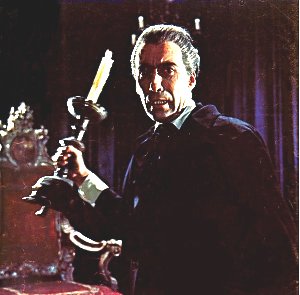 Several English critics have drawn parallels between Bond and Christopher Lee's Hammer version of Count Dracula. Dracula, they say, represents the same all-powerful male fantasy as does 007. All women are drawn to him; he uses them like Kleenex, leaving many dead. Mortal men are largely powerless against this sexually superior male. The irony is that male audience members boo Dracula and cheer Bond, when both 'heroes' think nothing of taking any and all females they choose, and killing their husbands without an afterthought. Dracula has supernatural powers, Bond a 'license to kill'. Giving someone a license to kill means he can kill you too, stupid.
Just one more point of reference, and one that seems unavoidable, even though it falls into none of the pat theories and relationships I've cooked up to justify my previous arguments: Fritz Lang practically invented the cinema Spy thriller and most of the conventions of pulp serial intrigue that underpin Spy thrillers, technological thrillers, and much of cinema Science Fiction. The Spiders from way back in 1919 is a fully realized treasure quest in the best Indiana Jones tradition. Dr. Mabuse, der Spieler (1922), Spione(1929), The Testament of Dr. Mabuse (1932), and Ministry of Fear (1945) all develop elements of Super-spy pulp fiction as if Lang and his scenarists alone held the secret formula of innovation.
Finally, Lang's last film,
Several English critics have drawn parallels between Bond and Christopher Lee's Hammer version of Count Dracula. Dracula, they say, represents the same all-powerful male fantasy as does 007. All women are drawn to him; he uses them like Kleenex, leaving many dead. Mortal men are largely powerless against this sexually superior male. The irony is that male audience members boo Dracula and cheer Bond, when both 'heroes' think nothing of taking any and all females they choose, and killing their husbands without an afterthought. Dracula has supernatural powers, Bond a 'license to kill'. Giving someone a license to kill means he can kill you too, stupid.
Just one more point of reference, and one that seems unavoidable, even though it falls into none of the pat theories and relationships I've cooked up to justify my previous arguments: Fritz Lang practically invented the cinema Spy thriller and most of the conventions of pulp serial intrigue that underpin Spy thrillers, technological thrillers, and much of cinema Science Fiction. The Spiders from way back in 1919 is a fully realized treasure quest in the best Indiana Jones tradition. Dr. Mabuse, der Spieler (1922), Spione(1929), The Testament of Dr. Mabuse (1932), and Ministry of Fear (1945) all develop elements of Super-spy pulp fiction as if Lang and his scenarists alone held the secret formula of innovation.
Finally, Lang's last film, 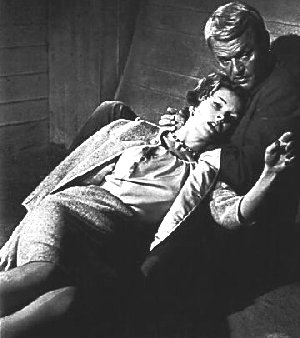 The 1,000 Eyes of Dr. Mabuse (1960), pulls it all together. It recapitulates everything from the previous tales and blends a pulp concoction mixing spies, evil masterminds, séances, mistaken identity and disguises, in a Nazi spy hotel where every room contains a dozen hidden cameras and microphones. There is a moment, a particularly grainy shot, of a couple worried about eavesdroppers. When this is revealed to be the POV of one of Mabuse's spy cameras, Lang both initiates, and makes the ultimate statement, about 'surveillance cinema.'
Mabuse has connived and murdered to gain control of the Arar Atomic Works, although none of the law enforcement types seem able to fathom how he can expect to profit from the acquisition. He can't extort or steal anything with it. What can he possibly want it for? The answer is the core motivator for the post-modern world: This is Mabuse, you fools, he doesn't want money -- he wants to destroy the world, for the sheer beauty of the act itself! The artist as destroyer, negator of everything, good and evil alike - a real Dr. No. Pulp meets poetry in a way that happens only occasionally in the world of James Bond. Like a fable whose moral is suddenly, astonishingly clear, at this moment in 1,000 Eyes of Dr. Mabuse, audiences 'ahhh' with understanding not commonly expected from 'just a spy thriller.'
Text © Copyright 1998 Glenn Erickson The 1,000 Eyes of Dr. Mabuse (1960), pulls it all together. It recapitulates everything from the previous tales and blends a pulp concoction mixing spies, evil masterminds, séances, mistaken identity and disguises, in a Nazi spy hotel where every room contains a dozen hidden cameras and microphones. There is a moment, a particularly grainy shot, of a couple worried about eavesdroppers. When this is revealed to be the POV of one of Mabuse's spy cameras, Lang both initiates, and makes the ultimate statement, about 'surveillance cinema.'
Mabuse has connived and murdered to gain control of the Arar Atomic Works, although none of the law enforcement types seem able to fathom how he can expect to profit from the acquisition. He can't extort or steal anything with it. What can he possibly want it for? The answer is the core motivator for the post-modern world: This is Mabuse, you fools, he doesn't want money -- he wants to destroy the world, for the sheer beauty of the act itself! The artist as destroyer, negator of everything, good and evil alike - a real Dr. No. Pulp meets poetry in a way that happens only occasionally in the world of James Bond. Like a fable whose moral is suddenly, astonishingly clear, at this moment in 1,000 Eyes of Dr. Mabuse, audiences 'ahhh' with understanding not commonly expected from 'just a spy thriller.'
Text © Copyright 1998 Glenn Erickson
DVD Savant Text © Copyright 1997-2001 Glenn Erickson
Go BACK to the Savant Index of Articles.
Return to Top of Page
DVD Savant Text © Copyright 2007 Glenn Erickson
|
|
|