| Release List | Reviews | Price Search | Shop | Newsletter | Forum | DVD Giveaways | Blu-Ray/ HD DVD | Advertise |

| Reviews & Columns |
|
Reviews DVD TV on DVD Blu-ray International DVDs Theatrical Reviews by Studio Video Games Features Collector Series DVDs Easter Egg Database Interviews DVD Talk TV DVD Talk Radio Feature Articles Columns Anime Talk DVD Savant HD Talk Horror DVDs Silent DVD
|
 DVD Talk Forum |
|
|
| Resources |
|
DVD Price Search Customer Service #'s RCE Info Links |
|
Columns

  

|
 |
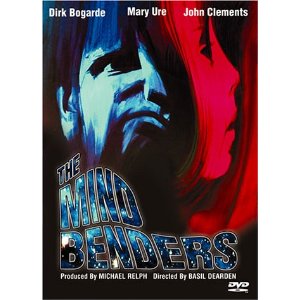
The Mind Benders
|
||||
Some films are difficult to classify. A serious movie about sensory deprivation experiments, The Mind Benders is often listed as a science fiction story, but it doesn't play like one. It's an espionage tale, a psychothriller, and a love story. It also would seem to connect up a half-dozen different threads in the history of fantastic films ... although technically, there's nothing fantastic about it.
The Mind Benders approaches its subject soberly, and may seem slow-paced to anyone aware of the somewhat similar movie Altered States. The 'reduction of sensation' experiments aren't yet called Sensory Deprivation, and we hear a lot of well-researched and authentic-sounding exposition repeating what exactly's going on. Prolonged experiences in isolation tanks become highly concentrated mental torture sessions, where the Self is broken down. Longman emerges with his personality 'loosened', in a state where he's susceptible to suggestions that can permanently change his beliefs and behavior. The investigators convince Longman that his loving wife Oonagh is a tramp, and that he doesn't love her. As with the genetic changes in Cronenberg's The Fly, these seeded suggestions only make themselves known later, and the balance of the film follows the efforts to turn Mr. Hyde back into Dr. Jekyll. Professionally directed by Basil Dearden, The Mind Benders is a well-acted tale where events are (now) perhaps a bit too predictable. But it's full of fascinating ideas and connections. It is strongly related to hardcore British Science Fiction. It acknowledges the existence of the pacifist 'ban the bomb' mentality championed in Day the Earth Caught Fire. Professor Sharpey was ejected from the American research community for his pacifist ideas. Now that he's back home, English intelligence ferrets are hot on his case. The Major Hall character could have walked out of the apocalyptic Sci-fi thriller These are the Damned: he doesn't have a Quatermass-like secret lab, but Hall is a cold warrior with an umbrella, a ruthless gentleman. Historically, the Isolation experiments seen here link up with the LSD and other mind-altering trials done in the United States. These weren't carried out for curiosity's sake or to launch culture gurus like Timothy Leary, but to investigate the possibilities of brainwashing and mind-control learned from the Communists during the Korean War. Major Hall leaps to life when he realizes that Longman's mental state after only eight hours in the tank is identical to that of a brainwashing subject who's been subjected to months of torture and isolation. Hall would seem to have discovered a useful tool for his espionage 'interrogations'. Before the Korean War, popular movies and stories about amnesia abounded, but afterwards they were supplanted by the new interest in brainwashing, or the more generic theme, The Remote Control of Human Beings. Suddenly we're not just talking about brainwashing stories like The Hook, but science fantasies like Invaders from Mars and Invasion of the Body Snatchers. Because the enemy now may be a loved one who no longer thinks like you or I, but is instead the programmed zombie of evil puppet masters, the only safe way to confront the world is with total distrust: paranoia. So the connections come full circle, from sci-fi to politics to history, and back to sci-fi again. The political truths of our Age of Terror are best recorded in our science fiction movies: The Mind Benders clearly states that the US and the UK as well as their Soviet counterparts were very keen on finding ways to mentally control people and pull information from their heads. In a couple of years spy movies like The Ipcress File (which now seems directly inspired by The Mind Benders) would characterize the West as amateurs trying to keep current with evil Communist brainwashing techniques. Along with nuclear weapons, nerve gas and biological weapons, brainwashing would join the list of activities that the West would spearhead, while our entertainments pretended they were the exclusive province of soulless foreign foes. The unwritten scene in The Mind Benders, therefore, is where Major Hall brings in a platoon of soldiers and converts Dr. Sharpey's Oxford lab into a top secret military 'establishment.' The University of California is said to have dozens of secret projects hidden on and off campus for these kinds of experimental science -- it's said that the only pure science research any more is being done with defense department money. Secret researchers are probably not raising radioactive children in hidden caves (the premise of These Are The Damned, but I think we'd be shocked to find out what they are doing. On the intimate level, The Mind Benders is an updated Dr. Jekyll and Mr. Hyde. The Isolation treatment doesn't split people into moral extremes or separate men from their souls, but it does soften a personality into something that can be permanently altered with just a few well-placed suggestions. The experimental programmers use the brainwashing to negate Longman's love for his wife; and it takes more psychological stress to return him to normal. At the end, Longman is supposedly cured, but how is anyone to know for certain, even Longman? Here is where the film is at its weakest, because Longman's psychological changes occur off-camera and we're confronted only with the extremes of his personality. Major Hall's conviction that he's turned Longman into a man who hates his wife, only works if Hall truly believes what everyone says: that Hall loved his wife in the first place. Hall doesn't trust anyone, so why should he be so sure that Longman's change of heart was the experiment's doing? Nicholas Ray's Bigger than Life, in which a loving husband becomes a raving psychotic because of cortisone overdoses, is far more convincing on this count. In that movie, James Mason is not being brainwashed. The drugs liberate and exaggerate suppressed facets of his personality. When he's 'cured' at the end, the chilling truth remains that somewhere inside Mason there still exists this man who wants to dominate everyone around him, to dispense God's judgment on the world. There's a Pulp chain from The Mind Benders to Bigger than Life, straight on to Fritz Lang's The 1,000 Eyes of Dr. Mabuse. We are the megalomaniac supervillains. John Clements makes a steely Major Hall, and Michael Bryant (Lenin in Nicholas and Alexandra, Dr. Herder in The Ruling Class) is effective as Longman's research associate, even though the subplot of his yearning for Oonagh goes nowhere. Wendy Craig from The Servant has an equally unassimilated role as a bohemian divorcee on a houseboat (!) who gets tangled up in the undeveloped love foursome of the film's last act. Dirk Bogarde's Longman is, if anything, a bit overdeveloped. He certainly projects a complicated man, but his transformation from neurotic Jekyll into sardonic Hyde happens mostly offscreen, and across a very fast time jump. Oonagh offers up stories of their disintegrating relationship, including some rather tame-sounding sexual humiliation, that fills in the gaps but comes off as stagey. Mary Ure, by the way, is excellent in the movie. She has a hard role to play that includes a convincing childbirth scene, and she provides an emotional foundation for a story that would otherwise be adrift in mindwarping science concepts. A very young Edward Fox can be seen in a bit, early on. Is Altered States a remake? Paddy Chayefsky's 'love conquers all' ending is emotionally satisfying but rather silly next to The Mind Benders. Michael Bryant describes Isolation subjects as 'dissolving' in the water tank, something that becomes a totally freaked-out reality in the Ken Russell movie. Altered States takes the real 1960s Isolation experiments down the Timothy Leary road, on a psychedelic search for the Soul. The Mind Benders shows the research for what it was, research in a methodology to enslave men's minds. Curiously, the mind-altering experiments in Wim Wenders' Until the End of the World explore both of these directions at the same time. Anchor Bay's DVD of The Mind Benders looks and sounds great. Georges Auric's stirring score comes across strong in the tense main titles, and the B&W photography of Oxford in 1963 (and dumb meaningless details, like Longman's antique car) is very good. There are some atmospheric angles and double exposures in the isolation tank, but in general, the movie doesn't go in for dramatic staging or visual fireworks. Neither subtitles nor closed captioning are on the disc, so it's good that the dialogue is recorded so clearly, a problem with the earlier Day the Earth Caught Fire, where closed captioning saved the day. This presumably uncut 109iminute DVD is a whole reel longer than the US release through American-International. Savant wasn't even aware of The Mind Benders until the 1980s, so can't know what had been cut out before. A very strange trailer tries to present The Mind Benders as a shocking adult exposé. It's hosted by a man in a room full of posters for the film, who soberly states that he can't show us any scenes. They crop up anyway. The science and politics of the show probably threw the original marketers, who wisely decided to stress the sex angle. The complexity seems to have thrown Anchor Bay's copywriters as well, as they posit The Mind Benders as an inspiration for The Manchurian Candidate. How can an English film released in 1963 be the inspiration for an American film released in 1962?
On a scale of Excellent, Good, Fair, and Poor, The Mind Benders rates:
|
| Coming Soon |
|
|
| Special Offers |
|
|
| Columns |



|
| Home | Release List | Coupons | Shop | Reviews | Forum | Video Games | Price Search | Advertise |