| Release List | Reviews | Price Search | Shop | Newsletter | Forum | DVD Giveaways | Blu-Ray/ HD DVD | Advertise |

| Reviews & Columns |
|
Reviews DVD TV on DVD Blu-ray International DVDs Theatrical Reviews by Studio Video Games Features Collector Series DVDs Easter Egg Database Interviews DVD Talk TV DVD Talk Radio Feature Articles Columns Anime Talk DVD Savant HD Talk Horror DVDs Silent DVD
|
 DVD Talk Forum |
|
|
| Resources |
|
DVD Price Search Customer Service #'s RCE Info Links |
|
Columns

  

|
 |
First Men In the Moon
|
||||
Just about the time outer space adventure movies were becoming rare because of the encroachment of real Gemini & Apollo space missions, Ray Harryhausen and Charles Schneer came forward with this utterly likeable version of H.G. Wells' classic First Men In the Moon. Filled with good humor, turn-of-the-century charm and awesome imagery, it has a first-rate script by English Quatermass creator Nigel Kneale, who does a fine job of updating the original story without ruining it. And the casting makes excellent use of Lionel Jeffries as an endearingly daffy Professor who invents a superior goo that 'severs the magnetic ties of gravitation'.
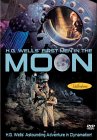
H.G. Wells really hit his stride with his book First Men In the Moon. Of all his early science fiction work, it's the most readable and fleshed-out. Told from Bedford's point of view, it flows as a semi-surreal fever dream, with Bedford trying his best to accurately describe one incredible situation after another. Savant was just old enough to be critical about movies when this matinee favorite hit the theaters, and you can bet he was the first kid in line. The book (and the excellent Classics Illustrated comic) had been one of my favorites, and I looked with trepidation at the poster that showed the story had been changed to include a girl on the voyage. There was nothing to fear. The film has a much lighter tone than the book, but Martha Hyer is a welcome stowaway who did not interfere with the classic situations in the story. The book's strange (and almost drug-like) depiction of lunar weightlessness is missing, but from the moment that humans meet spear-carrying Selenites on the underground cliffs, I knew the show was on the right track. A socko music score by Laurie Johnson 1 kicks off an arresting title sequence combining views of the moon with rippling water reflections. The drama begins in a 'quaint' period setting familiar from earlier H.G. Wells and Jules Verne adaptations like The Time Machine and Journey to the Center of the Earth. But as soon as Cavor's capsule launches skyward, the show enters a realm of nonstop special effects and doesn't come back until the very end. Unlike many of Harryhausen's earlier films, First Men In the Moon doesn't withhold its effects for episodic vignettes. Once in space, the effects are constant. The moon calf, a rather disappointing caterpillar creature is the only standard monster; instead we are given a horde of insectoid Selenite creatures. Some are animated with stop-motion but the majority of them are not. The subterranean moon world is imaginative, colorful and well designed: the only failed illusion, a very minor point, is the rows of stalactite crystals on the stairway to the Grand Lunar that are too clearly flat paintings. For some reason they stick out every time. Although there's relatively little of Harryhausen's standard animation techniques on view, the design and creation of the wall-to-wall effects is clearly his. His wavy-glass tricks with the Grand Lunar are mesmerising, and his bottomless wells, galleries of caves, and self-mummifying ant creatures are fascinating creations. This is actually Ray's finest film overall. As a showcase for his effects it's not top-rank, but as a movie, it's way out front. Kneale was the perfect collaborator for Harryhausen, who was a childhood fantasy fan along with Forrest Ackerman and Ray Bradbury. One can imagine them sharing ideas with a budding sense of wonder. Kneale rarely saw his work brought to life with such technical artistry: even the effects of the superior Quatermass and the Pit are barely adequate. But Kneale gave Ray an even greater gift, a script that added up to something more than a string of monster encounters. All of Harryhausen's Dynamation tricks needed to be adapted for anamorphic Panavision. Proportion and perspective look good in most shots, and the miniature rear-projection behind the animation doesn't look terrible, as in the previous 'scope stop-motion film, The Beast of Hollow Mountain. Harryhausen never worked in an anamorphic format before or since. In Germany, First Men In the Moon was blown up to 70mm and marketed as a one-film Cinerama attraction, in stereophonic sound. Edward Judd (The Day the Earth Caught Fire) makes for a thickly brash hero, and Martha Hyer is both sensible and sympathetic as the girl written into a boy's adventure. The irresponsible Bedford becomes a take-charge guy on the moon, making for a nice change of tone. Jeffries' wonderful Cavor begins as a silly twit and by the end is the conscience of the human race. He has the boyish fervor we associate with English hobbyists -- Michael Powell was said to be this kind of impulsive, buoyant man. Cavor's character has its own built-in nostalgia for another time. There is a bit too much kiddy humor up front ("Madame, please leave the room!" "I hate chickens") but Lionel Jeffries is too good to throw lines like this away. A moment when he bids farewell to a gaggle of geese is very endearing. Otherwise, Nigel Kneale and Jan Read's script is exemplary. With Wells' story outstripped by current events, Kneale cleverly frames his narrative in a flashback from a present where a United Nations capsule lands on the moon - only to find that a desiccated Union Jack has made it there before them. The economy of these scenes is typical Kneale efficiency; and except for a few details, the moon landing is identical to the real one that happened five years later. Kneale's script uses a shock cut from feet touching the lunar surface to a ticker tape parade back home, a cut copied by The Right Stuff twenty years later. 2 Now a 90 year-old man, Arnold Bedford is located by the authorities in a rest home and is all too eager to tell his story, now that someone is willing to believe him. The effect is charming. It also allows for a bit of characteristically Knealian irony. All of his previous Sci-Fi work shows our potential meeting with alien species to be one kind of biological mismatch or another. In this instance, Kneale works a reversal of the famous conclusion of Wells' other hit, The War of the Worlds. First Men In the Moon is not a classic science fiction film, and it doesn't quite fit in with the earlier vogue for family films based on Verne and Wells stories, a subgenre cheapened by A.I.P and Irwin Allen. Classic 50s Sci-Fi had flourished in their own slightly more innocent world of wonder, and it was not only the space race that made their ordinary escapism no longer seem vital. The alarming assassinations and wars of the early 60s forced fantasy to grow up to a degree. From then on, most serious Sci-Fi pix would tend toward real threats and conspiracies, often with an ecological or political basis. The abstract paranoia of the 50s became a given state of affairs. First Men In the Moon is all the more endearing for its success in being resolutely retro. Since everyone else points it out, Savant will too: the unctuous bailiff who serves a writ on Martha Hyer is none other than Peter Finch, clearly doing a favor for the producers, or perhaps having fun with Lionel Jeffries. Jeffries may have had more creative input than just acting; several years later he made his directorial debut with the rarely seen minor classic The Railway Children. Columbia TriStar's DVD of First Men In the Moon is a welcome sight. Harryhausen releases average one a year, with rumored double bills of the earlier Columbia hits always 'coming soon'. A special Pioneer laser disc of this title from the early 90s had a terribly distorted soundtrack, but better sources have been found in the interim and the audio here is fine. The show hasn't fared well in 16mm or earlier videos. In badly timed television copies or faded theatrical prints, the mattes and miniatures tend to stand out badly. This may be the first opportunity for many to see it in the Panavision screen shape, and it's going to be a treat. For the first time, First Men In the Moon is also in stereophonic sound, thanks to a 4 track Mag element secured at Columbia a few years back - the stereo mix engineered for West Germany's Cinerama release was remixed with the English dialogue stem. The anamorphic-enhanced image is up to Columbia TriStar's high standards, with the extra resolution making the details in the wide shots easier to read than before. 3 The title sequence does look a bit contrasty; my inside info is that, like other popular Harryhausen pictures, film elements on First Men were in pretty haggard shape. The disc has a nice pack of extras. There are trailers, and an unimpressive photo gallery. The 'This is Dynamation' featurette is the oft-seen one from The 7th Voyage of Sinbad. The big goodie is the entire 60-minute Richard Schickel docu 'The Harryhausen Chronicles', an excellent critical appreciation of the beloved Ray with ample clips of his early amateur work and fairy tale short subjects. It also has a great many new video close ups of his classic monster models. The artwork on the cover is attractive but a bit cluttered. There's only one moment where the movie draws unintentional laughter, both back in 1964 and in every subsequent group viewing. After smiling indulgently at the strained credibility of Cavor's capsule, and their oxygen supply, etcetera, we're treated to the spectacle of the iron sphere striking the surface of the moon at what must be over 100 miles an hour, with the astronauts inside basically unprotected. The railroad shock absorbers don't fool anyone - most audiences laugh reflexively, as the impact is so violent, we'd expect Hyer, Jeffries and Judd to be emulsified into Lunar Jelly. It's all part of the fun.
On a scale of Excellent, Good, Fair, and Poor,
Footnotes:
1. An album of Laurie Johnson cues from First Men In the Moon omits the beautiful romantic theme, leading Savant to wonder if it was not composed by he. After proudly playing a dozen cues, Laurie in the liner notes scoffs at the show, and disdains the 'chore' of having to compose insipid music that basically says things in the movie are 'big'. Savant loves the score and places it in his category of 'music and landscape' films like Bernard Herrmann's Garden of Evil.
2. The advertising posters cleverly promoted the film as endorsed by a real astronaut: "It's out of this world!"
3. A bit of distressing news. Sony has shuttered their on-the-lot HDTV center, at which Columbia-Tristar was mastering its library at top quality and making their consistently superior DVDs by downconverting. Apparently the expensive facility wasn't doing much else, what with the high prices and industry standards- bickering slowing (or stalling) the wide adoption of HDTV.
Review Staff | About DVD Talk | Newsletter Subscribe | Join DVD Talk Forum |
|

| Release List | Reviews | Price Search | Shop | SUBSCRIBE | Forum | DVD Giveaways | Blu-Ray/ HD DVD | Advertise |