| Release List | Reviews | Price Search | Shop | Newsletter | Forum | DVD Giveaways | Blu-Ray/ HD DVD | Advertise |

| Reviews & Columns |
|
Reviews DVD TV on DVD Blu-ray International DVDs Theatrical Reviews by Studio Video Games Features Collector Series DVDs Easter Egg Database Interviews DVD Talk TV DVD Talk Radio Feature Articles Columns Anime Talk DVD Savant HD Talk Horror DVDs Silent DVD
|
 DVD Talk Forum |
|
|
| Resources |
|
DVD Price Search Customer Service #'s RCE Info Links |
|
Columns

  

|
 |
The Saragossa Manuscript
|
||||
Yet another example of an obscure masterpiece unearthed by DVD, The Sargossa Manuscript is a 1965 Polish fantasy epic physically set in Spain but actually happening in the mind of its imaginative author. Adapted from an early 19th century book, the show is part Luis Borges, part Canterbury Tales, and part Playboy's Girls of Warsaw.
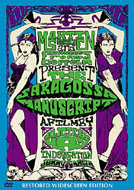
Luis Buñuel likes to play with flashbacks hidden within flashbacks, a literary device employed in The Sargossa Manuscript to create a Spain of interlocking destinies and endless complexity. It eventually coalesces into a humorous portrait of a culture united by its prejudicial differences. Soldiers mingle with priests who are really sheiks in disguise, and officers of El Santo Oficio indeed appear when no-one expects them (nobody expects the Spanish Inquisition!). A rake leeches off the son of Jewish merchant, but appearances are deceptive, and both he and a vagabond Gypsy prove to be honorable souls. Using about 4x the running time of Simon of the Desert, The Sargossa Manuscript creates a Spain where the doings of ghosts and devils are as real as the beautifully-recreated town squares and villas. Every nubile maiden in Poland would seem to have been recruited to play the various unholy vixens and mortal temptresses met along the way, and their coquettish games remind us of the narrative tricks the author is pulling on Alfons - and us. Most of the relationships have aspects of a con in action; to watch the show is to constantly try to figure out what the heck is going on - whether the weird happenings will be revealed as a conspiracy, or perhaps the trick of the mind, or if Alfons is a soul already in hell. With the Inquisition popping up unannounced at any moment, we're almost ready for our hero to be revealed as dreaming the whole plot from the torture chamber of Terry Gilliam's Brazil. Doors are constantly opening before us, as if we're sharing Alfons' dream. Potential clues to the mystery are offered: the sheik's lost shoe, the weird skeleton-like landscape, the drinks Alfons is repeatedly offered (in various locations) from the same skull-shaped goblet. Fans who like to graph out the time-level intricacies of the Back to the Future movies will want pencil and paper handy to take notes: the flashbacks go far deeper than in anything else Savant has seen, indicating that Jan Potocki must have been having great fun dreaming up such a twisted pretzel of a plot. No sooner does one story begin, than a character in it begins telling another story. The tangents overlap and confusion is inevitable; not only is it difficult to figure out how storyteller #2 would learn the particulars of the tale told by storyteller #4, but it's impossible to keep them straight anyway. The good news is that the stories don't lead into conceptual cul-de-sacs, but pay off in the kind of ribald good humor that one would expect from a classic farce. Zbigniew Cybulski is a buffoonish hero, very unlike the ultra-cool rebel he played for Andrej Wajda in Ashes and Diamonds (Cybulski has the honor, along with Jack Lord in Dr. No, of having some of the earliest publicity stills showing the modern man dressed cool by wearing not a hat, but sunglasses). All the other roles are fun, especially Zdzislaw Mkalakiewicz as the manipulative rake who, happily does not turn out to be a demon like so many of the other characters. A number of very attractive and alluringly-clad actresses decorate the screen in this old-fashioned, male-oriented adventure. The film is very good-looking, filmed in anamorphic B&W. 1 Director Has' camera moves constantly and well; he's a very good director. There are some stylistic flourishes at the end involving a mirror and a doppelganger world that might indicate time travel as well as a literal 'literary distance'; these are intriguingly handled and pitched at a tone consistent with the rest of the film. Watching the movie means enduring 3 hours of Spaniards speaking Polish subtitled in English - it's broken down into two parts, which helps. But it's not the easiest film to watch or, especially with this crazy continuity, to follow. The music uses several classical cues and several instances of Spanish guitar source music. A few Forbidden Planet- like electronic warblings find their way in but seem right at home in the weird fantasyscape. Image Entertainment's DVD of The Sargossa Manuscript is presented with the flourish of its 1998 micro-release, using a Fillmore West-like poster to make the film seem as if Jerry Garcia (whose ardor for the film extended to paying for part of its restoration) directed it himself. The DVD includes some nice stills, an isolated music track, and very informative liner notes by Darren Gross. These were especially helpful when I became hopelessly confused at around the 30 minute mark. Included in the liner booklet is an attempt to graph out some of the nested flashbacks in the film's plot; and an essay by Alan Trist, a publisher who remembers when Jerry Garcia saw the film for the first time. Trist mentions a scene that Jerry was 'tickled with' - that turned out, curiously, not to be in the movie. But it's no mystery to Savant. From the description given by Trist, the movie in question is Roberto Gavaldon's 1960 Macario, from Mexico. Hopefully Trist just got the story wrong, and the whole legend of the Garcia endorsement of The Sargossa Manuscript isn't based on the wrong film!
On a scale of Excellent, Good, Fair, and Poor,
Footnotes:
1. The disc has ovaloid changeover cues, indicating a 'scope film. But
the aspect ratio is about 2:1. It's difficult to tell if the show was cropped on the sides, because all the compositions look fine. Perhaps this is a Polish variation on SuperScope or something similar?
Review Staff | About DVD Talk | Newsletter Subscribe | Join DVD Talk Forum |
|

| Release List | Reviews | Price Search | Shop | SUBSCRIBE | Forum | DVD Giveaways | Blu-Ray/ HD DVD | Advertise |