| Release List | Reviews | Price Search | Shop | Newsletter | Forum | DVD Giveaways | Blu-Ray/ HD DVD | Advertise |

| Reviews & Columns |
|
Reviews DVD TV on DVD Blu-ray International DVDs Theatrical Reviews by Studio Video Games Features Collector Series DVDs Easter Egg Database Interviews DVD Talk TV DVD Talk Radio Feature Articles Columns Anime Talk DVD Savant HD Talk Horror DVDs Silent DVD
|
 DVD Talk Forum |
|
|
| Resources |
|
DVD Price Search Customer Service #'s RCE Info Links |
|
Columns


|
 |
The Vikings
|
||||
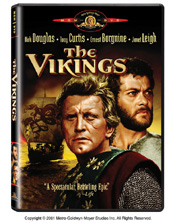
A rip-roaring action adventure that places exciting battles, blood vendettas and pulpy violence over any particular depth of theme, The Vikings fares better than many more solemn period epics. It's free of pretense and blessed with peerless production values.
The Vikings was never at all taken seriously, at least not here in the States. The Academy at that time accepted big flashy spectacles only when sobered with religious themes, as in Ben-Hur. Producer-star Kirk Douglas, established as a name in Westerns but not an epic hero, 1 assembled a crack production team for this expensive, difficult-to-shoot outdoor spectacular. As shown on this disc's informative illustrated interview with director Richard Fleischer, the research into Viking lore was extensive. Harper Goff, the creator of the Nautilus for Disney's 20,000 Leagues Under the Sea (reportedly coming soon!), built 3 impressive functioning Norse raiding ships. An entire Viking village was constructed, and a real castle totally refurbished. When Curtis and Douglas fight to the finish on the castle ramparts, a clear view of miles of coastline and horizon provides the background - all of it cleared of telltale shipping or other anachronisms. 3 The acting is actually quite good, starting with the much-maligned Tony Curtis (okay, so Brooklyners can't be expected to ignore his accent) and his then-wife Janet Leigh. She repeats the heavy-breathing damsel in distress she had done so well in previous swashbucklers Scaramouche, The Black Shield of Falsworth, and Prince Valiant. The latter Fox film seems to be the point of departure for The Vikings; Douglas clearly wanted to avoid Valiant's corny opera Norsemen in their horned helmets, along with the 'thee and thou' chivalry talk. Fleischer's Vikings are marauding pagans, nothing more, and the fights are all short and savage. The supernatural element is toned way down to just a few incantations from a hag-like seer, and some nice frissons from Mario Nascimbene's excellent music score. But, to the joy of little boys everywhere, the violence quotient is way up: most of the male stars come in for gory deaths or gross dismemberment - none actually onscreen but certainly not downplayed. Douglas reserved the most striking gore for himself, by having his eye torn out by a hunting falcon. He spends the rest of the picture snarling behind facial scars, with a dead collodion eye staring nowhere. Things do get a bit campy. Leigh's demure femininity is kicked all over the place, in Douglas' rape attempt, and in Curtis' encouragement for her to pick up an oar to help row her own way to safety: he rips the back of her dress open. It's too tight, you see, a factor no healthy kid could miss, with all those drop-dead sexy, form-fitting dresses Leigh wears. Douglas even seems to be asking for laughs now and then, as when he smashes through a stained glass window and wards off priest Godwin (Alexander Knox) with a grunted, "Keep your magic to yourself, Holy Man!" The earnestness of the situation and the eerie beauty of Nascimbene's score put the drama back on track in seconds. A clever animated prologue from UPA starts the film without standard titles. Instead, portentous Orson Welles narration communicates some Viking lore, along with a few important exposition points. It sets up the world quite nicely, so that the first live-action shot, Ernest Borgnine's kill-crazy helmeted face, isn't so much of a jolt. The Vikings does shoot itself in the foot a bit when it comes to plot. Much screen time is expended on the significance of Eric's talisman, the one he gives to Morgana. Both Godwin the Priest and Egbert the turncoat (an excellent James Donald of The Great Escape and Quatermass and the Pit) take pointed notice of it. It all comes down to Morgana blurting out the secret to Einar, to try to cool off the inevitable fight. But when Einar hesitates during the duel, we have to assume he's suddenly struck by a realization of his true relationship to Eric .... a sensitivity that his character and the tone of the film haven't really prepared us for. It's no great fault to a basically action-oriented story, but the feeling remains that The Vikings could have reached a slightly higher level of ambition, if it wanted to. Note that the Egbert character is always reacting ironically to talk about the talisman, and it looks as if he might spill the beans to Einar just before the assault on the castle ... but changes his mind. At that point Egbert simply drops out of the story. Savant gets the twinge of an arc not completed, a circle not closed. I wonder if a shooting script has more to divulge about ol' Egbert. The Vikings is a series of great physical set pieces that climax with the assault on the castle. This is the kind of knuckle scraping, shield bashing violence that kids & men love - the English defenses are battered down one after another, and the main door to the final tower is breached with a Burt Lancaster-like acrobatic stunt. Once inside, there's little of the slack sword clacking of earlier films - the Vikings fight like insane berserkers, hacking away with axes. Careful angles allow them to look as if they're not holding back at all. Equally uncompromised is the one-on-one fighting. Curtis and Douglas'es clash atop a castle turret looks all too real; there can't have been room up there for much more than the two of them and a camera. They slide down the ragged stone and crash onto the hard floors like it's really gotta hurt. Even the idea of being stabbed with a broken sword instead of a sharp one, adds to the feeling of real pain. Modern action films certainly know how to pour on the effects, but after a few hundred obvious knockout blows, or other forms of physical overkill, they usually lose their edge. The Vikings makes us feel the athleticism, as if it's possible to leap over a ten foot gap and climb atop a drawbridge gate, while rocks and spears rain down around us. What fun! The big asset I've so far not mentioned is the inspired photography of ace cameraman Jack Cardiff. A man's man for shooting in remote locations, he not only gets the expansive exteriors right but paints the colorful interiors of castles, Viking lodges, and chapels with expressive pools of colored light. Slight fog and haze add character to dank galleries and lonely fjords. There's even room for muted expressionist touches; Cardiff wasn't the Technicolor master of Black Narcissus for nothing. It's not the greatest movie in the world, but Cardiff's Legend of the Lost stars John Wayne and Sophia Loren, so it might be up for DVD treatment in the next year or so from MGM. This DVD of The Vikings is an incredible bargain and by far the best of MGM's May epic offerings. The 16:9 enhanced image was mastered in HDTV from the original Technirama negative, 2 and the effect is stunning. Previous videos and laser discs are colorless mush next to this - even on a giant screen, the detail and vibrancy of the color are a real treat to behold. MGM must also have gone back to a better sound element, because the distortion of earlier videos, especially in the music, is gone. A good extra on the disc is an extensive interview with Richard Fleischer that covers the whole of the shoot, especially the research and production design. It's all illustrated with dozens of interesting diagrams and photos, including a lot of behind-the-scenes coverage of the set, and the stars on the deck of the sleep-aboard boat that took them from location to location and served as production headquarters. A trailer is also included.
On a scale of Excellent, Good, Fair, and Poor,
The Vikings rates:
Footnotes:
1. Unless you count the almost-forgotten Ulysses (1954). Kirk was one of the first big American stars to make a movie in Italy.
2. Technirama is squeezed VistaVision; it not only goes through the camera sideways but has a slight anamorphic squeeze as well. In his interview, director Fleischer's memory doesn't serve him well when he mistakenly remembers the film as being in 70mm. Weirdly, when Irving Allen decided to do a The Vikings-like story called The Long Ships a few years later, it also was filmed in Technirama - by Jack Cardiff!
3. One old rumor always tells us to look for the Viking wearing a nice, shiny, modern wristwatch! I've not seen it yet. Reader Response from Gordon Thomas 5/29/02: Glenn - Well, I came to work in a rotten mood; but your review of The Vikings perked me up. I'd been writing a review of this DVD in my head for weeks, but you've said everything--and more, and better. The cinematography aspect of this film alone should be underlined: with everybody going on about the terrific looks of current films like Lord of the Rings, maybe some attention should be paid to Cardiff's astonishing use of real landscape, e.g. Ragnar's entrance into the Fjord, or the approach to the castle in the last act. No digital crap here, and we'll never see its like again. As for the dismembering and the mutilation... as a kid, true, I thought this was way cool; but seeing it now, I thought it was far from gratuitous pandering. The hurt inflicted on these guys resonates in a strange way with all the emotional brutality in the story. Curtis' wound feels right---his essential decency allows him to give the sword to Ragnar, but it's also because he intuitively aligns himself with the Borgnine character, i.e. he (sniff) somehow recognizes his father, and to the pagan, yet heroic, code of the Vikings. I mean, who'd want to cozy up to Frank Thring? Not even Egbert. Tony's kind of a masochist in this thing, anyway: what did he think the consequences would be after having Kirk's eye ripped out? And Douglas' scarring is absolutely necessary. At the beginning of the picture he is way too frisky---and he looks like an aging surfer, with the blond hair and the sleeveless tunic and all the chicks, of course. The eye-rip is what tilts him; it's a badge of his obsessive angst. And Tony's amputation: it was time for him to feel some Viking pain and get off his high horse. Plus, it's pretty vivid symbolism for what's coming with him and Einar. As for Douglas' allowing Tony to win the sword fight, I think he was already halfway there. Tony had earned big Viking points for the resourcefulness of the escape into the fog business, then losing his arm for Ragnar's sake, and finally leading the whole troupe to Thring's castle. The bird in the eye and the tussle over the babe had certainly ratcheted down Kirk's pride, but I think the power of Tony's Odin-sanctioned actions was making Douglas see him as an equal. He's not really surprised when Morgana tells him the truth.
Tony's delivery of the line, "Why did he hesitate?" is one of the best in the movie. Thanks for the great review! -Gordon Thomas
Review Staff | About DVD Talk | Newsletter Subscribe | Join DVD Talk Forum |
|

| Release List | Reviews | Price Search | Shop | SUBSCRIBE | Forum | DVD Giveaways | Blu-Ray/ HD DVD | Advertise |