| Release List | Reviews | Price Search | Shop | Newsletter | Forum | DVD Giveaways | Blu-Ray/ HD DVD | Advertise |

| Reviews & Columns |
|
Reviews DVD TV on DVD Blu-ray International DVDs Theatrical Reviews by Studio Video Games Features Collector Series DVDs Easter Egg Database Interviews DVD Talk TV DVD Talk Radio Feature Articles Columns Anime Talk DVD Savant HD Talk Horror DVDs Silent DVD
|
 DVD Talk Forum |
|
|
| Resources |
|
DVD Price Search Customer Service #'s RCE Info Links |
|
Columns

  

|
 |
THE CHARGE OF THE LIGHT BRIGADE
|
||||
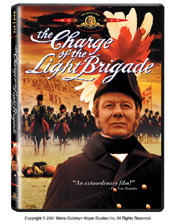
English director Tony Richardson hit it big with the rousing Tom Jones but was more at home with subversive social gauntlets like his influential Loneliness of the Long-Distance Runner. He found a home at United Artists but never repeated his box office successes, giving UA instead melancholy think-pieces like Mademoiselle and awkward vehicles like Ned Kelly. For a big studio to set this art house anti-war liberal loose with a huge budget was an economic blunder reminiscent of the total military disaster in the movie. But The Charge of the Light Brigade itself is a beauty -- two hours and eleven minutes of unrelieved rage directed at the folly of war. 1854. England has decided to 'rescue' Turkey from the depredations of Russia, and decides to send an expeditionary force to the Crimea. Unfortunately, except for constant fighting in India, England's home officers haven't seen real action for decades, and there is a backlog of inexperienced noblemen seeking to make their careers before retirement. Most have bought their commissions as well. The administrative head of the Army, the borderline-senile Lord Ragland (John Gielgud), keeps confusing the Russian enemy with the French to whom he lost his arm, thirty years before. He appoints himself expeditionary leader, while feuding, petty rivals Lord Lucan (Harry Andrews) and Lord Cardigan (Trevor Howard) are placed in field command positions. This is a terrible mistake, for neither man can think past his own ego and status. Cardigan personally equips and 'owns' the Light Brigade, a corps of 700 beautiful young horsemen-officers who yearn for battle just like the little toy soldiers they resemble. Cardigan is a borderline madman who flogs and expels a sergeant for refusing to spy for him, and takes the simplest error as an affront to his ostentatious masculinity: he despises young Captain Nolan (David Hemmings) simply because he's seen action in India. A dinner-table trifle between them is blown up into the 'black bottle' scandal, which inflames the command to the point where normal military functions are impaired. The expeditionary force goes to the Crimea in a shockingly inept fleet packed with clerks and luxuries for the officers. Many wives and onlookers like nosy corps wife Mrs. Duberly (Jill Bennett) come as well, getting in the way. Cholera strikes the ranks as soon as they reach land, and when they come face-to-face with the orderly, battle-ready Russians on the plains of Balaclava, it's a miracle that the tough Scots infantry overwhelm the enemy during the first engagement. The British have a surfeit of noble fighting men willing to die in battle, and they might have been capable of winning - if it were not for the appalling incompetence and arrogant idiocy of their officers. Savant's best-friend neighbor in 1968 had this mom that drove him all the way into Los Angeles to see new movies. But it was always mother-son bonding night, so Savant had to stay home and just hear about incredible screenings Cinerama Dome of 2001 and Ice Station Zebra from this really inarticulate friend. The Charge of the Light Brigade had been advertised with a splendid poster of a cavalryman with a saber, and promised to be a lavish update of the old Errol Flynn movie. The neighbor friend was mortified. He'd never seen anything critical of war, armies, or officers like this before. We'd both grown up on a diet of fables like The Sands of Iwo Jima. Like all red-blooded American kids in denial, he refused to talk about it. The 1938 The Charge of the Light Brigade is a malicious historical fantasy that simplifies the mire of 1850 politics into an easily understood story of personal revenge (sounds kinda modern, no?). Dashing hussar Errol Flynn loses his friends to a treacherous warlord in India, Surat Khan, who has the backward notion that waging war on rapacious foreign invaders is acceptable behavior. Years later, Flynn is in the Crimean conflict. Surat Khan is now allied with the Russians and present on the very same battlefield. Flynn spurs his men on with the news that the evil Khan is their prey, and the Light Brigade rides through shot and shell to overwhelm the enemy. The film's history is a travesty, but audiences loved the unquestionably grand cavalry charge, with its hundreds of horses and men tumbling and flying every which-way under cannon fire. The action was fatal to literally dozens of horses, and helped start the first campaign against the mistreatment of animals in movies. Tony Richardson's 1968 The Charge of the Light Brigade is the antithesis of this, and might be considered an anti-war correlative to Jean-Luc Godard's Contempt: The big studios want a big, flashy rah-rah war movie now, right in the middle of Vietnam? We'll show them a thing or two. Historically accurate down to the last brass button, the script by frequent Richard Lester scribe Charles Wood (A Hard Day's Night; The Knack ... and How to Get It) is a dissection of British arrogance and pomposity that never would have been tolerated in the later Thatcher years. The loathsome Lord Cardigan thinks the British Empire revolves around his personality, and becomes psychotic at the slightest hint of disagreement with his set prejudices. Any officer who's served in India is a swine to Cardigan because he can't admit there are real soldiers out there with more experience than he. His Light Brigade is a personal extension of his sexual ego, and he considers his officers' wives, if willing, to be his personal property. When war breaks out, there's a line of pompous asses demanding high command. Ditzy Lord Ragland puts himself in charge of the whole campaign, when he's incapable of dictating a clear memo. He dislikes young Captain Nolan for idiotic reasons -- and is supremely incompetent because he expects battle to be an orderly process with a preordained outcome based upon the fact that he is a gentleman. When a Russian defector comes forward with important information, Ragland won't even listen to it. Raglan's worst screw-up is to place Lord Cardigan under the command of his own hated brother-in-law, Lord Lucan. Each would prefer defeat to seeing the other succeed: Lucan is a craven coward who refuses to march when ordered, and Cardigan flatly refuses to acknowledge Lucan's authority. The disaster that looms ahead is only too easy to predict. Unlike the aggrandizing direction of Michael Curtiz, Tony Richardson orchestrates the famous Charge as a blunt and inglorious slaughter. Telephoto shots make the horsemen look crowded and ineffectual, and there are no grand vistas of mighty steeds charging forward - only short shots of very brave men riding into certain death. Our Errol Flynn cognate, the only officer on the battlefield with a notion of reality, is one of the first casualties. The historians aren't sure why the real Light Brigade advanced into the wrong valley and into the 'jaws of death', and every account, including Tennyson's poem, has preferred to print the gallant legend. Richardson's condemns the mindset that sees military conflict as a glorious arena where issues are irrelevant and legends are all, by showing the pretty toy soldiers chopped up like mincemeat under the Russian barrage. Even the Russian artillerymen shake their heads at the waste. The few wounded lancers who breach the Russian lines are quickly slaughtered by overwhelming odds. The final image of the film was surely intended as a 'f*** you' to the late '60s enlistment posters ... the implication being that modern (1968) military politics hadn't improved much. A not-very compelling romance subplot develops between David Hemmings and his best friend's wife, played by then-marquee bait Vanessa Redgrave. It provides color and context more than content. The day-to-day running of the Light Brigade is very well presented, from a jolly-good recruiting drive to the petty cruelties and class boorishness that permeate every corner of the corps. The brigade seems to have a barracks for enlisted wives, but they're such a saucy mob, it's hard to tell if it isn't just a glorified bordello. One pointed correlative is the scene where the peace demonstration of a Quaker pacifist (Andrew Faulds of The Crawling Eye) is broken up by Cardigan on horseback, saber drawn -- much the way soldiers & workingmen would attack anti-war demonstrators in 1968. One very good reason to see The Charge of the Light Brigade even if you don't care for the subject, are the wonderful Richard Williams animated segments that form the titles and several connecting montages. Marvelous recreations of period illustrations establish the nonsense rationale for the English expedition to the Crimea, and provide the most stinging satire in the form of an animated political cartoon: at the sight of poor Turkey being molested by the Russian Bear, the British Lion sternly dons a Bobby's cap. The glorification of Victoria's economic paradise is counterpointed with skies full of coal smoke, and children slaving in mines. An earlier Savant review of It Happened Here recounted the story of young Kevin Brownlow, an assistant editor under Tony Richardson, making a whole feature on the cheap. Here Kevin has become the main editor, and his partner the military expert John Mollo is on the payroll as well. Mollo's work is particularly grand. The movie shows admirable restraint by not using all the jaunty, dandified uniforms as a cheap route to make fun of the military. Like any army, this Light Brigade is well worthy of their red wool and ribbons. But the conflicts in which they're asked to fight are not worthy of them. MGM's DVD of The Charge of the Light Brigade is a beautiful enhanced transfer of a film that always looked rather fuzzy before, even on laserdisc. David Watkin's soft colors need the extra resolution and definition of 16:9 DVD, and this is the first time I think I've seen it as it should be. A trailer sells the show as a straight action movie, only with Vanessa Redgrave. Repeating the key art from the 1997 laserdisc, the cover displays John Gielgud's baleful face alone. His name was probably the only one from the cast that the MGM marketers recognized.
On a scale of Excellent, Good, Fair, and Poor,
Review Staff | About DVD Talk | Newsletter Subscribe | Join DVD Talk Forum |
|

| Release List | Reviews | Price Search | Shop | SUBSCRIBE | Forum | DVD Giveaways | Blu-Ray/ HD DVD | Advertise |