| Release List | Reviews | Price Search | Shop | Newsletter | Forum | DVD Giveaways | Blu-Ray/ HD DVD | Advertise |

| Reviews & Columns |
|
Reviews DVD TV on DVD Blu-ray International DVDs Theatrical Reviews by Studio Video Games Features Collector Series DVDs Easter Egg Database Interviews DVD Talk TV DVD Talk Radio Feature Articles Columns Anime Talk DVD Savant HD Talk Horror DVDs Silent DVD
|
 DVD Talk Forum |
|
|
| Resources |
|
DVD Price Search Customer Service #'s RCE Info Links |
|
Columns

  

|
 |
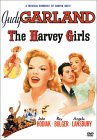
The Harvey Girls
|
||||
A perfectly acceptable but mostly by-the-numbers MGM musical, The Harvey Girls starts off with a wonderful, timeless musical number and goes steadily downhill. The color is splendid but the story is weak and the rest of the music hardly better than ordinary. The charm of Judy Garland, Virginia O'Brien, Ray Bolger and Marjorie Main still comes through, but for one of MGM's most successful tuners, this one holds up the least.
The Harvey Girls has Victory written all over it. It was made right at the close of WW2, when production was at the highest pitch in the studio's history, and nobody could predict that the industry would be in big trouble only a few seasons later. The Western ambience was possibly inspired by the stage smash Oklahoma!, but MGM aped it only in that both shows had songs about Kansas City. There's lots of square dancing but no big choreographed set pieces or equivalents to the ballet showstoppers that would soon be the studio's highlight. Instead we get some individual tapping by a just-okay Bolger, and the one bravura logistical number, "The Atchitson, Topeka and the Santa-Fe". It launches the show on a high level that the rest of the film can't maintain. Both Angela Lansbury and Cyd Charisse' singing is dubbed by others, none too convincingly, which adds to the lack of pizzazz. The script (credited to a screen-full of writers) presents a Destry-like competition between the old Saloon establishment and the Harvey Restaurant, with the idea that civilization is pushing out the whorehouse in favor of starched uniforms and genteel manners. "Don't slurp your soup! Fan it with your hat!" urges one cowpoke. This being an MGM Technicolor family film, the bargirls are resolutely asexual. Every cowboy has a color-coordinated outfit that tells us this is a fantasy West (where a truck-mounted back-projection plate through Monument Valley gives a really rough ride to the Sand Rock- bound train). The 'bargirls' are plumper and more vulgar than the Harvey ladies in their prim, high-buttoned dresses. Nobody's seen taking the customers upstairs, so we all have to take it on faith that the Alhambra dames are trash and the demure Harveys are all little saints. The idea that there are two types of women hasn't aged well, and we have good reason to sympathize with Angela Lansbury's worldly Em. Lansbury handles the role with solid authority, especially when we consider that she was just 19 at the time. Judy was 23 and Cyd Charisse 24! The film has the good sense to let Em off the hook at the end, or we'd really resent it. A barely-billed Stephen McNally is her consolation prize. Also rubbing us the wrong way is the business twist on the winning of the West. Audiences like the lawlessness of Western movies; the idea that the fun always ends as soon as decent women come to a town is what the show is really about. This makes 'sensitive' sin-master John Hodiak into a rather self-contradictory, masochistic guy. What's really happening is that a monopolistic franchise with an exclusive railroad contract (the first and the crooked-est of the American corporate swindles) is wiping out the independents. Thus, in The Harvey Girls, we're meant to celebrate a victory similar to a new Wal-Mart rolling in to doom the locals. I told you the show had the smell of Victory about it -- the new America is settling into its corporate pattern without delay. Warner/Turner's DVD of The Harvey Girls presents this enormously popular show just about as nicely as is humanly possible. The Technicolor separations fringe a bit, especially around cuts early on, but later that flaw seems to go away. There are none of the hue fluctuations that mar other Tech restorations, and the overall impression is very favorable. The extras start with two cut scenes. One that featured prominently in That's Entertainment III is a big march out to a bonfire that looks as if Judy's singing at her own lynching or is about to be burned at the stake, or something. Unlike the other gloppy song performed by Hodiak (yikes) and Garland atop the San Fernando Valley's Stony Point, the Judy Lynch Mob number (actually titled March of the Doagies) looks like something that might have been a highpoint if it had been retained. 1 "On the Atchison, Topeka and the Santa-Fe" is reprised as an extra with a stereo track reorganized out of the separate mono tracks of the original recordings. It's very interesting to hear this Oscar-winning tune by itself. Other extras include an assortment of scoring session cues called the 'Singsong Express.' It's 27 tracks long and is the equivalent of a full CD of rare material, for free. The late George Sidney provides an informative and friendly commentary track, recorded in 1995 or '96. He has an excellent memory for names and tells us a number of facts right off the top. The reason the show has so many writers is that it bounced around MGM for years before anybody thought of making it into a musical. It was originally meant to star Clark Gable, and it was one of the scripts pushed on Joan Crawford that she refused because she didn't think it right for her (and then she went to Warners and made her career-boost movie about another waitress! Sidney also tells the oft-repeated story that Judy Garland did her Atchison number in just one take each for the two shots she's in, after watching a rehearsal only once. Poor Sand Rock. Who knows why, but this town name ended up being used in a fistful of Universal '50s sci-fi films beginning with It Came from Outer Space; the Harvey organization is still going strong, but it must have been scared away by flying saucers, giant spiders, and overgrown forests of giant crystals.
On a scale of Excellent, Good, Fair, and Poor,
The Harvey Girls rates:
Footnote:
1. A few years back, Savant the editor helped Turner producer Peter Fitzgerald edit together about a dozen unused musical numbers, that existed only as soundtracks and uncut dailies. It was great fun watching Peter figure out the cutting pattern and trying to get maximum smoothness out of the cuts, while making them hit at the appropriate moments. "My Intuition" was a big problem because of the poor continuity of the shots, but I think we made most of them better than acceptable. The version on this disc may be a later re-cut, because the picture quality is much better than the material I remember working with.
Review Staff | About DVD Talk | Newsletter Subscribe | Join DVD Talk Forum |
|

| Release List | Reviews | Price Search | Shop | SUBSCRIBE | Forum | DVD Giveaways | Blu-Ray/ HD DVD | Advertise |