|
|
1941 - A Giant Comedy, Only with Guns!
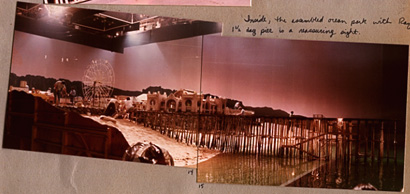
A production onceover, with more than a few new, true tales of the making of a
legendary lopsided Epic.
The making of 1941 is a huge story, very little of which was told in the Making-of Book. I've tried to include some fresh tales in this abbreviated account. Along the way I'd also like to highlight some of the wonderful men who were behind 1941's Oscar-nominated special effects.
1941 began as a very funny, very un-PC script called The Night the Japs Attacked, from the minds of young USC filmmakers Robert Zemeckis and Bob Gale. Meeting Steven Spielberg through fellow USC alumnus John Milius, the duo soon found themselves in Mobile, Alabama, working on the idea with Steven during downtime on Close Encounters of the Third Kind. Back at Douglas Trumbull's Venice 70mm effects facility, we knew 1941 was likely to happen whenSpielberg asked the saucer crew if it was possible to make a P-40 fly between the buildings down Hollywood Boulevard, as the spaceships had 'surfed' the Death Star trench in Star Wars. Miniature maker Greg Jein made Steven a gift of several highly detailed models of the P-40, Lee tank and Japanese Sub described in the script. When Spielberg called to express his excitement upon receiving them, Jein characteristically told him they wouldn't last very long if he played with them in the bathtub!
Production started off fairly simply, but grew into a massive undertaking. Greg Jein's miniature crew were engaged in the construction of miniature planes, tanks and subs, and several tremendous miniature sets, more than eight months before principal photography began. A now famous T-Shirt was at one point printed with the Spielberg quote "I will not make this movie if it costs one cent over eleven million dollars'. Hundreds of shooting days and 19 million dollars of Columbia's (and eventually Universal's) money later, a film resulted that looked every cent of the money spent.
Zemeckis and Gale's slim original script grew like Topsy. In meetings, Spielberg said he was going to cross It's a Mad, Mad, Mad, Mad, World with The Russians Are Coming, The Russians Are Coming to make the craziest comedy anyone had ever seen. Beyond the core group of teenaged protagonists, other roles were created or enlarged to accommodate big stars, especially the hot talent from Saturday Night Live, John Belushi and Dan Aykroyd. The script swelled to 170 densely typed, narrow-margined multicolored pages as business and scenes were added and padded for these and almost two dozen other name stars.
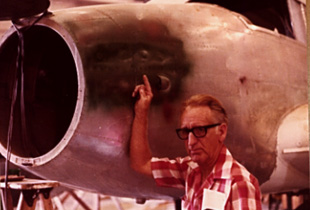
A.D. points out how putty is used to conceal squibs that will blow out pre-drilled bullet holes on the fullsized Beechcraft.
Physical effects were handled by veteran A.D. Flowers, who flew flying saucers for Forbidden Planet and blew up Hawaii in Tora Tora Tora!, and unsung effects whiz Logan Frazee, who had engineered countless brilliant gags like the trick knife used to slit Jack Nicholson's nose in Chinatown. Flowers had a steel nerve. The effects hangar was a frequent studio tour site, and A.D. became fed up with constant requests for pyrotechnic demonstrations that slowed preparations and depleted his department's supplies of miniature squibs. After days of exposion demos, flak demos, and machine gun demos, Spielberg brought George Lucas on a visit. A.D. suggested a demo of 'miniature fire'. This consisted of Flowers pouring out, then igniting, a gallon of rubber cement on the hangar floor. The fireball blazed twenty feet high, while A.D. stood by calmly. Watching A.D. for a cue, effects men slowly reached for extinguishers like cowboys inching their fingers toward their sixguns . . . Spielberg and Lucas were forced to pretend they weren't
concerned by the inferno six feet in front of them. Soon thereafter the 'effects demonstrations' stopped being an everyday occurrence.
Spielberg enlisted cartoon maestro Chuck Jones to concoct wild gags for a never-filmed runaway torpedo scene. The torpedo was constructed, however, and actually did run out of control in a test, ripping right through the hangar wall.
The job of making the centerpiece Ferris Wheel (1941's 'Mothership') fell to a younger crowd of effects wranglers headed by Matt Sweeney and Richard Stutsman. Their 'old-fashioned' way of rigging the wheel like a giant marionette was in keeping with the decision to do all the flying shots by refining 40's techniques A.D. Flowers had employed on films like 30 Seconds Over Tokyo. The most
modern gizmo was a camera-realistic radio-control M3 Lee tank model. Its full-functioning running gear was custom-cast in metal. Crack effects man Ken Swenson not only designed and built the model from scratch but operated it on its fatal trip down the crumbling Ocean Park pier. (Note: the majority of the miniatures seen in the home-movie segment of the DVD were actually the first generation built at 3/4" scale. When everyone realized Spielberg wanted total freedom to improvise with the miniatures just as he would with live-action, the decision was made to enlarge the models to 1 & 1/2" scale - Barbie-Doll size, as Greg Jein put it. The little tank, therefore, ended up being over two feet long, twice as big as the little model shown in the home movies.)
First to be filmed was the tremendous Ocean Park miniature, which completely filled one of MGM's largest sound stages. Modelmaker Milius Romyn's twenty-foot Japanese sub model cruised in the Esther Williams tank and fired cannon shells at a park consisting of fifty ornately detailed carnival buildings copied from the Santa Monica Pier and the Long Beach Pike. Explosions were done with flashbulbs and compressed air cannons, to produce blasts slow enough to be appreciated by cameras running only 48 frames per second; several structures had to be made exclusively from balsa wood so as not to produce a hail of shrapnel when ignited. Spielberg's famous order, 'Emulsify it!' became another buzzword on the miniature set. At the instigation of pal John Landis, ape effects man Rick Baker donned a gorilla suit at the end of filming and trashed some of the miniature buildings of Ocean Park as a tension-relieving gag. A still of this can be seen in the DVD supplement titled 'Comedy Relief'.
Meanwhile, back in the full-size world vehicle expert Pat Carman found a self-propelled gun with the same basic chassis as the extinct M3 Lee, being used for gunnery practice on an Air Force target range. Its purchase was completed but the time factor for delivery had some red tape snafus, so together with Ken Swenson and some cooperative servicemen, Carman 'legally' smuggled the tank from its desert base in an operation worthy of the Impossible Mission Forces. Within weeks Pat had a new diesel engine in the beast, and with a plywood face lift it became the fullsized 'Lulubelle' tank named after Humphrey Bogart's honey in Sahara. Later, it was Pat himself who manned the tank with pinpoint accuracy when it crushed cars and drove into the midst of hundreds of rioting extras. Weirdly, in an unreported late-night incident, someone used the tank to crush a number of vehicles parked on the TBS lot in Burbank!
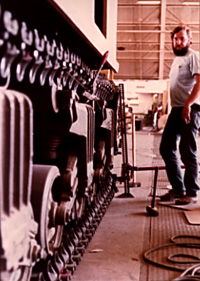 Pat Carman installs 'brand new' treads on his refurbished Lulubelle.
A collector's real P40 Tomahawk pursuit fighter taxied through the 'Barstow' munitions base at Indian Dunes and in the film's most breathtaking shots flew over the Grand Canyon. Except for this and another scene made on an Oregon beach, all of 1941 was filmed in and around Los Angeles. John Belushi stayed mostly in his trailer but put his all into his brief, physical role; for a while he and Aykroyd flew from New York twice a week trying to reconcile conflicting schedules with Saturday Night Live. Note: when Belushi's foot slips from the wing of the P40 and he falls on his head, it's no stunt. He was knocked stone cold. For a few minutes the company feared he'd broken his neck. (DVD: chapter 35, 1:25:45)
The newly imported video-assisted Louma camera crane hired for the miniatures ended up being used for everything, to the frustration of 1941's camera operator. The irreplaceable technician found his finely-honed skills being immediately second-guessed by a host of gawkers watching the video monitor. Cameraman William Fraker had used smoke and
filters to give the miniatures a hazy perspective, a technique that was carried over to much of the live action filming, lending 1941 a very non-1940's ambiance.
The parade of famous supporting actors was a constant thrill. Dub Taylor, Slim Pickens, Warren Oates - it was an
autograph hunter's dream. Belushi and Aykroyd signed copies of their new Blues Brothers album. Lionel Stander, one of the few actors to make just the right comic impression in the film ("Close, Ward, close") told stories about filmmakers from William Wellman to Sergio Leone. Comic Eddie Deezen was too much for many of the crew, who couldn't believe he really talked and acted the way he did. (He sure does.) John Candy had people constantly in stitches while being genuinely friendly (he was an extremely likeable man). And Savant once listened to just-starting Mickey Rourke complain that he wanted out of his nothing role on 1941 to go to Montana to film Michael Cimino's Heaven's Gate. Ditto diva Patti LuPone, whose clever A.W.O.L sneakaway to a New York audition landed her the title role in Broadway's Evita. Star visitors were 'enlisted' more than once: James Caan dropped by for just an hour and ended up in a cameo bit as a sailor who helps start the riot on Hollywood Boulevard. Just as the riot begins, he's one of two sailors that pitch fake Marine Dennis (Perry Lang) off the dance floor. (DVD ch 30: 1 14 15)
Spielberg's search for visual perfection was hard on crew and actors alike. The exhausting seven-minute
Swing dance number went through take after take with little recovery time until the dancers were literally
collapsing in pain. When the Hollywood Boulevard crash of the P40 didn't go perfectly the first time, the
gag was completely re-rigged and expensively re-filmed. What seemed unnecessary to some was a remarkable success; on its second trip the P40 glided in perfectly and struck the traffic signal, whose semaphore sign clanged 'Stop' just perfectly. Steven wanted to refilm the falling of the U.S.O. Marquee because an extra kicked over a prop fire hydrant revealing it to be a fiberglass fake. (DVD ch 42: 1 41 17) The event is hard to see in a film frame with more action than the average 'Where's Waldo' picture. Producer Buzz Feitshans won this round; the shot was not redone. It was the only time Savant did not see Spielberg get his way in a creative dispute.
Stunt people were constantly injured in on-the-set mayhem that looked truly murderous. When two trucks full of rioting Zoot-suiters collide, one stuntman can be seen tumbling off a vehicle and fracturing his head on a concrete curbstone. Treat Williams was bashed by a falling glitterball during rehearsals on the nightclub set. A luckless extra got a broken collarbone when hit by the swinging ladder of a fire truck. An associate producer broke her shoulder when a stuntman fell on her during a take at the beach house. And when actress Nancy Allen fled a fire in the gimbals-mounted Beechcraft airplane, she tumbled blindly from a hatch fifteen feet above the concrete floor. Effects man Steve Lombardi somehow leapt from the wing and grabbed her by the arm, quite possibly saving her life. Luckily, the film's least repeatable gag, the falling of an entire house off a Malibu cliff, was so well rigged by A.D. Flowers and company that it didn't have to be repeated.
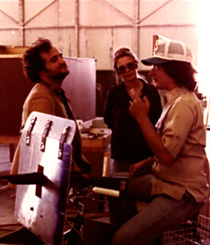 John Belushi with casting director Sally Dennison and a helmeted
director - 'boys with toys.'
John Belushi with casting director Sally Dennison and a helmeted
director - 'boys with toys.'
1941 completed shooting in August of 1979. The finished film was by no means a financial failure but quickly got the reputation of being a Bomb. It just proves how delicate a critter comedy is. Spielberg has claimed he does not consider himself a comedy director, which certainly isn't true when you think of the very funny moments in Jaws
and the sustained level of fun in the Indiana Jones movies.
Perhaps if 1941 had stayed reasonably small-scale and focused on the core group of teen characters from Zemeckis and Gale's original script it could have maintained the balance it lost when it became a 'comedy spectacular'. Their I Want to Hold Your Hand is still an hilarious tall tale woven around true historical events, and 1941 began as a similar farce. But even if it now carries the rap of being unfunny (not true, there are countless funny bits in the film), 1941 still rates as a jaw-dropping spectacular on an awesome scale, with an all-star onslaught of movie stars unheard of today, twenty years later. And remember folks, it contains not one digital effect . . .
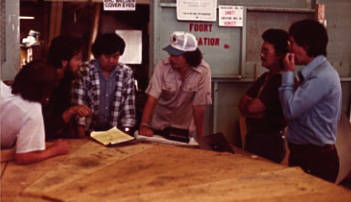 From left to right: Richard Stutsman, Matt Sweeney, Greg Jein,
Steven Spielberg, Ken Swenson, & producer Buzz Feitshans.
From left to right: Richard Stutsman, Matt Sweeney, Greg Jein,
Steven Spielberg, Ken Swenson, & producer Buzz Feitshans.
1. Don't miss Savant's 2015 article 1941 - Reunion at the American Cinematheque.
|