| Release List | Reviews | Price Search | Shop | Newsletter | Forum | DVD Giveaways | Blu-Ray/ HD DVD | Advertise |

| Reviews & Columns |
|
Reviews DVD TV on DVD Blu-ray International DVDs Theatrical Reviews by Studio Video Games Features Collector Series DVDs Easter Egg Database Interviews DVD Talk TV DVD Talk Radio Feature Articles Columns Anime Talk DVD Savant HD Talk Horror DVDs Silent DVD
|
 DVD Talk Forum |
|
|
| Resources |
|
DVD Price Search Customer Service #'s RCE Info Links |
|
Columns

  

|
 |
Les Dames du |
|
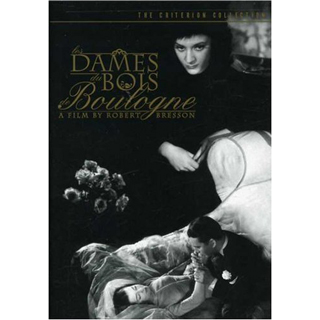
Les Dames du Bois de Boulogne Criterion 183 1945 / B&W / 1:37 / 90 min. / Street Date March 11, 2003 / $29.95 Starring María Casarès, Paul Bernard, Elina Labourdette, Blanchette Brunoy Cinematography Philippe Agostini, Maurice Pecqueux, Marcel Weiss Production Designer Robert Lavallée Art Direction Robert Clavel, Max Douy Film Editor Jean Feyte Original Music Jean-Jacques Grünenwald Written by Robert Bresson & Jean Cocteau from the novel Jacques le Fataliste et Son Maitre by Denis Diderot Produced by Raoul Ploquin Directed by Robert Bresson |
A difficult and intimidating picture by modern standards, Les Dames du Bois de Boulogne isn't going to attract the audience for The Core. It may also confound casual viewers not fluent in French film history. It's an early film by Robert Bresson, a stylist who eventually created ascetic films where spiritual quests meet resistance from grimy reality. Diary of a Country Priest is about a rural cleric who seeks to emulate Christ; au hasard Balthazar is a strange story of a burro used to traffic contraband, who pays the penalty for his owners' crimes.
The loftier critics find favor with this earlier, accomplished story of vengeful romantic plots and obsessive love, and see evidence of Bresson's later themes in its finer details. Some dismiss Bresson and assign patrimony to Jean Cocteau, who wrote the poetic, sometimes-cryptic dialogue script. At times rather rough going, the film's real appeal is that of a poisonous melodrama. A powerful woman decides she has been wronged, and others suffer for it ... but do they eventually prevail?
Wealthy Parisian Hélène (María Casarès) dates the stuffy Jacques while moping about her love for Jean (Paul Bernard). But when she trifles with a 'dear John' speech to elicit more attention from Jean, he seizes upon the opportunity to agree with her, urging them both to break up and remain friends. Paul doesn't realize how furious Hélène is behind her smiles; she makes plans to destroy her former lover by involving him in a disastrous romance. This she accomplishes by taking a destitute mother and daughter under her financial wing. The daughter is the beautiful Agnès (Elina Labourdette), a cabaret singer who has fallen to the status of prostitute. With Hélène maneuvering behind the scenes, Jean falls hopelessly in love with the now-socially ruined Agnès, and the trap is set for Hélène's cruel revenge.
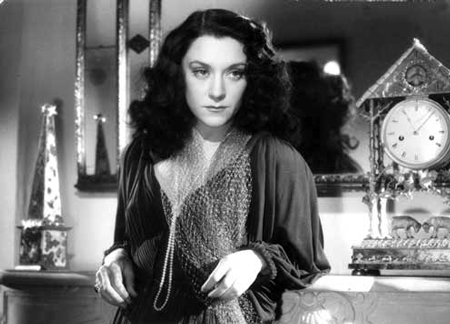
Savant knows European film fans that can spot every minor actor in obscure art pictures, and spaghetti westerns as well. I watched Les Dames du Bois de Boulogne for an hour before finally giving up to search out where I'd seen the creepy, intense María Casarès: as it turns out, she plays the suffering wife of Jean-Louis Barrault in Children of Paradise. Here, she's the exact opposite, a cold customer whose emotions boil behind a sly smile and calm refusal to show her cards. Why the other characters don't run from this sinister personality can only be chalked up to the cultural factor - that and the fact that only the audience sees the woman's duplicity for what it is. Hélène is a crafty manipulator of affections. She toys with one man while pining for the full worship of another. When Jean has the impudence to take one of her remarks at face value and admit he's grown tired of her as well, her rage sets the drama in motion.
Luckily, Hélène's intentions are clearly spelled out, as some of us might not understand the trap she sets. The two 'women of The Bois de Boulogne' (a neighborhood of Paris) are an old acquaintance and her daughter. Hélène arranges to 'rescue' them from a sticky situation: daughter Agnès has sunk to the level of trading sexual favors for money. Although she calls herself a whore, it isn't altogether clear to us how unacceptable is Agnès's position to the higher class inhabited by Jean and Hélène. The mother and daughter live in almost total isolation as part of Hélène's supposed plan to rescue their reputation over time. The center of the story walks a neat balance between Jean's painful attempts to contact Agnès, and the women's awkward obligations to their benefactress. It's not until Agnès attempts to take a job in a shop that her reputation follows her and we realize what 'cabaret dancer' really means. It is apparently assumed that all of those entertainers are prostitutes.
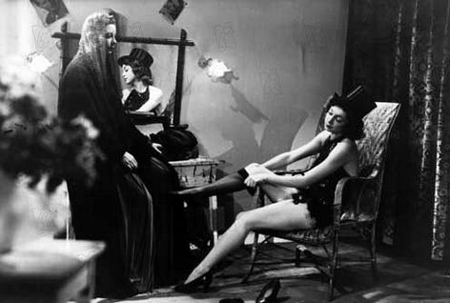
Ms. Casarès is something of a marvel as a black widow capable of great harm, willing to lay curses on others but too proud to simply tell her beloved Jean how she feels. Young Elina Labourdette is affecting and fresh as the tortured Agnès. The tough role of her mother, a woman who has allowed her daughter to fall and even waits on her as she's visited by men, is handled very well by Lucienne Bogaert. Frankly, the situations are so out of Savant's sphere of experience, that I don't mind admitting that I just accepted them at face value.
There are plenty of odd moments to keep us on our toes. In a key scene the mother first refuses to receive Jean at her doorstep, but then suddenly admits him and gives him a full tour of the apartment, including Agnès's room and its private possessions. Agnès is the victim of betrayals large and small - she's fully aware of Hélène's trap and seemingly contemptuous of Jean's overbearing attentions, yet she eventually falls for him. That part of the film is neatly ellipsed, with Jean and mother's wedding plans dissolving directly to Agnès looking mysteriously radiant in her bridal gown. According to the review by David Thompson that accompanies the disc, in the original book, Agnès and her mother are plotting social-climbers as well. Sounds pretty cynical ... or just honest.
Bresson shows some startling directorial moves. In one scene, Jean tries to escape from a parking lot, and the camera watches cooly from the passenger seat as he repeatedly lurches his car forward, then backward, getting nowhere. Every time he goes forward, Hélène's face reappears in the window, proudly proclaiming herself the inescapable victor. For a director who later decided to make films with almost no camera movement at all, the moment has an electricity worthy of Joseph H. Lewis in Gun Crazy.
Francois Truffaut's review on the insert pamphlet says that French audiences in 1945 rejected the film (it may have not been shown here until the 70s). Even in subtitles, the language of Cocteau's dialogue is stylized and pointedly poetic, and may have seemed ridiculous to French moviegoers just free of the war. I must admit that I found the film absorbing, and the details that weren't spelled out, puzzles to ponder. The people are sympathetic and the romantic entanglement compelling. But this bizarre film is a good reminder that having seen a lot of movies doesn't substitute for a cultural education.

Many reviews compare the story to Les Liaisons Dangereuses, the oft-filmed tale of aristocratic lovers who use cruel deception and plots to make conquests and corrupt the innocent. Sometimes as dark and mysterious as a film noir, Les Dames du Bois de Boulogne works best as a more exotic version of a Hollywood melodrama. The surprising conclusion is much like the end of a glitzy tragic romance from MGM, except with a completely different kind of depth and impact.
Criterion's DVD of Les Dames du Bois de Boulogne is a classy rendition of a film that's considered fairly obscure (to the extent I can determine such things). A careful transfer and Criterion's expected digital cleanup have done wonders with an original element that resists a high polish. It's a dupe negative with built-in limitations of contrast, and subtle but stubborn flaws, like a pulsing of contrast in some scenes. With its heavy duty audio cleanup, the show probably plays better overall than any surviving screening copy.
Since this is Criterion the relative thinness of extras attests to the rarity of the picture. A short selection of behind-the-scenes stills aren't particularly illuminating, but rate an A for effort. The review reprints from Truffaut and Thompson go a long way toward lessening ignorance of the film, although it's obvious some heavy reading on Bresson is in order if one wants a better understanding of this revered, 'transcendent' French filmmaker.
On a scale of Excellent, Good, Fair, and Poor,
Les Dames du Bois de Boulogne rates:
Movie: Excellent
Video: Excellent
Sound: Excellent
Supplements: Stills
Packaging: Keep case
Reviewed: March 29, 2003
Review Staff | About DVD Talk | Newsletter Subscribe | Join DVD Talk Forum
Copyright © MH Sub I, LLC dba Internet Brands. | Privacy Policy | Terms of Use
|

| Release List | Reviews | Price Search | Shop | SUBSCRIBE | Forum | DVD Giveaways | Blu-Ray/ HD DVD | Advertise |