
| Reviews & Columns |
|
Reviews DVD TV on DVD Blu-ray 4K UHD International DVDs In Theaters Reviews by Studio Video Games Features Collector Series DVDs Easter Egg Database Interviews DVD Talk Radio Feature Articles Columns Anime Talk DVD Savant Horror DVDs The M.O.D. Squad Art House HD Talk Silent DVD
|
 DVD Talk Forum |
|
|
| Resources |
|
DVD Price Search Customer Service #'s RCE Info Links |
|
Columns
  


 
|
|
|
Umbrellas of Cherbourg
This enormously popular movie was a hit with all but the most die-hard Musical haters. Instead of aping the MGM style Jacques Demy extended his lyrical romantic-philosophy movies (Lola, Bay of Angels into a musical realm. Michel Legrand provided a beautiful set of musical themes in a pop mode and the result is a unique film with a timeless theme. Anybody who is young or remembers the painful impossibility that usually accompanies young love will respond. The show made an instant star of Catherine Deneuve.
Jacques Demy in The Umbrellas of Cherbourg essentially reinvents the operetta format. When people aren't flat-out singing they're speaking in rhythm and melody to the music. The direction and especially the vivid color stylize the film just enough to make it all work. Even though the streets, apartments and shops are basically naturalistic, the candy color and manipulation of elements (mostly rain and snow) are all carefully orchestrated. We accept Demy's melodic world as easily as we accept ballet dancers in Manhattan in West Side Story.
The story is placed solidly in the Jacques Demy romantic universe of suffering and ecstasy: yet another generation of lovers learns the painful lessons of the heart. The experience of parents and others who have gone the same route before mean nothing. As in the masterpiece Lola, every heart has to experience love for itself and take its chances. These people are certainly pretty, but they're far from perfect. Geneviève is sweet and sincere but also susceptible to doubt and self-interest. Visually, Ms. Deneuve is such a perfect fairy tale princess that I've heard audiences gasp at the character's marriage, as if Geneviève had personally betrayed them. Geneviève's mother is a familiar type from Demy films, the attractive older woman with just enough unrealistic vanity to think that the handsome young swain wants to propose to her. She pressures her daughter but also is not a villain, having remembered her own early romances and the mistakes that can be made.
Guy initially comes off as blameless. The Algerian war is given the blame for his lack of timely communication, which is a bit of a cheat. Guys Don't Write used to be the rule, which may have changed for the better forever with the advent of the internet. Or maybe not. 1 When he returns, Guy mopes and sulks until he's helped by the interest of another woman, Madeleine (Ellen Farner), the unsung heroine of the story. She's rewarded for her quiet faith, like a Jane Austen character.
The Umbrellas of Cherbourg was an eye-opener for American teens raised on movies with puritanical morals or oversensationalized themes. Anybody trying to organize their love lives around pictures like Blue Denim or A Summer Place would be heading for disaster. Demy acknowledges the obvious truth that blue-noses deny: Young people fall in love and have sex. When they have sex, rational thought rarely guides them. Just Say No is a slogan for fundamentalists and fools. In Umbrellas we see the young lovers in crisis, slowy drifting through the streets. They're standing still but moving completely unrealistically, as if pulled by an unknown force. But we know exactly where they were heading and the movie doesn't wave any flags of cosmic disapproval. It just happens. Just because it's sad doesn't make it any less beautiful.
Later on, Guy allows himself to be picked up by a woman in a bar. He sleeps with her. They part. That's it - the skies don't open up with a curse (as they of course now can, with STDs). This just didn't happen in retribution-soaked MPAA fare. Avoiding total chaos in one's life is probably a good idea, but movies like Umbrellas acknowledge the human truth that when it comes to love, most anything seems to be possible.
Demy's romantic philosophy is universal. Young hearts will be broken; people will make mistakes. The ones left behind will find other partners, but will know forever what they've lost. The last episode of the film brilliantly expresses all the confused emotions we feel about the characters. It's sad and happy at the same time. We don't assume that Geneviève's marriage is a bad one or that Guy is unreasonably bitter. Things happen and people make choices, and that means that some separations have to be forever.
Who knows if Guy and Geneviève would have worked out? Perhaps Guy wouldn't know how to be truly faithful to his second love, without having first experienced the loss of his first.
I've not mentioned Roland Cassard, the link between this movie and Jacques Demy's wonderful movie Lola. My review of it goes into that subject in full detail. Suffice it to say that it was years after Umbrellas that I saw Lola, and the experience was a shock. Roland Cassard's musical theme is the same one used in Lola. The scene where Roland tells of his past, with its cut to the location from the older picture, just chokes me up, so I guess I'm a confirmed softie. Cassard always seemed the villain, the interloper, when he's really just another traveller looking for happiness and trying to be decent about it. Madeleine may wonder if Guy dreams of Geneviève, but Geneviève must know that Roland still pines for Lola.
Nobody sings for themself in this picture, and for the most part it's all entirely convincing. Just to be obstinate, I've listed the singing roles from the IMDB ... they're half the performances, after all:
José Bartel = Guy Foucher
Christiane Legrand = Madame Emery
Georges Blaness = Roland Cassard
Claudine Meunier = Madeleine
Claire Leclerc = Aunt Élise
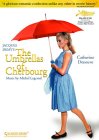
Koch Lorber's DVD of The Umbrellas of Cherbourg is good news all around. Criterion's old laserdisc and the earlier Fox-Lorber DVD were both time compressed (Pal conversion?) and slightly cropped at the sides, and this release solves those problems (I think!). 2 The enhanced picture frames compositions neatly at 1:78, and the main titles don't go off the screen any more. The picture was possibly protected for 1:66, but I don't see anthing wrongly being cut off. The fact that there's more visible above and below on old VHS tapes is irrelevant.
The enhancement also helps keep the colors from buzzing - on the earlier discs, some of those crazy wallpaper designs wanted to stand up and walk around the frame. There are a couple of weaker scenes, but most of the movie looks great for color and detail - the contrasting settings leading to Guy's apartment pop off the screen, and the concluding snowstorm no longer blurs into fuzz.
I was almost getting used to the incorrect faster speed of the earlier disc, but the music here sounds great. Whatever they've done to it, it no longer distorts in the louder passages, including the big orchestral finish with the last choral note. Legrand's score never sounded better. The synchronization appears to have improved as well.
The film print comes appended with various restoration credits that add twenty seconds to the running time. The disc's one extra is a pleasant excerpt from an Agnes Varda docu about her director husband Jacques Demy. In it we meet the producer of Umbrellas - a woman - and see Anne Vernon, Nino Castelnuovo and Mirelle Perrey at the re-premiere of the movie.
On a scale of Excellent, Good, Fair, and Poor, The Umbrellas of Cherbourg rates:
Movie: Excellent
Video: Excellent
Sound: Excellent
Supplements: episode excerpt from Agnes Varda's The World of Jacques Demy
Packaging: Keep case
Reviewed: April 3, 2004
Footnote:
1. Though it has little or no discussion of politics, The Umbrellas of Cherbourg is a great anti-war movie. It's guys like Guy who get sent away to be killed, and for many there's a lover left behind. I saw this film just as it was becoming apparent that I had to make some choices about Vietnam. Staying home with Geneviève or Madeleine or even the café pickup Ginny is the better choice, believe me.
Return
2. Frustrating as it is, I can't directly compare the DVD running times because the old Fox Lorber disc lacks the encoding that allows my player to measure it. Grr. So I'm not absolutely sure the new disc isn't time compressed also.
Return
| |
|


| Popular Reviews |
| Sponsored Links |
|
|
| Sponsored Links |
|
|
| Release List | Reviews | Shop | Newsletter | Forum | DVD Giveaways | Blu-Ray | Advertise |
|
Copyright 2024 DVDTalk.com All Rights Reserved. Legal Info, Privacy Policy, Terms of Use,
Manage Preferences,
Your Privacy Choices 
| |||||||