
| Reviews & Columns |
|
Reviews DVD TV on DVD Blu-ray 4K UHD International DVDs In Theaters Reviews by Studio Video Games Features Collector Series DVDs Easter Egg Database Interviews DVD Talk Radio Feature Articles Columns Anime Talk DVD Savant Horror DVDs The M.O.D. Squad Art House HD Talk Silent DVD
|
 DVD Talk Forum |
|
|
| Resources |
|
DVD Price Search Customer Service #'s RCE Info Links |
|
Columns


 
|
|
|
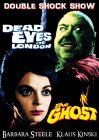
Dead Eyes of London/The Ghost
Reviewed by Glenn Erickson
Retromedia
1:66 flat letterbox
Street Date May 11, 2004
$19.95
In 1964 or 1965, a little outfit called Magna released this double bill of dubbed European horror films. As the liner notes on Retromedia's DVD points out, we had no idea that the pictures represented subgenres that wouldn't be fully defined until later: the German "krimi" and the Eurohorror thriller.
Retromedia is a label that sometimes puts out disappointing discs, but they've given some care to this double bill release. The prints used (Ghost 35mm, Dead Eyes 16mm) are not perfect, but they're basically intact and are transferred to look as good as possible. They're better than Reference Quality, good enough to give us a solid idea of what the originals might look like, and they'll do nicely until the titles are released in ideal versions with original foreign language tracks.
1 
The Ghost
Retromedia
1963 / Color / 93 min. / Lo Spettro
Starring Barbara Steele, Peter Baldwin, Elio Jotta (Leonard G. Elliott), Harriet Medin
Cinematography Raffaele Masciocchi (Donald Green)
Art Director Mario Chiari (Sammy Fields)
Editor Ornella Micheli (Donna Christie)
Original Music Roman Vlad, Francesco De Masi, Franco Mannino (Franck Wallace)
Written by Riccardo Freda and Robert Davidson
Produced by Luigi Carpentieri, Ermanno Donati (Louis Mann)
Directed by Riccardo Freda (Robert Hampton)
Eurohorror has been covered darn well by DVD in the last seven years, thanks to the great work of pioneering independent labels that produced quality genre discs coveted by the younger early adopters of the format. Almost everything by Mario Bava has been released on DVD, for instance. But the work of Antonio Margheriti is still pretty thinly represented (Castle of Blood), and for the initiator of the Eurohorror movement, Riccardo Freda, there is just one (rather good) entry, I Vampiri.
Freda's greatest horror film is The Horrible Dr. Hichcock, a wonderfully perverse and eerily atmospheric tale with a morbid delirium that overcomes its narrative inconsistencies. The Ghost is about a Doctor Hitchcock, has Barbara Steele and was made by almost the exact same crew, but it isn't a sequel. It's a straight gothic murder thriller with greed at its core.
The Ghost has plenty of Riccardo Freda's directorial problems. Once a director of top Italian popular classics, when Freda reached the horror genre he appeared to hit some level of burn-out, shooting only parts of films before jettisoning big sections of script, or leaving cameraman Mario Bava to finish up for him. His films are noted for isolated scenes of exquisite funereal creepiness surrounded by indifferent and slow-moving sections where the camera seems arbitrarily planted just to get the scene over with.
This is a fairly well-organized tale of murder with the expected hauntings that unnerve the killers and eventually lead to their undoing in as macabre a way as possible. There's a beautiful funeral scene as in the first Hichcock film, and frequent stunning closeups of Steele that one wishes one could frame. Just when things start looking sloppy, a great shot will appear to revive our interest - an extreme color design or careful composition, or an interesting idea like having the lens drip with blood as Steele lacerates her victim (us) with a straight razor.
The dubbing is better than usual and although there's no all-time great performance here like that of Robert Flemyng in the first picture, the four principal actors are good. Barbara Steele's acting is better than usual mainly because her character has a little more to convey than just looking scared or perfidiously sensual. Returnee Harriet White (Medin) contributes a less-mannered version of the same character. There's still the odd scene here and there that makes us think nobody was in charge, including one where Babs enters her bedroom and gets ready as if following step-by-step instructions from behind the camera. But her later breakdown scene is quite an achievement for her. She's more iconographically evil in Black Sunday and sexier in Castle of Blood, but this is one of her better "resumé" roles.
Phil Hardy goes over the deep end praising The Ghost's "delirious" visual qualities in his Encyclopedia of Horror movies, and gets the ending wrong too. The windup is a great combo of the end situation in Steele's Pit and the Pendulum, combined with a macabre variation on an un-filmed twist ending for Alfred Hitchcock's Suspicion, the one that actually got used for William Castle's noir When Strangers Marry. It reads better than the way Freda films it, but it's still pretty good.
Retromedia's DVD presents The Ghost on the same side of a disc with its co-feature, but the encoding is very good. There's none of the frame-blurring and blobbing in the black areas that plague some "professional" DVDs that I am beginning to think are sometimes literally homemade. The transfer is done on a good telecine, as evidenced by the slight distortion caused when splices go through the gate, as opposed to jumping in the image. There are many little bumps like that, but none that disturb the picture or interrupt the nicely cleaned-up audio track. The mix for this export English language version is crude but effective; the score appears to be a collection of borrowed tracks, as some very recognizable Roman Vlad cues from The Horrible Dr. Hitchcock are heard.
The color is not terrific but also not a washout. The contrast isn't good enough and can't be improved because the blacks are already crushed to a dark gray, with little or no detail in them. The film was originally released in Technicolor and I would guess that this is a good 16mm reduction from a 35mm Tech print, or a so-so negative made from a splicy 35mm Tech print. No, it's nothing like watching a really good color transfer, but we at least get a good idea of how beautiful the original was. It's as close as we can get for now.
As discussed recently on the web's The Mobius Forum, Retromedia has actually corrected a problem that was built into most of the 16mm-sourced versions of this movie. Astute viewers long ago noticed that the first two scenes were reversed, scrambling the sense of the titles. With a quick rearrangement, the movie now has a smooth opening instead of a "Huh?" stumble-start. In 1991 Savant tried to watch a Sinister Cinema VHS of this and gave up, it was so poor. This Retromedia copy is far better, even if it isn't going to win any awards.

Dead Eyes of London
Retromedia
1961 / B&W / 98 min. / Die Toten Augen von London
Starring Joachim Fuchsberger, Karin Baal, Dieter Borsche, Wolfgang Lukschy, Eddi Arent, Anneli Sauli, Klaus Kinski
Cinematography Karl Löb
Art Director Mathias Matthies, Ellen Schmidt
Editor Ira Oberberg
Original Music Heinz Funk
Written by Egon Eis from a novel by Edgar Wallace
Produced by Horst Wendlandt
Directed by Alfred Vohrer
The German popular thriller genre known as "krimi" hasn't been seen much in the United States. A Krimi is a medium budget program whodunnit picture that typically has a large cast of would-be killers and victims working their way through a bizarre series of crimes. Many are set in England, especially those based on books by Edgar Wallace.
This particular story was made once before in 1940 as The Dark Eyes of London aka The Human Monster, with Bela Lugosi playing two roles. Once again, a thriller is dressed up with gothic horror overtones, although there's nothing supernatural afoot this time. There's no horror star in sight (Lugosi was excellent in the Associated British original) but there is a hulking, hairy killer with a grotesque imbecilic grin to inspire nightmares.
These thrillers must have been at the heart of the postwar German film industry. Fritz Lang's swansong Die Tausend Augen des Dr. Mabuse was really a more fanciful and ambitious Krimi effort. Die Toten Augen von London employs a battery of experienced actors who repeatedly turned up in Krimis. Comic relief Eddi Arent's jokes didn't translate well into English in Circus of Fear, but he's still making Krimi-like TV movies in Germany. Handsome stars Joachim Fuchsberger and Wolfgang Lukschy were exported as the "German name" for the international productions The Face of Fu Manchu and Fistful of Dollars respectively. Karin Baal also never stopped working.
Edgar Wallace's story is elaborated into a fancy insurance scam scheme that uses hidden relationships between the characters to turn what should be obvious into a mystery thriller. No sooner does one person mention a missing orphaned child, than another character talks about being an orphan unsure of their identity. Various parties are hiding other crimes or manipulating evidence to shift suspicion, enabling a serviceable level of suspense. Edward G. Robinson in Double Indemnity would have uncovered the guilty parties right away just by following the profit chain. And that old Perry Mason rule applies here too: the most obviously malicious characters are never guilty. Slimy blackmailer Flicker-Fred pokes his spring-loaded stiletto around but is an obvious patsy. Featured player and future star Klaus Kinski is surely a villain, but is he the right villain?
The blindness gimmick is well-utilized to give the proceedings a gothic feel. 2 The murders only occur in the thick London fog, and the central location is a homeless mission for single blind men that resembles something out of Dickens, or at least Fritz Lang's "M". Gentle reverend Dearborn plays Beethoven for his boarders, sometimes to block out the sounds of skullduggery elsewhere in his Thames-side establishment. Several characters have those spooky collodion eyes with no pupils that make blindness look like an eerie curse.
Dead Eyes of London's monster is Blind Jack, a huge and gross Tor Johnson type played by Ady Berber, who was also an ex-wrestler. He had a featured role (among 250) in Ben-Hur but is best remembered as the dimwit circus strongman in the King Brothers' Carnival Story, the one who threatens to kill Anne Baxter high on a carnival ride. Here he's gross and filthy and much less pitiful; Blind Jack functions as a stooge assassin like the killer gorilla in the Florey Murders in the Rue Morgue. Heavy matted hair covers his arms and hands and his big dopey grin, egg-white eyeballs and bald head make him a particularly disturbing boogeyman. Blind Jack locates his victims by sound just like the Blind Templars in the Spanish De Ossorio movies, a stylish twist that can't be very practical. How does he get around in unfamiliar places, or know that his killings are being witnessed?
Alfred Vohrer's direction is lively and certainly gimmicky enough to keep things popping. Most scenes begin or end fixated on cogent details, and using the narrative shorthand of Fritz Lang the tight script often cuts sharply from the mention of a person or place, directly to that person or place. Few opportunities for extreme angles are passed up. A macabre murder in an elevator shaft (with a false elevator car floor made of paper, a diabolical trick) has no down-view showing the deadly fall, but another scene starts with the silly camera point of view looking at a dentist at work - from inside his patient's throat!
The story moves to an okay climax, with the very non-macho Eddi Arent pausing long enough from his fussy knitting hobby to reveal himself as a crack shot and great action man. His comedy schtick is thick but pleasant, and I imagine that the cumulative effect of the Krimis was like a continuing TV show where predictable and familiar personalities returned to make us feel more at home.
Retromedia's copy of Dead Eyes of London is a basic match for its co-feature, with an edge because when the quality drops B&W doesn't lose viewability as fast as color does. Like The Ghost, it's not enhanced but is matted to a pleasing 1:66. There are few more splices here (with noisy pops this time around) but most are in a single short section and only one non-essential dialogue line is affected. Otherwise the track is good - the dubbing is very good, actually. The mix doesn't hurt the moody music, which switches to corny organ tones whenever a killing is imminent.
Retromedia seems to be reaching for a better product here; although they haven't sprung for enhanced transfers they're trying to do the best with what they've got. This time the liner notes are accurate and serious, with Mirek Lipinski providing good information as well as a gallery of production stills from the German movie. One shot of Berber strangling Baal is followed by an amusing joke still of Baal strangling Berber! There's also an insert booklet that reproduces the German pressbook from the popular Krimi, a frill atypical of Retromedia.
Each feature is preceded by the same "now for our feature presentation" theatrical herald used by Quentin Tarantino in Kill Bill Vol. One.
On a scale of Excellent, Good, Fair, and Poor, The Dead Eyes of London rates:
Movie: Good
Video: Fair ++
Sound: Good
Supplements: Still montage
Packaging: Keep case
Reviewed: April 30, 2004
On a scale of Excellent, Good, Fair, and Poor, The Ghost rates:
Movie: Very Good
Video: Fair ++
Sound: Very Good
Supplements: none
Packaging: Keep case
Reviewed: April 30, 2004
Footnotes:
1. Reference Quality to Savant means something you watch when nothing better is available. In my case, seeing The Ghost in any form is better than not seeing it at all.
Return
2. Substitute wagons and buggies for a couple of modern trucks and automobiles, and the story might as well be happening in 1920 or 1895.
Return
| |
|



| Popular Reviews |
| Sponsored Links |
|
|
| Sponsored Links |
|
|
| Release List | Reviews | Shop | Newsletter | Forum | DVD Giveaways | Blu-Ray | Advertise |
|
Copyright 2024 DVDTalk.com All Rights Reserved. Legal Info, Privacy Policy, Terms of Use,
Manage Preferences,
Your Privacy Choices 
| |||||||