
| Reviews & Columns |
|
Reviews DVD TV on DVD Blu-ray 4K UHD International DVDs In Theaters Reviews by Studio Video Games Features Collector Series DVDs Easter Egg Database Interviews DVD Talk Radio Feature Articles Columns Anime Talk DVD Savant Horror DVDs The M.O.D. Squad Art House HD Talk Silent DVD
|
 DVD Talk Forum |
|
|
| Resources |
|
DVD Price Search Customer Service #'s RCE Info Links |
|
Columns
  



 
|
|
|
Monsieur Verdoux
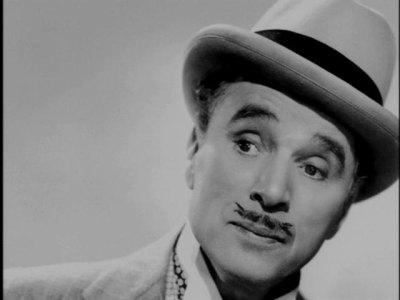 In 1941, soon after The Great Dictator was released, Orson Welles approached Charlie Chaplin about playing the lead in a movie Welles wanted to direct. The movie would be loosely bases on the life of Herni Landru, a Frenchman who had been convinced of murdering eight women. Welles had written the darkly comic part with Chaplin in mind. Chaplin was very interested, but finally declined because he did not want to have anyone else direct him. Since he couldn't see anyone else play Landru, Welles agreed to sell the concept and a rough script to Chaplin for $5,000 and a screen credit if the move was ever produced.
 Chaplin then spent some time toying with other script ideas and traveling. It wasn't until 1945 that Chaplin started working on the story that would become Monsieur Verdoux. After selecting his cast, filming began in April of 1946 and wrapped up a little less than a year later.
This was to be a totally talking film. Chaplin was trying to catch up with the times and release something more contemporary. But it really didn't work. The direction was stogy and the movie had the feel of something from the early 30's, not the late 40's.
The Movie:
 Monsieur Verdoux was a bank clerk. He worked for the same bank for a good number of years and did an acceptable job, until the depression came and he was fired. He has an invalid wife and child to support, but can't find a job, so he hits upon the scheme of marring rich women and then killing them to get their money. Things are going well until he meets a woman who isn't easy to kill.
This movie just doesn't work for me. It is as if Chaplin is no longer trying to charm the audiences with humor and gentle romance. There were elements of drama, dark humor and slapstick, but where Chaplin had been able to masterfully blend these disparate elements together in the past, he wasn't able to do so this time. The picture doesn't flow smoothly like his earlier films. It is too jarring and can't seem to make up its mind what it wants to be.
The film is slow moving too. Clocking in at two hours, the pace is very slow, and this second talkie of Chaplin's suffers from being overly verbose. Chaplin has forgotten the beautiful subtlety of his best movies. There is very little that is subtle, from the acting to the dialog, which hurts the film greatly.
The worst aspect of the film is its preachy message at the end. Here Verdoux describes his murders as just capitalism in action. His speech also implies that capitalism causes war: "It's all business, one murder makes a villain, a million a hero." It is insultingly simpleminded and very heavy handed. It was the equivalent of a giant mallet hit on the top of the audience's head, an insulting one at that.
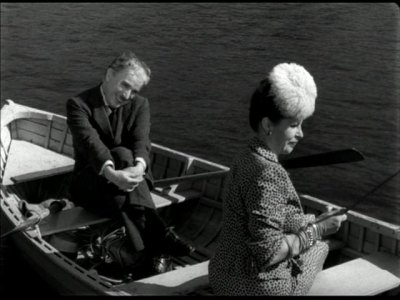
That is not to say that the movie is a total failure, there are some bright spots. Martha Raye gives a great performance as one of Verdoux's romances, and there are some very funny bits, especially the scene in the boat. But these parts are overshadowed by the film's failures.
The DVD:
This movie was mastered from a PAL video source and converted to NTSC. What does that mean? Without going into the details, it means that the film runs 4% faster than it should. The pitch seems to have been corrected on the soundtrack, but the playing times are still 4% shorter than they should be. This is very unfortunate, but not a huge deal. About the only way to notice the difference is to check the run times, the slight speed up is not noticeable to the casual viewer. Even someone familiar with the movie would be very hard pressed to see the difference, it is very slight.
This is a single DVD, unlike most of the other DVDs in this set. There are still a good amount of extras and bonus features.
Audio: This talking picture has both the original English soundtrack, and a French dub. There is the choice of the original mono audio, or a 5.1 mix. Both have been remastered. There is not a lot of difference between the mono and 5.1 tracks. The mono is a little thinner and not as full sounding, but neither track is dynamic and vibrant, due to the nature of the movie. A pleasant sounding DVD, there are no audio defects that one usually associates with a film of this age.
Video: The video on this DVD was very good. The picture has been restored from elements obtained from Chaplin's own film vault, and the picture looks as good as the day it was released. A transfer that is sure to please all fans.
Extras:
Introduction by David Robinson (5 min): The Chaplin biographer puts Monsieur Verdoux into historical perspective and gives some background to the film. He mentions Welles involvement, but doesn't believe that he wrote the script.
Chaplin Today: Monsieur Verdoux (26 minutes): Another in a series of featurettes about each of Chaplin's films. This installment includes comments by French filmmaker Claude Chabrol, and his feeling about Monsieur Verdoux. Chaplin's problems with HUAC are also mentioned.
Plan Drawings for the Set and Preparatory Sketches: Blueprints and production sketches are compared to scenes in the film.
Photo Gallery: Some production stills from the movie.
Movie Posters: A selection of movie posters advertising Monsieur Verdoux from all around the world.
Trailers (5 min): A collection of trailers from the release of Monsieur Verdoux.
Chaplin Collection (12 min): A selection of scenes from each of the movies in the Chaplin Collection.
Final Thoughts:
While not a perfect film, it is still of interest to Chaplin fans like myself. The film starts off a little slowly, but it picks up in the second half. While I found the end a little preachy and overbearing, the film shouldn't be discounted because of that. If you are a big Chaplin fan be sure to view this one, but others would be advised to rent it.