
| Reviews & Columns |
|
Reviews DVD TV on DVD Blu-ray 4K UHD International DVDs In Theaters Reviews by Studio Video Games Features Collector Series DVDs Easter Egg Database Interviews DVD Talk Radio Feature Articles Columns Anime Talk DVD Savant Horror DVDs The M.O.D. Squad Art House HD Talk Silent DVD
|
 DVD Talk Forum |
|
|
| Resources |
|
DVD Price Search Customer Service #'s RCE Info Links |
|
Columns
  


 
|
|
|
Kid (2 Disc Special Edition), The
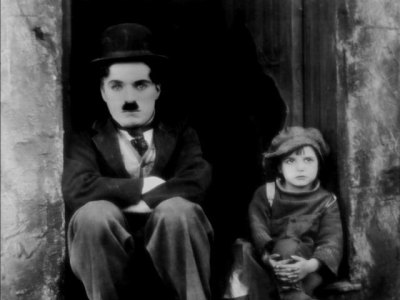
Charlie Chaplin signed on with First National in 1917 with a contract that made him a millioniare. The only problem with the contract was that Chaplin no longer wanted to make two-reelers. He was more interested in feature films. But no one, including First National and Mutual, the company he worked for previously, wanted longer comedies. Shorts were what they knew they could sell, and that's what they wanted. Syd Chaplin tried to get First National to at least consider longer films, but the best he could do was to get a token $15,000/reel bonus for any movie longer than two.
The Kid was the 6th film that Chaplin made for First National. His productions had taken longer than anyone thought they would, and The Kid was no exception. Shooting started at the end of July 1918, and didn't finish until a year later. Chaplin took his time, shooting take after take, and rewriting the story as he went. He even took out a loan for $500,000 to help cover the costs. When shooting was completed, Chaplin had almost half a million feet of film to edit.
First National was not sure that Chaplin would ever finish the movie. They, along with Chaplin's estranged wife, Mildred Harris, who was suing him for divorce, convinced a judge to song on order to seize the negatives of the film as collateral against future judgments. Tipped off of in advance of the seizure, Chaplin and three assistants hid the negatives in coffee cans as raced off to Salt Lake City where they started editing the film in a hotel room. When word leaked out as to where they were, the party headed to New Jersey and finished editing the film there.
When Chaplin showed up at First National headquarters and presented them with a six-reel movie, the executive were not happy. They had wanted a short. Contractually, they only owed him $170,000 for the film, but Chaplin had invested much more than that in the picture. After screening the film and realizing its potential, First National offered to count the movie as the equivalent of three two-reel movies. That would have netted Chaplin $400,000, still much less than the film had cost. Chaplin wanted $1.5 million and 70% of the profits after that amount had been earned back.
Faced with the options of releasing a major film and meeting Chaplin's demands or fighting him in a legal battle that could last years, First National met his price. The film was released on January 5th, 1920 to rave reviews and large crowds. It was Chaplin biggest hit to date.
The Movie:
 A woman (Edna Purviance) has a child out of wedlock. Abandoned by the father and with no mean to support the child, she places it in the back seat of a fancy car in front of a large house. Unfortunately, two toughs steal the car. When they realize there is a baby in the back, they abandon it in an alley in the seedy side of town. Along comes the Tramp, who stumbles across the infant. He picks it up, thinking it belongs to a woman passing by, but when she inform him that it's not hers, he can't seem to get rid of it. Nothing he tries works. Admitting defeat, he decides to raise the child himself.
Meanwhile, the woman has had a change of heart and goes to retrieve her son from the car, but the car, and her son, is gone.
Five years pass and the baby has grown into a little boy. The kid and the Tramp have come up with a business idea: The boy runs down the street throwing rocks and breaking windows, and the Tramp, a glazier, strolls by in time to get the business the kid has drummed up.
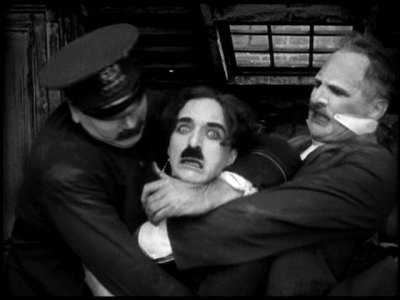
The two of them are very poor, but they are happy. But one day the kid gets sick. When the doctor comes and finds out that the Tramp is not the boy's father, he notifies the authorities. They send the police to remove the child and put him in an orphanage, by force if need be. But there is no way that the little tramp is going to let someone take his child away, even if it means fighting the law.
The Kid is an important movie. It was the film where everything came together in Chaplin's style. In this movie he was able to take a very serious situation and make it funny while still keeping the drama. He walks a fine line here, and does it well. The film never becomes irreverent; it is funny but always grounded in reality. The dramatic scenes have a lot of impact too, but they that neither overpower the film nor turn it into a melodrama.
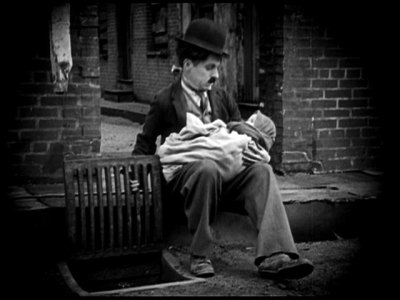 Chaplin's ability to weave between drama and comedy while keeping one foot firmly on the funny side is amazing. He establishes the Tramp as a reluctant caregiver to the child in the beginning. At first, the Tramp tries to get rid of the boy. At the end of this sequence he opens up a sewer drain and looks at the hole and the size of the baby. It's a perfect fit. Then he grimaces, shakes his head, and decides that if he can't get rid of it, he will raise it. The scene is very quick, only lasting a couple of seconds, but in this brief moment Chaplin is able to establish, with only a look, that the Tramp is not an amoral character, even if he doesn't always obey the law.
The relationship between Coogan and Chaplin is wonderfully illustrated. Chaplin uses comedy to show how close the two have become, without ever getting sentimental. When they are eating dinner, Charlie tries to teach the waif some manners. He tells him not to wipe his mouth on his shirtsleeve, and shows him how to use the tablecloth to do clean himself. Chaplin doesn't fawn over the boy, just the opposite. When the kid gets into a fight, Charlie tries to stop it only when he thinks the boy is losing. When he realizes that the small kid is trouncing a child twice his size, the Tramp encourages the fight.
These humorous scenes show the tight bond between the two without ever approaching melodrama. But when the boy is taken away to an orphanage screaming, the movie turns very serious. Coogan's crying pulls at the heartstrings and is all the more powerful because it is so unexpected. The film had been funny up to that point, and this sudden turn into drama is surprising but effective.
While watching this film be sure to look for an appearance by Jackie Coogan's father as the pickpocket in the men's shelter. Also notice the angel in the dream sequence that flirts with Charlie. The angel is twelve-year-old Lita Grey. Lita later started dating Chaplin, and married him in 1924 when it was found out she was pregnant. She was 16 at the time.
With this film, Chaplin establishes himself as an artist. His previous movies had been very creative and he had toyed with juxtaposing serious elements and comedy before, most notably in A Dog's Life, but here all the elements of tenderness and humor that he would be known for come together in a very strong film. This is a movie that is not to be missed.
The DVD:
This movie was mastered from a PAL video source and converted to NTSC. What does this mean? It means that the film runs 4% faster than it should. The pitch seems to have been corrected on the soundtrack, but the playing times are still 4% shorter than they should be. This is very unfortunate, but not a huge deal. About the only way to notice the difference is to check the run times, the slight speed up is not noticeable to the casual viewer. Even someone familiar with the movie would be very hard pressed to see the difference, it is very slight. Another reason that this in a non-issue is that silent movies did not have a standard film rate. It wasn't until sound movies arrived that projection speeds were standardized. (That's why silent movies are always measured in reels of film and not the length of time it took to show them.) Sometimes the distributor would even send notes with the films instructing the projectionist to run certain scenes faster or slower. So the fact that these are 4% faster than an arbitrary 'silent speed' should not be a large factor when deciding whether or not to purchase this set.
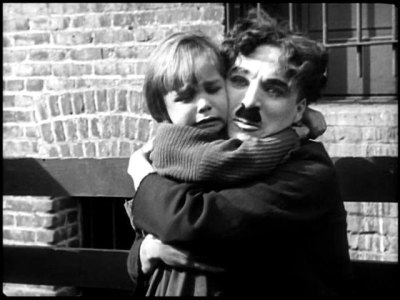 In 1971, Chaplin revisited The Kid. He wanted to re-release the film, and decided to write a score for it. While he was doing that, he decided to reedit the film. Since the original editing had been done under less than ideal circumstances, it is understandable that he might be tempted to reevaluate the job he did. It is unfortunate that he gave in to this temptation though, because he ended up cutting three entire scenes that appeared when it was originally released, and reduced the running time from 68 to 50 minutes. (Ironically, the dream sequence that most critics feel doesn't fit with the rest of the film and First National originally wanted to cut, is still present.) This later edit is the version that is presented on this DVD.
I'm not too happy about that. Rumor has it that the Chaplin estate only want his 1971 edit released, but that is not the version that won him such acclaim and rave reviews. The later edits do not necessarily make it a better film, but they do make it a different one, and most film buffs are interested in the film as it was originally shown. The deleted scenes are included as an extra, but it is not the same.
Audio: The orchestral score, written by Chaplin, is available in a stereo and 5.1 mix. The audio quality was very clear and clean with no noticeable hiss or distortion. The 5.1 mix had a fuller, more encompassing sound than the stereo track, but both were sufficient. There are subtitles in French, Spanish, Portuguese, Chinese, Thai, and Korean.
Video: The restored video for this movie was excellent. You will never see this film look any better. The image was clean with an excellent amount of detail. You can make out the creases in the note pinned on the baby's blanket, and even see the shadows they cast. There are a very few hairline scratches and a frame or two missing, but aside from those minor imperfections a stunning looking disc.
Extras:
The second DVD in this set has an enormous amount of extras!
Introduction by David Robinson (6 min): The Chaplin biographer gives a short overview of Chaplin's life at the time he made The Kid, and recaps the movie. This was not really needed. Everything that Robinson says is repeated, often in more detail, in the Chaplin Today documentary.
Chaplin Today: The Kid (26 minutes): This featurette tries to illustrate that The Kid is still an important movie today. The first half puts the movie in historical context. It talks about the situation with First National, and how he wanted to make longer films. It mentions, though in a sanitized form, the problems Chaplin was having in his personal life at the time. For the second half of the documentary, the filmmakers travel to Iran, and visit with director Abbas Kiarostami who watchs The Kid, and talks about how it is relevant to his own work. Though I have heard of Kiarostami, I have never seen one of his movies, and this later part of the show didn't really interest me. I also didn't see the need to search out someone who has built on Chaplin's work in a dramatic fashion. There isn't any serious doubt that Chaplin was a very gifted filmmaker, and comparing The Kid to an obscure (in the US at least) Iranian movie won't convince people that he was a genius. Just watching the movie will accomplish that.
Deleted Scenes (6 minutes): Here are the three scenes that Chaplin cut in 1971. I wish that they had given you the option of watching the movie with the cut scenes included, but since the score does not cover these scenes that would have been a little impractical.
I disagree with these scenes being removed. Though Edna overacts a bit in one, they flesh her character out more. I'm not sure what Chaplin had against them.
How to Make a Movie (16 minutes): (This extra also appears on the Chaplin Revue DVD.) This 1918 short is a delightful bonus! I had heard about this for years, but had never seen it. This is a short Chaplin made to show First National when he signed with them, and it was never released theatrically. A genie grants Chaplin his wish, and with time-lapse photography, his studio is magically raised. There are a lot of behind-the-scenes type shots, mostly staged, that show what it was like making movies in the late teens. There is an interesting but brief sequence where they show how movie film was developed and processed. The end has a sequence where Charlie puts on his Tramp outfit and goes to play golf. It includes some amusing gags. I'm very happy they included this historical piece on this disc.
My Boy (50 Minutes): This was the movie that Jackie Coogan made in 1921 right after the release of The Kid. This feature, also released by First National, has Jackie playing an orphan. His father died in WWI, and his mother sets off for America, but she dies on the boat over leaving Jackie all alone. After the boat docks in the US, the authorities plan to send him back to Europe. Jackie manages to slip off the ship and has to survive in New York not knowing that his rich Grandmother is looking for him.
This wasn't a great film, but it is worth watching. It's obvious that they were trying to recapture the magic of The Kid, but this didn't have Chaplin in it.
The print they obtained for this transfer has a fair amount of damage to it. There are a lot of scratches and marks, and there are some missing frames. The image is clear though not incredibly detailed. A lower quality print, but one that is watchable.
Jackie Coogan Dances (2 min): Coogan hoofs it up for visitors to the Chaplin studios.
Nice and Friendly (11 min): A short shot with Chaplin, Coogan, and Lord and Lady Mountbatten in 1922.
Charlie on the Ocean (4 minutes): Some newsreel footage of Charlie traveling back to his native England for the first time since coming to America. He made this trip in 1921, right after The Kid was released.
Jackie Coogan in Paris (2 min): Brief footage of Jackie visiting Paris.
Recording the new Score (2 min): Footage of Chaplin conducting the orchestra as they record the score he has written for The Kid in 1971.
Photo Gallery (3 min): Some production stills from the movie.
Movie Posters: A selection of movie posters advertising The Kid from all around the world. It includes original releases and re-issue posters.
Trailers (8 min): A collection of three trailers from the US and Germany promoting the re-release of The Kid. The Germany parts were not subtitled, but still an interesting thing to watch.
Chaplin Collection (12 min): A selection of scenes from each of the movies in the Chaplin Collection.
It is wonderful that these rare clips of Jackie Coogan and Charlie Chaplin were included with this movie. A great set of bonus material.
Final Thoughts:
I wish they had presented the original version, but The Kid has never looked better. The stunning transfer and the inclusion of the deleted scenes as extras makes it easier to overlook the fact that the 1971 edit is utilized. This film is an important film, and one of Chaplin's best. Highly Recommended.
|




| Popular Reviews |
| Sponsored Links |
|
|
| Sponsored Links |
|
|
| Release List | Reviews | Shop | Newsletter | Forum | DVD Giveaways | Blu-Ray | Advertise |
|
Copyright 2024 DVDTalk.com All Rights Reserved. Legal Info, Privacy Policy, Terms of Use,
Manage Preferences,
Your Privacy Choices 
| |||||||