
| Reviews & Columns |
|
Reviews DVD TV on DVD Blu-ray 4K UHD International DVDs In Theaters Reviews by Studio Video Games Features Collector Series DVDs Easter Egg Database Interviews DVD Talk Radio Feature Articles Columns Anime Talk DVD Savant Horror DVDs The M.O.D. Squad Art House HD Talk Silent DVD
|
 DVD Talk Forum |
|
|
| Resources |
|
DVD Price Search Customer Service #'s RCE Info Links |
|
Columns
  


 
|
|
|
Circus (2 Disc Special Edition), The
 After the success of The Gold Rush, the film Chaplin made after A Woman of Paris, all was right with Chaplin and his partners at United Artist. The Gold Rush did a tremendous box office, helping to fill the coffers of UA, and was hailed as a masterpiece. But how does an artist follow up what is being hailed as his greatest work?
 Chaplin decided right away that the Tramp should appear in his next film. He settled on the concept of a circus picture relatively quickly. He had been talking about playing the part of a clown in a movie for years, and now he had come up with an angle that would make the film stand out. Originally, the film was be a tragedy, with the Tramp dying in the center ring of the circus, while the audience applauds to his death throws thinking it is all part of the act.
With this ending in mind, all Chaplin had to do was come up with a beginning and middle. As he often did, he decided that he'd come up with those details in front of the camera. He ordered a circus set to be built on his studio's back lot.
Chaplin was a perfectionist. He also worked very slowly. He didn't know what was going to happen in the film, so he'd try something out, film it, and see how it felt. He would try a gag or scene out again and again, and if he didn't like the results, he'd throw it all away and start over. This is the formula that he used when making The Circus. It was a laborious process, and very expensive, but the results were usually impressive.
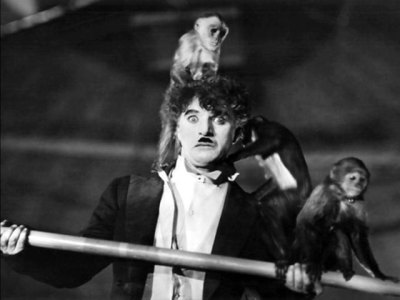
Chaplin had a few vague ideas for scenes that would appear in the movie. For example, he knew he wanted a tightrope-walking scene, and took lessons. When it came time to film the scene, Chaplin wanted realism. Instead of building the rope a few feet off the ground and creating the illusion of height with camera angles he had the rope strung 35 feet above the ground. The idea for the monkeys reportedly came to him in a dream.
While working on the film, he decided that he couldn't kill the Tramp. So not only didn't he have a beginning, he didn't have an ending either. Undeterred, Chaplin worked on. The film was in production for two years, but in the end, a very funny movie was created.
The Movie:
A poor, hungry tramp is strolling the grounds a struggling circus when a pickpocket stashes a stolen wallet in his pants to avoid being caught. Discovering the wallet, the Tramp is ecstatic with his new found wealth, until the rightful owner spies him with his property, and sets the police on him. Running from the law, the Tramp ducks into the circus and enters the main ring where he totally ruins the acts. Fortunately, the crowd thinks he's a clown, and roars with laughter.
The overbearing ringmaster, knowing a good thing when he sees it, offers the Tramp a job cleaning up. Every show the Tramp goes on and messes up to the delight of the audience. Soon the circus is doing very well, but the Tramp doesn't realize that he is responsible for their newfound success.
The ringmaster's daughter, Merna is a pretty girl who does stunts on horseback for the circus. Her father treats her very poorly, but she and Charlie become friends and the Tramp looks out for her. Soon the Tramp falls in love with Merna, but she has fallen for the new tightrope walker, Rex, an athletic and handsome man. When Charlie realizes that his affection is not returned, his heart is not in his act, and he stops being funny. As attendance starts falling off again, the ringmaster becomes more cruel to Merna and the Tramp. It's up to the little fellow to come up with a plan that will make everyone happy. Well, almost everyone.
The Circus is a very funny movie, though not Chaplin's greatest work. By the time he made this film Chaplin had mastered the art of comedic filmmaking. He knew what would make audiences laugh, and more importantly, what would make them cry. The sentimentality that he used so effectively in The Kid is present here too, though to a lesser extent. The relationship between the Tramp and Merna doesn't work as well as well as his relationships in other movies. The bond isn't as strong as in City Lights or The Kid. The movie doesn't really suffer much because of this, it's still a good film, but it doesn't have the punch that Chaplin's greatest works had.
 Like Chaplin himself must have done while wondering what made The Gold Rush so successful, this movie examines why comedy is funny. The crowd loves the Tramp when he first runs out into the ring, but when he is given an audition in front of the ringmaster the next day, he has no idea how to make people laugh as he did the night before. The clowns show him some of their tired routines, and Chaplin isn't able to follow the directions. But in doing the acts incorrectly, the Tramp makes them much funnier than they were. It is as if Chaplin was admitting that there is a mysterious aspect to humor, that can't be defined or analyzed.
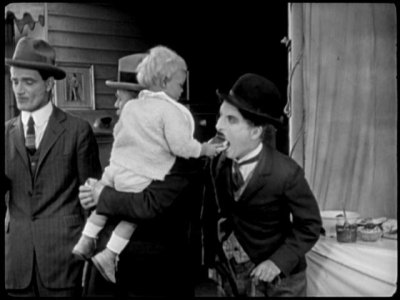
Ironically, the gags that have the biggest set ups don't work as well as the more simple jokes. The funniest part for me was when the Tramp was eating a baby's hot dog without the father, who was holding the child, knowing what was happening. Similar to the 'eating rolls' scene in A Dog's Life, Chaplin makes the gag even funnier here by literally stealing from a baby. It is a short scene, but one that is full of laughs. Another great gag, that goes by very quickly, is when the Tramp is ordered to clean up. He takes a rag and dusts off a table, a fish bowl and then reaches in and dusts off a fish. A simple joke that is more effective because you aren't expecting a gag to be inserted there.
Today, The Circus is though of as a good film, but not Chaplin's best. If just about anyone else had made a film this funny, it would be considered his or her masterpiece. But the bar is set very high for Chaplin. Don't pass this great film up just because it doesn't have the reputation that City Lights or The Gold Rush has. It is still an excellent film.
The DVD:
This movie was mastered from a PAL video source and converted to NTSC. What does this mean? It means that the film runs 4% faster than it should. The pitch seems to have been corrected on the soundtrack, but the playing times are still 4% shorter than they should be. This is very unfortunate, but not a huge deal. About the only way to notice the difference is to check the run times, the slight speed up is not noticeable to the casual viewer. Even someone familiar with the movie would be very hard pressed to see the difference, it is very slight. Another reason that this in a non-issue is that silent movies did not have a standard film rate. It wasn't until sound movies arrived that projection speeds were standardized. (That's why silent movies are always measured in reels of film and not the length of time it took to show them.) Sometimes the distributor would even send notes with the films instructing the projectionist to run certain scenes faster or slower. So the fact that these are 4% faster than an arbitrary 'silent speed' should not be a large factor when deciding whether or not to purchase this set.
Audio: There is a choice of the original mono track, or a 5.1 mix. The 5.1 mix was a little more open, but not to a huge degree. Both sounded very good. The audio is clean and bright, with no distortion or audio defects. It suits the movie perfectly.
Video: This is a great looking DVD. The full frame picture is clean and clear, with crisp lines and a good detail. There is one short section were some very light emulsion decomposition is apparent. A couple of the scenes are a little dark, most notably the night scene when Merna finds the Tramp at his camp in the forest. Some details were lost in the darkness, but it was still a scene that was easy to view. The encoding is excellent, with digital artifacts being almost nonexistent. It is had to believe that this film is over seventy years old. I doubt you will ever see this film look any better.
Extras:
Another Chaplin movie that WB has released with a great set of extras!
Introduction by David Robinson (5 min): The Chaplin biographer recaps the movie, and gives a short overview of Chaplin's life at the time he made The Circus. A nice brief overview without much depth, but what do you expect for 5 minutes?
Chaplin Today: The Circus (26 minutes): Another in a series of featurettes about each of Chaplin's films. Director Emir Kusturica talks about The Circus, and the history of the movie is examined.
Deleted Sequence (10 min): A scene that was removed from the film involving the bareback rider, the tightrope walker, and the Tramp going out to dinner.
October 7-13, 1926 (26 min): Some of the outtakes from this week's filming. Though this does go on for a while, it's interesting to see Chaplin at work and what wasn't wanted.
Mountbatten Home Movies (7 min): Three short home movies from the archives of Lord Mountbatten, which all involve Chaplin on the set or hamming it up. A fun extra.
The Hollywood Premier (6 min): Footage of the star-studded premier of The Circus in 1928.
Camera A, Camera B (1 min): Chaplin always used two cameras to shoot the action in The Circus running simultaneously. This is a comparison of the footage that was obtained from each camera.
3-D test footage (2 min): An interesting test of a 3-D image made by Chaplin's chief cameraman, Roland Totheroh.
Circus Days (12 min): Excerpts from a 1923 Jackie Coogan (The Kid) movie adapting the adventures of Toby Tyler. I was disappointed that they didn't include the entire 6-reel movie, like they did with Coogan's My Boy on The Kid DVD.
Photo Gallery: Some production stills and set designs from the movie.
Film Posters: A selection of movie posters advertising The Circus from all around the world. It includes original releases and re-issue posters.
Trailers (8 min): A collection of trailers promoting The Circus.
Chaplin Collection (12 min): A selection of scenes from each of the movies in the Chaplin Collection.
These extras are a great bonus! While it would have been nice to see the entire Toby Tyler movie, this was still a good compilation of extras. Sure to please any Chaplin fan.
Final Thoughts:
The Circus is still very funny 75 years after it was first released. The pacing and tempo are not as finely tuned as they are on Chaplin's greatest pictures; this is still a very enjoyable film. The beautiful print and copious extras make this a DVD that everyone should checkout. DVDTalk Collector's Series.
|



| Popular Reviews |
| Sponsored Links |
|
|
| Sponsored Links |
|
|
| Release List | Reviews | Shop | Newsletter | Forum | DVD Giveaways | Blu-Ray | Advertise |
|
Copyright 2024 DVDTalk.com All Rights Reserved. Legal Info, Privacy Policy, Terms of Use,
Manage Preferences,
Your Privacy Choices 
| |||||||