
| Reviews & Columns |
|
Reviews DVD TV on DVD Blu-ray 4K UHD International DVDs In Theaters Reviews by Studio Video Games Features Collector Series DVDs Easter Egg Database Interviews DVD Talk Radio Feature Articles Columns Anime Talk DVD Savant Horror DVDs The M.O.D. Squad Art House HD Talk Silent DVD
|
 DVD Talk Forum |
|
|
| Resources |
|
DVD Price Search Customer Service #'s RCE Info Links |
|
Columns
  


|
|
|
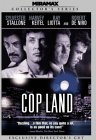
Cop Land - Director's Cut

We don't always take the most direct path to discovering a film. When Cop Land was headed to screens back in 1997 I couldn't wait until release date, thanks to my love of director James Mangold's previous film, the quietly powerful Heavy, and the unusually strong cast. Instead, I acquired a VHS tape of... dubious origins from a fine open air retailer on a street corner.
The quality was something like watching the movie at the bottom of the Mississippi River but the movie itself was a taut, uncompromising police thriller, with little in the way of unnecessary exposition and decidedly dark character portraits. Once the film did hit theaters I headed in expecting a more visually pleasant version of the engaging drama I'd already experienced. Instead, I got an overwrought, over-explained mainstream failure with a tacked-on happy ending. I was mortified. What happened? It seemed like the movie was completely different, not just in a few added scenes, but in overall structure.
It turns out the film was a victim of test screening-itis. Major changes were made after some test audience didn't like the dark, brooding original cut. Thankfully Miramax has decided to release a director's cut which, while not quite as spare as that original tape, is a major improvement over the theatrical version.
Cop Land is the story of Freddy Heflin (Sylvester Stallone), the sheriff of Garrison, New Jersey. Freddy has always dreamed of being a New York City cop, often sitting on the far side of the George Washington Bridge, watch the twinkling of the big city lights. The problem is that he lost the hearing in his right ear while performing an act of heroism, a disability that disqualifies him from his dream job. Now he's overweight, understimulated, and depressed.
It doesn't help that the town that Freddy watches over is a haven for big-city cops looking for a quiet place to raise their families (the film seems to take place during the wild early-nineties.) This tight-knit community barely needs a sheriff: With every other resident carrying a badge, a gun and a chip on his shoulder, the law pretty much preserves itself.
Trouble starts early when a young city cop nicknamed "Superboy" gets involved in a very violent "accident" on the bridge (it takes place, of course, right on the literal border between New York and New Jersey) which leads to all sorts of drama that I won't reveal here. The aftermath of all this tension is the bursting to the surface of the seamy underbelly of Garrison. Nothing, of course, is as Freddy has long assumed, and by the end of the film everything falls apart.
The first thing that hits you about Cop Land is the absurd strength of the cast. Every shot seems to reveal another famous, and famously excellent, actor. The main players include Stallone, Harvey Keitel, Robert De Niro, Ray Liotta and Robert Patrick. The cast also includes Michael Rapaport, Annabella Sciorra, John Spencer, Cathy Moriarty, Peter Berg and Janeane Garofalo. Hell, even the bit parts are filled by the likes of Edie Falco, Debbie Harry, Method Man, Frank Vincent and Malik Yoba. It's a little absurd and would have distracted from a weaker film. Here, however, everyone does some of their finest work.
Of particular note are Liotta (really perfecting the tweaked-out undercover cop-turned-addict), Patrick as the sinister human equivalent of his pitiless T2 cyborg, and De Niro, who hasn't been this understated and engulfed by an ordinary character since The King of Comedy. His every-man take on an Internal Affairs detective is totally of a time and place; He's like Rupert Pupkin's more mature older brother who has no interest in moving back into mom's basement. He's all business. A scene that he shares with Keitel in a convenience store bristles with tension; The two characters have known each other for decades but De Niro's switch over to IA has caused an irreparable rift (you sense there may be even more to it than that.) But Mangold's blocking and the performances remind of the legendary backroom conversation the two actors shared in Mean Streets and for a moment it seems like maybe Charlie and Johnny Boy, those two meatheads, grew up and grew apart. Now running into each other all these years later they can barely contain their mutual hatred while pretending to smile and catch up on old times. It's a tiny scene, but to a long-time observer of these actors and the flawed characters they've played, it's huge.
The lion's share of the work, even in this tremendous ensemble, falls on the shoulders of Sly Stallone. This film was his chance to prove himself to be a serious actor, capable of pulling off his own Raging Bull or Taxi Driver after years of soulless action flicks. The sad fact is that he totally pulled it off and then got no recognition. The Stallone of the Rambo and Rocky sequels is completely invisible inside the sad, lumpy sheriff. It's not just that Stallone transformed his obscenely fit body into a formless blob for the film (which is what got all the press at the time) but he creates this character from the inside. The slouch, the shuffle, the droopy eyes. At one point Liotta helps a drunk Stallone to his car and the man looks shockingly tiny next to his co-star, like a shrunken, broken version of a hero. It's subtle work except that it's every little detail about the way he is. The tiny little smile his mouth forms when another character condescends to him. The way he spaces out in his cop car, gazing at what might have been. As he says at one point, he only did one worthwhile thing in his life and that's the thing that ruined him. It's a tough character and Stallone nails it.
The film itself is a throwback to the kinds of gritty cop dramas made in the 70's. The characters are dark and often display their own code of what's right and wrong. The entire film is infected with an uneasy sense that there are no true good guys. It's up to Freddy to try to untangle what's going on, which isn't easy because the film leaves a lot of backstory murky, which is great since that's how it would be. These characters have had many years to develop their own interpersonal relationships and no outsider would be able to understand it all at once.
Of course, Mangold was punished for his audacity in not handing everything to the audience on a platter with huge changes to the film. I'm happy to report that much of the ridiculous tacked on ending from the theatrical version is gone. Added back in are many smaller moments that help flesh out the characters. One segment that bugged me in the studio edit is annoyingly still present (it's something that spells out a lot of what's going on rather than leaving it murky) but overall this edit is a vast improvement. Mangold unfortunately ended up making a few less interesting films after Cop Land (Kate & Leopold, Girl, Interrupted) but after the thriller Identity he seems to be trying to get back to darker subject matter. His next film, I'm happy to read, is Walk the Line, the biography of Johnny Cash. Cash, a man with as much inner turmoil as the entire cast of Cop Land, should be perfect material for Mangold, a filmmaker not afraid to peek into a troubled soul and not sell out what he finds inside.
VIDEO:
The anamorphic widescreen of Cop Land is really beautiful. I found the colors to be vibrant and the image stunningly crisp, even when the lighting was dark and the locations dingy. There is a clarity here that is terrific to see on a somewhat smaller film. Eric Edwards' cinematography makes the most of mundane and modest locations, really creating an impressive picture.
AUDIO:
The Dolby Digital 5.1 audio is pretty good, if not quite as stunning as the picture. Sometimes the location recording and the post-production dubbing are a bit too tonally different and some voices are a bit muddled compared to others. One scene appeared to have a bit of a lag in the sync between audio and picture (I thought it might have been my player, but then the next scene was fine. Weird.) Overall, however, a fine effort.
EXTRAS:
A nice selection of extras. Foremost is the commentary track from Mangold, producer Cathy Konrad, and, best of all, Sylvester Stallone and Robert Patrick. I feel like getting a star like Stallone to do commentary for a smaller, older film is a real coup. Of course, I wouldn't care if he was boring, but he comes off as a funny, intelligent actor with a lot of insightful comments. All of the participants are great here, sharing stories from the set and discussing where Cop Land fits into their careers. It's an especially useful commentary since the film was both a high-point for everyone artistically and such a disappointment commercially. Stallone clearly feels like he missed his chance to move into a completely different world of acting when this film didn't succeed at the box office. There is also a lot of talk of the changes in the edit and about the other actors. Discussing an extended argument Mangold had with Keitel and De Niro over who should enter a scene first, Stallone says something like "I left, had a facelift and came back and they were still arguing!" One of the best commentaries I've heard in a long time.
There is a 15 minute or so behind the scenes piece that consists mostly (or entirely) of footage shot at the time. Mangold discusses how his love of westerns influenced the lone-sheriff style of the film. It's a good piece.
A couple of deleted scenes with optional commentary are included. There probably could have been more in here but it's still good to have. And a storyboard-film comparison is included.
FINAL THOUGHTS:
One of the recent examples of a "lost" film that suffered at the hands of the studio, Cop Land has been given something of a new lease on life. This excellent disc rights some of the wrongs of the earlier cut and presents an interesting, thought-provoking, exciting film stocked with more great performances than most entire shelves at Blockbuster.
|



| Popular Reviews |
| Sponsored Links |
|
|
| Sponsored Links |
|
|
| Release List | Reviews | Shop | Newsletter | Forum | DVD Giveaways | Blu-Ray | Advertise |
|
Copyright 2024 DVDTalk.com All Rights Reserved. Legal Info, Privacy Policy, Terms of Use,
Manage Preferences,
Your Privacy Choices 
| |||||||