
| Reviews & Columns |
|
Reviews DVD TV on DVD Blu-ray 4K UHD International DVDs In Theaters Reviews by Studio Video Games Features Collector Series DVDs Easter Egg Database Interviews DVD Talk Radio Feature Articles Columns Anime Talk DVD Savant Horror DVDs The M.O.D. Squad Art House HD Talk Silent DVD
|
 DVD Talk Forum |
|
|
| Resources |
|
DVD Price Search Customer Service #'s RCE Info Links |
|
Columns
  


 
|
|
|
Munchhausen
Baron Karl Friedrich Hieronymous von Münchhausen was a real person, a German army captain who lived from 1720 to 1797. He would be unknown to people today except he had a knack for telling outlandish tales that he claimed to be true. The stories were written down and expanded upon, and Baron Münchhausen's Narrative of His Marvellous Travels and Campaigns in Russia became a classic work of fantasy in Europe. Eventually 'Münchhausen' came to mean the telling of an entertaining outlandish lie. There is even a malady named after the Baron, Munchausen Syndrome, a mental illness where one feigns an illness in order to undergo medical treatment. But I digress...
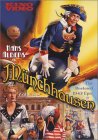
The fantastic and colorful stories contained in Münchhausen's book (though it wasn't penned by the Baron) were ripe for putting onto film, and Terry Gilliam did just that in 1988 with The Adventures of Baron Munchausen, but he wasn't the first. In 1943 at the height of the Second World War, Ufa, the official German movie studio, filmed a movie based on the 18th century tales simply entitled Münchhausen.
This film was ordered to be made by Josef Goebbels, the Reichsminister of propaganda, ostensively to celebrate Ufa's 25th anniversary, but more importantly to raise German moral and to show the rest of the world what Ufa could do. Goebbels wanted Ufa to compete with Hollywood and was sure that they would be the preeminent studio in the world after the war. No expense was spared on this production. They used a new color process, Agfacolor, (this was the third or fourth (depending on who you believe) color film to be made in Germany) and had cast populated with most of hte popular German actors at the time. It was Nazi Germany's attempt at an epic film. And for the most part it succeeded. The F. W. Murnau Foundation has just finished restoring this movie, which Kino has released on DVD. This is the first time that Münchhausen has been commercially available in the United States.
At a ball one night, a young man tells the current Baron Münchhausen that he is very interested in his famous ancestor. The Baron sits down with the young man, and his fiancé, and narrates the story of Baron Hieronymous Münchhausen, an adventurer, a womanizer and a solider. He tells of the Barons conquest of many beautiful women including Catherine the Great of Russia. He relates the Baron's travels from Germany to Russia to Turkey, Italy and even the moon. Münchhausen's many fantastic feats are related, saving beautiful women, dueling in the dark, and flying into an enemy stronghold on a cannonball. All of the most famous Münchhausen tales are brought to life.
This was a fun movie filled with outrageous stories. It seemed like something out of the Arabian Nights, with clothes that contracted rabies and attacked their owner, an incredibly fast runner, and a gun that can hit a target 100 miles off. There isn't a lot of deep meaning in the film (as a mater of fact the Nazi censors deemed the film to have no political value,) but it is still very enjoyable to watch. It reminds me of Around the World in Eighty Days somewhat. Like the big budget Verne adaptation, this movie has a lot of interesting things to look at, and there is no real link between the exciting adventures. They just occur one after another.
The special effects were very good, especially for the time. Ernst Kunstmann who created the special effects for Fritz Lang's Metropolis did the same for this movie. He included animation on top of live action shots, and some inovative creations, such as the view of the ground while the Baron is flying on the cannon ball. Though you can see where the strings are in some scenes, they went to a lot of trouble to make the effects look natural and real, and did a great job for the most part.
The musical score for this film was very good too. Georg Haentzschel wrote the score and did a fantastic job. There is a lot of music in this film, and each piece seems to go with the setting Münchhausen finds himself in, whether it is the imperial court in Russia or a Turkish harem. The music adds a lot to this film.
The DVD:
A word about the print used: This film originally ran for 134 minutes, but was cut to just under 2 hours (118 minutes) soon after. This restored version clocks in at just 111 minutes. The F. W. Murnau Foundation did look at many prints and negatives while restoring and reconstructing this film, and I assume the missing scenes are no longer in existence.
Audio:
The two-channel mono German soundtrack was good. A hiss was only evident if you really raised the volume in the quiet scenes, for all practical purposes it was nonexistent. The dialog was easy to hear and the music was clean but neither were forceful or dynamic. With a sound track this old, you really can't expect high fidelity sound, even with restoration. The best you can hope for is a clean soundtrack with a lack of defects and that is what this DVD offers. There were optional English subtitles.
Video:
The full frame image looked very good. The Foundation did an excellent job restoring this picture. This movie was filmed in Agfacolor, which projects a more pastel-like color than Technicolor. The colors were slightly muted when compared with the other Agfacolor examples on the disc (see the extras section) but only slightly. I think this is due to the restoration process and evening the colors out more than age, but I could be wrong. In any case, this was a minor defect and the colors were still clear and fairly vivid. The image had excellent definition and detail for most of the film (there was a softer print used in a couple of scenes,) and the contrast was also very good. This film looked absolutely beautiful, with a full array of colors used in the various scenes. The blacks were solid throughout. You won't find many 60-year-old films looking this good.
The Extras:
In addition to the film this disc has some great extras:
Introduction by Friedemann Beyer, head of the F. W. Murnau Foundation: This 17-minute interview has Mr. Beyer talking about the foundation, its mission, and what they have done in the past. He also talks about the restoration process for this film, and some of the various materials that they found while searching film archives. He talks about the Agfacolor process and the political climate when the film was made. This is a very interesting and informative piece, and a welcome addition to the DVD.
Original Theatrical Trailer: An unrestored trailer for the movie.
Die Abenteuer des Baron Münchhausen - eine Winterreise: an animated short from 1944 telling another Münchhausen story that wasn't related in the movie. This color cartoon has no dialog, just music. The Baron goes out for a ride on his horse and has some interesting adventures. While this short is not as entertaining as the movie, a nice extra to include.
Photo gallery: A collection of production and behind the scenes stills.
Examples of Agfacolor restoration: Frauen sind doch bessere Diplomaten (1941): Before and after clips of restoring this early Agfacolor film. I'm not sure why they didn't include examples from Münchhausen, but this is an interesting demonstration anyway.
Excerpt from the Agfacolor film Die Fledermaus (1944): A five-minute except from this musical. This shows off how well Agfacolor reproduced various shades of green because the background is full of that color.
Pop-culture gallery of Münchhausen images: various book covers and other drawings of Baron Münchhausen.
Gustave Dore Illustrations: Some wonderful pictures of Münchhausen and his adventures by the famous artits. I really enjoyed these.
Final Thoughts:
Kino is starting to become a force to be reckoned with in the DVD market. They put out an absolutely top-notch product. Their Buster Keaton set, the Douglas Fairbanks boxed set, and the F.W. Murnau films they've released all hold places of honor in my DVD collection. This is another stellar disc. The movie is very good, and the restoration is amazing. Kino has included some wonderful extras to make this a great all around package. This disc gives Criterion a run for its money. Highly Recommended.
|



| Popular Reviews |
| Sponsored Links |
|
|
| Sponsored Links |
|
|
| Release List | Reviews | Shop | Newsletter | Forum | DVD Giveaways | Blu-Ray | Advertise |
|
Copyright 2024 DVDTalk.com All Rights Reserved. Legal Info, Privacy Policy, Terms of Use,
Manage Preferences,
Your Privacy Choices 
| |||||||