
| Reviews & Columns |
|
Reviews DVD TV on DVD Blu-ray 4K UHD International DVDs In Theaters Reviews by Studio Video Games Features Collector Series DVDs Easter Egg Database Interviews DVD Talk Radio Feature Articles Columns Anime Talk DVD Savant Horror DVDs The M.O.D. Squad Art House HD Talk Silent DVD
|
 DVD Talk Forum |
|
|
| Resources |
|
DVD Price Search Customer Service #'s RCE Info Links |
|
Columns


 
|
|
|
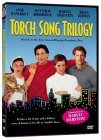
Torch Song Trilogy
Harvey Fierstein maybe be known today for cute turns in campy Hollywood films like Independence Day and Mrs. Doubtfire, but his recent turn on Broadway in Hairspray should make viewers curious to check out his seminal work, the 1988 film Torch Song Trilogy, which was based on his hugely successful play of the same name.
In some ways Torch Song Trilogy is the definitive film on being a gay man during the generation that immediately preceded AIDS. Fierstein's writing and acting are fearless in attacking every emotion his character experiences. Fierstein plays Arnold Beckoff, a sensitive and shy gay man living in Brooklyn who leads something of a double life: While he may appear meek during the day, at night he performs as Virginia Ham, a fierce torch song drag queen in a tiny club. This nightclub act, which also includes legendary female impersonator Charles Pierce as the amazingly named Bertha Venation, is raucous, rowdy and rude while also feeling personal and comfortable. There are obviously regulars at the club, some not what you'd expect to meet at a drag show.
Arnold introduces the different sides of his complex personality during an early monolog that Fierstein delivers directly to the camera while applying his stage costume. This is a tough and honest scene that lays the actor and character out bare - both thanks to the raw emotion on display and the unflattering lighting and in-progress make-up. It's funny and sad at the same time, which is an excellent way to introduce Arnold and the movie. As Arnold says, "I think my biggest problem is being young and beautiful. It's my biggest problem because I've never been young and beautiful. Oh, I've been beautiful, and God knows I've been young, but never the twain have met."
Arnold's hesitant character comes out again when a friend convinces him to hit the after-hours clubs, to cruise and be cruised. Arnold sits quietly nursing a drink while his friend hits the sleazy back room. Still, Arnold meets a handsome guy named Ed (Brian Kerwin), who first spots the demure Arnold while slowly circling a pool table. This kicks off the first part of this somewhat episodic trilogy. While the film isn't broken into the strict segments that its title suggests, there are three main segments: The first finds Arnold dealing with the drama of his life with Ed, who can't really commit to being gay. The second introduces Arnold to Alan, played excellently by Mathew Broderick, and the third reintroduces Arnold's mother (Anne Bancroft) into his life. While the three stories blend into each other in profound ways (and I don't want to give too many more details here) there is a definite sense that Arnold develops as a person from beginning to end. Looking back at his bitter soliloquy with the knowledge of what he goes through later shows the depth of feeling that Fierstein brought to his writing.
There are many interesting and surprising character angles. Arnold's parents (Bancroft and Edgar Small) don't fully accept him but they don't reject him in some stereotypical way either: It's almost like they're more upset about his lack of ambition or, later, that his boyfriend isn't Jewish. Bancroft plays the mother in broad strokes that can be off-putting at first (a little to much Neil Simon) but she finds a rich, contradictory woman when she reappears later. There is a stirring sequence over Arnold's father's grave where some very complex emotions are laid out. The viewer wants to side entirely with Arnold in this particular conflict but it's hard to not feel sympathy with Bancroft's wounded character as well.
Also of note is Broderick's tender, soulful performance. His character suspiciously starts off as a friend of a particularly nasty heckler in Arnold's club but the young actor and the script take him in numerous surprising directions. One of the unexpected pleasures of the film is discovering Broderick's marvelous performance.
Fierstein, however, dominates the production, appearing in nearly every scene, and carrying the bulk of the emotional burden. He makes the transition from stage to screen very well while still maintaining the winking slyness that makes him such a unique performer. As I said, the film is set entirely pre-AIDS, and in fact the ending arrives practically the moment before the AIDS crisis began. It does add a possibly sad overtone to the film, which is that no matter how emotionally content the characters are at the last fade-out, much of the real misery still lies ahead. It's a mark of Fierstein's excellent writing, however, that you care enough about his fictional characters to worry about their lives beyond the film.
VIDEO:
The anamorphic widescreen video is surprisingly strong. Good, sharp images, nice subtle but rich colors, deep contrast. Darker sequences sometimes display some compression artifacts but overall it's a very pleasant picture for a fairly low-budget film and a very inexpensive disc.
AUDIO:
There are both Dolby Digital 5.1 and DTS soundtracks, as well as a Dolby Digital stereo track. This is a pretty nice selection and all the options are solid. The DTS is a bit louder but both 5.1 soundtracks sound really excellent. The music in the drag show sounds very dynamic and dialog sounds perfectly clear. The stereo soundtrack even sounds acceptable. There's something for everyone here. There are also English and Spanish subtitles.
EXTRAS:
The only significant extra is a commentary track from Fierstein, which is obviously excellent. His raspy voice and deft observations really add to the disc. He discusses everything that went into writing the play and adapting it to the screen, as well as his decades of experience in entertainment. He's also extremely funny, talking smack and telling tales. He really gives an entertaining performance on one of the most memorable commentary tracks I've heard in a while. There's also a theatrical trailer for Torch Song Trilogy as well as for other New Line releases.
FINAL THOUGHTS:
Torch Song Trilogy is a fondly remembered classic from queer cinema and it should have strong enough characters to break out into mainstream viewing as well. However, one of the beautiful things about it is that it isn't one of those films that makes the well-intentioned case that "deep down inside we're all the same." It tells a distinctly gay story about characters with distinctly gay issues and does it with pride and class. Fierstein takes on several hats here and delivers a moving, powerful film that's full of wit and life.
|



| Popular Reviews |
| Sponsored Links |
|
|
| Sponsored Links |
|
|
| Release List | Reviews | Shop | Newsletter | Forum | DVD Giveaways | Blu-Ray | Advertise |
|
Copyright 2024 DVDTalk.com All Rights Reserved. Legal Info, Privacy Policy, Terms of Use,
Manage Preferences,
Your Privacy Choices 
| |||||||