
| Reviews & Columns |
|
Reviews DVD TV on DVD Blu-ray 4K UHD International DVDs In Theaters Reviews by Studio Video Games Features Collector Series DVDs Easter Egg Database Interviews DVD Talk Radio Feature Articles Columns Anime Talk DVD Savant Horror DVDs The M.O.D. Squad Art House HD Talk Silent DVD
|
 DVD Talk Forum |
|
|
| Resources |
|
DVD Price Search Customer Service #'s RCE Info Links |
|
Columns
  


 
|
|
|
Foyle's War - Set 2
If you had the pleasure of watching Foyle's War: Set 1, you'll know that Foyle's War isn't your typical mystery series, which perhaps leads it to confound expectations at first. It's that originality that gives the series its strength; in its thoughtful and complex stories, Foyle's War is equally outstanding whether considered as a serious period drama or as a mystery series. Michael Kitchen stars as Detective Chief Superintendent Foyle, a quiet and dedicated man who is trying to maintain order in his corner of England while all around him, World War II turns life upside down. Set 1 established a high bar of quality for the series, and Set 2 follows through with another four episodes that are as good, or even better, than those in the first set.
The hallmark of Foyle's War is its consistently thoughtful and complex treatment of the ethical issues of the war, and its realistic portrayal of the daily life of the British under the constant threat of a German invasion. It's a worthwhile experience especially for viewers in the United States, a country that has been embroiled in many wars but yet not had a realistic threat of conflict on its own soil since the Civil War. And of course, as with the excellent Set 1, the stories are marvelous: they're engaging, well-crafted, and intelligent mysteries that capture viewers' interest early and don't let go.
Set 2 opens with the complex "Fifty Ships," in which Foyle's concern with a series of lootings from bombed houses turns into a murder investigation. When the trail of evidence suggests a connection to a prominent businessman involved with the start of the Lend-Lease program, Foyle is faced with the question of whether the ends can justify the means. The situation is ethically complex, and there are no easy answers presented, either for Foyle or for the viewer.
Next comes the equally well done "Among the Few." Honeysuckle Weeks gets a chance to shine in this episode, as her character Sam goes undercover to find out what's going on at a fuel depot that features some suspicious activity. Foyle's son Andrew, who was introduced in the first set, comes more into the picture here as well, when Foyle discovers connections between the fuel depot and several of Andrew's friends.
"War Games" puts Foyle and his assistant, Milner, up against big money, as they suspect that a prominent businessman is involved with some sort of illicit dealings with Nazi Germany. An unreported burglary, and the seemingly unrelated deaths of a secretary and a member of the Home Guard, come together in a nasty tangle.
The set closes with "The Funk Hole," which has the weakest opening of the four episodes here, as it falls more into the traditional pattern of "detective investigates a houseful of suspects" that Foyle's War usually departs from with such excellent results. Fortunately, though, partway through the episode the story develops in a very interesting direction, as Foyle is charged with a serious crime while his investigation turns up a murder as well as a theft. The conclusion is handled well, leaving Foyle's War: Set 2 on a strong note.
The four episodes of Set 2 take place in the fall of 1940, following the pattern of Set 1, whose four episodes are set in the spring and summer of 1940. It's interesting to compare Foyle's War to other series with a historical setting, many of which tell stories that are essentially independent of the setting. This seems to be particularly the case with mysteries: favorites like the Poirot or Lord Peter Wimsey series are given more color and character by their early-20th-century settings, but there's nothing that really ties them to their time and place. The same most definitely cannot be said of Foyle's War, which makes the 1940s setting an integral part of each and every episode. As a member of the civilian police, Detective Chief Superintendent Foyle is not directly connected with the war effort, except through his son Andrew, who is a pilot; nonetheless, there is no escaping the effects of wartime either personally or professionally. Rationing, the Home Guard, invasion drills, and falling bombs are all constant reminders that Britain is in a precarious position. Human nature being what it is, some things remain the same... such as the existence of people who see wartime as an opportunity to make money or gain power, either legally or illegally. What's perhaps most of note in Foyle's War's historical setting is how seamlessly it's integrated into the story, or looking at it the other way, how seamlessly the stories are woven into the real historical context of wartime Britain.
But while the line between legal and illegal seems as firmly drawn as ever, in these episodes Foyle comes up against the fact that right and wrong aren't so easy to define. Michael Kitchen does a truly marvelous job of bringing Foyle to life as a complex and extremely sympathetic character; he's a man of few words but strong principles, at once strict yet humane. In episodes like "War Games," we see Foyle faced with situations that put pressure on him from a personal as well as a professional front, and we see him struggling to do the best he can, to bring as much justice as he can in less than ideal circumstances. "Among the Few" also brings out the more personal side of Foyle, showing that despite his deep reserve, he's a man who loves his son dearly and cares about the well-being of those around him. I've seen very few series in which I liked the central character as much as I do in Foyle's War: between the excellent scripts and Kitchen's outstanding performance, the character of Detective Chief Superintendent Foyle is what really brings Foyle's War to the top of the heap. I'm sure that I'm not the only viewer who's hoping for a third (and fourth...) series of this outstanding series.
The episodes presented here are the original, uncut 100-minute U.K. versions, originally broadcast in 2003.
The DVD
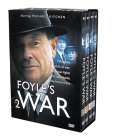
The four 100-minute episodes of Foyle's War are packaged in individual keepcases, inside a glossy paperboard slipcase.
Video
Foyle's War appears in a lovely anamorphic widescreen transfer, at its original aspect ratio of 1.85:1. While the image does tend to be on the soft side, it's otherwise excellent, offering a clean, clear picture with attractive and natural-looking colors. Contrast is handled well, so the image always looks good whether the scene is indoors or out, brightly lit or dimly lit.
Audio
The Dolby 2.0 soundtrack does a nice job of handling everything that's thrown at it. Dialogue is consistently clear and distinct, though sometimes a little on the flat side, and is well balanced with the rest of the track. Special effects such as planes and bomb blasts, along with the subtle musical theme, are integrated well into the overall sound, with volume levels handled well.
Extras
On Disc 1 ("Fifty Ships"), we get a 13-minute joint interview with Anthony Howell (Sgt. Milner) and Honeysuckle Weeks (Samantha Stewart), with the two actors discussing topics such as their careers, and their personal thoughts on the characters and situations of Foyle's War. Also on this disc are text production notes for Foyle's War in general and "Fifty Ships" in particular, a behind-the-scenes photo gallery, and cast filmographies. Each of the other three discs has cast filmographies and production notes for their respective episode.
Final thoughts
If there's any need for an example of the best of British television, Foyle's War would do very nicely: this thoughtful, well-written series presents a complex and sympathetic main character (played to perfection by Michael Kitchen) with difficult problems to solve on both a practical and ethical level. The setting in 1940s Britain is extremely realistic, and it's more than mere window dressing, as the stories all revolve in some way around the war effort and the conflicts, both internal and external, that it inevitably causes. Acorn Media has done another nice job in presenting the set, with the episodes of Set 2 appearing in their original widescreen aspect ratio, and anamorphically enhanced. Set 2 easily gets a "highly recommended" rating, and by the way, if you haven't seen Set 1, that's highly recommended too.
|



| Popular Reviews |
| Sponsored Links |
|
|
| Sponsored Links |
|
|
| Release List | Reviews | Shop | Newsletter | Forum | DVD Giveaways | Blu-Ray | Advertise |
|
Copyright 2024 DVDTalk.com All Rights Reserved. Legal Info, Privacy Policy, Terms of Use,
Manage Preferences,
Your Privacy Choices 
| |||||||