
| Reviews & Columns |
|
Reviews DVD TV on DVD Blu-ray 4K UHD International DVDs In Theaters Reviews by Studio Video Games Features Collector Series DVDs Easter Egg Database Interviews DVD Talk Radio Feature Articles Columns Anime Talk DVD Savant Horror DVDs The M.O.D. Squad Art House HD Talk Silent DVD
|
 DVD Talk Forum |
|
|
| Resources |
|
DVD Price Search Customer Service #'s RCE Info Links |
|
Columns
  


 
|
|
|
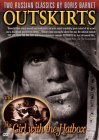
Outskirts / The Girl with the Hatbox
When people discuss Russian film makers, Eisenstein and Tarkovsky are the directors most often mentioned. The Soviet Union had many good directors, of course, it is just that historically, it's been hard to see their films here in the United States. The advent of home video has eased that situation somewhat, and the success of the DVD format has lead to a lot of foreign films becoming available to the casual fan. Image, in association with film preservationist David Shepard and Blackhawk films, has brought two films from the Russian director Boris Barnet to DVD: The early sound film Outskirts (1933) and the silent comedy The Girl with the Hatbox (1927.)
Outskirts:
Set in and around a shoe factory in a small town, Outskits is a slice-of-life drama about Russian life before and during WWI. There are little vingets of life in the factory and around the city. The scenes start of with a light tone, one worker uses the chaos when the police break up a strike to pick up a girl, but they get darker as the movie goes on. When the war with Germany breaks out, many of the factory workers enlist in the army. The war is not as easily won as most of them assume it will be, and life in the trenches is much more harsh than in the shoe factory. When a German shoe maker is captured, the narrative follows him back to the town and the POW camp located nearby. Life in the little town has changed, and not for the better. When the Russian Tsar abdicated in 1914, that brings even more changes to the small city and the soldiers fighting for it.
This was a good film. It presented a very interesting look at Russian existence during the first World War. The main focus is the people, and how the changes taking place in the world effects this little village. People who only wanted to make shoes, end up fighting far from their home for reasons that they don't understand. As one villager says near the end of the movie: "Explain to me, we don't want to fight, and they don't want to fight, but it's been three years that we've been fighting."
There are several interesting scenes in this film that really make it worth viewing. After the Tsar steps down, the shoe factory becomes automated. The workers no longer nail the shoe soles on by hand, but have loud machines that preform the task in a fraction of the time. These machines running are cut into scenes of machine guns firing on the front.
The trench warfare sequences were very good to. It is reminiscent of, though not nearly as powerful as, All Quiet on the Western Front. Another powerful scene in the film occurs when a solider doesn't go over the top because he has a horrible tooth ache. His commanding officer drags him through the trenches and holds him up over the edge while the young man screams.
This movie looks like it was filmed silently and dubbed afterwards. There are few background noises, and those that are included don't sound natural. Even so, this doesn't distract from enjoying the film.
Girl with the Hatbox:
This early Russian comedy is much lighter in tone than the first feature, and surprisingly amusing. Natalya is a hat maker who lives with her grandfather in the rural countryside. Every week she travels to Moscow to sell her hats to a particular store. The store owners have Natalya registered as living in one of the bedrooms in their house, so that they can use it as an office. This arrangement works out well until Natalya runs into a poor student, Ilya, sleeping in the train station. He can't find any apartments for rent, and is forced to sleep where ever he can find the space. Natalya feels sorry for him and comes up with a bright idea: they will claim to be married so that he can live in her room in the hat shop. Well, as you can imagine, that doesn't go over well with the shop owners. They don't like having a strange man living with them and stop buying Natalya's hats. Instead of paying her for the last delivery, they give her a lottery ticket instead, which she leaves with Ilya. But when the ticket turns out to be worth 25,000 rubles, there's a mad dash to try to get the slip and the fortune it represents.
This was a very enjoyable movie, though very different from Outskirts. The pacing and situations were very reminiscent of American comedies of the time. Aside from some of the Russian referances, it could have been filmed in the States.
There was a little slapstick, a few word jokes, but mainly it was a situational comedy. Most of the jokes worked well, and the movie had a lot of laughs. The troubles poor Natalya's grandfather has to go through to get a paper made me laugh out loud, and scene with Natalya and Ilya in front of the Housing Committee were also funny.
Another thing that I enjoyed about this movie was seeing what life was like in Moscow over 80 years ago. The idea of having a government official come into your house and tell you who would be living with you (rent free) almost inconceivable. These authorities were not portrayed as evil or mean, just people doing their jobs. It was also interesting to note that the shop owner was using an abacus to balance the books.
One thing about the film that I didn't like was that the framing is rather odd. The tops of heads are cut off frequently, and you often can't see the speaker's eyes because of this. I'm not sure if it is an error with the print or the way the movie was filmed, but it did give the film a rather amature feel to it. Aside from that single issue, Barnet does a good job, creating some interesting scenes by mounting the camera on a train, or by playing with the focus. In one interesting experiment he has two people talking, one in the foreground and one in the background. Both can't be in focus at the same time, so he focuses on one individual and then cuts to the same shot, but with the other person in focus. The effect was a little jarring, but it was an interesting idea, and something I hadn't seen before.
The DVD:
Audio:
The audio track for Outskirts is a little muffled and very flat, but that is to be expected with a film this old. There is not much distortion and very little hiss. Overall it sounds very good for a film of this age. This movie has optional English subtitles.
Unfortunately, the silent film The Girl with the Hatbox has the English translations of the intertitle cards burned into the print. They are not removable. This should only bother people who can read Russian though. The musical accompaniment was created by the Gorky Studios in 1968, and has some hiss, a few dropouts, and other minor defects associated with older audio, but does an acceptable job.
Video:
Both of these movies looked very good considering their age. Outskirts has some scratches and dirt, but looks very good for a film from the early 30's. The contrast is very good, and the detail is excellent.
The Girl with the Hatbox was a little worse off, but still looked fine. The contrast wasn't as good as I was hoping, and a lot of details were lost in black areas. Many dark figures had a slight black halo around them, but this wasn't distracting. The image was generally sharp and clear, and looked good for a film so old.
Extras:
There were no extras included on this disc.
Final Thoughts:
These are two very good movies, though they had very different tones. The Girl with the Hotbox is a funny film that has the feel of an American comedy, but also offers an interesting look at life in Moscow soon after the revolution. Outskirts is an excellent film, examining the effects of war and the revolution on a small Russian village. Together they make an excellent package that is sure to delight film buffs. Highly recommended.
|



| Popular Reviews |
| Sponsored Links |
|
|
| Sponsored Links |
|
|
| Release List | Reviews | Shop | Newsletter | Forum | DVD Giveaways | Blu-Ray | Advertise |
|
Copyright 2024 DVDTalk.com All Rights Reserved. Legal Info, Privacy Policy, Terms of Use,
Manage Preferences,
Your Privacy Choices 
| |||||||