
| Reviews & Columns |
|
Reviews DVD TV on DVD Blu-ray 4K UHD International DVDs In Theaters Reviews by Studio Video Games Features Collector Series DVDs Easter Egg Database Interviews DVD Talk Radio Feature Articles Columns Anime Talk DVD Savant Horror DVDs The M.O.D. Squad Art House HD Talk Silent DVD
|
 DVD Talk Forum |
|
|
| Resources |
|
DVD Price Search Customer Service #'s RCE Info Links |
|
Columns
  


 
|
|
|
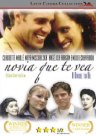
Novia Que Te Vea
The Movie
Based on the novel by Rosa Nissan, the 1994 Mexican film Novia Que Te Vea (Like A Bride) presents a warm and touching tale set within the Mexican Jewish community, starting with a prologue in the 1920s and spanning all the way to the present. The film focuses on two young women: the sensitive, wide-eyed Oshi Mataraso (Claudette Maillé) and the rebellious and idealistic Rifke (Maya Mishalska), and their coming-of-age in a time ripe with alienation, self-discovery, revolution, destruction, and rebirth.
In a sense, both women can be viewed as a metaphor of the search for Jewish identity in a world radically reshaped by World War II and the Holocaust. Oshi's Sephardic family immigrated to Mexico from Turkey in the 1920s, spared from the terrors of Nazism. Rifke's family, with Ashkenazic roots, were not so lucky, as many of her relatives perished in Hitler's camps (her uncle, a Holocaust survivor, has turned his back on God and religion.) Both girls are born and raised in Mexico, unaware of each other's presence but both of them experiencing anti-Semitism and alienation at a young age (Oshi and her brother are called "Christ killers" by a pair of teasing girls, while young Rifke complains bitterly about being left out for wanting a Christmas tree. Kyle Broslofski's It's Hard To Be A Jew On Christmas suddenly springs to mind, but anyway...)
By the time both girls enter the university, they experience the standard tug-of-war that emerges when the conflict between traditions and an ever-changing and modernized world erupts. Both girls have embraced Zionism and Socialism (Oshi a bit less fervent than Rifke), trying to establish a Jewish identity in an environment that grows more secular and revolutionary by the moment. Oshi's family is pushing her towards marriage, especially with a promising young Jewish doctor who is as exhilarating as a shot of Novacaine, while she has aspirations to follow her desires as an artist. Rifke, who enjoys anthropology and sociology, is attracted to a handsome young revolutionary gentile named Eduardo (Ernesto Laguardia), and her attraction to him conflicts with her desire to maintain a Jewish identity.
Plots and subplots emerge throughout the tale, with nothing overly surprising or complex. What director Guita Schyfter and screenwriter Hugo Hiriart have done is present a fairly compelling and warm look at a time and place not often explored in cinema. While the entire cast is uniformly impressive, credit must also be given to the two main actors. As Oshi, Claudette Maillé is wonderful. She radiates quiet confidence, conflict, and innocence all at once, lending her role an air of genuineness. The look of fear and anger on her face while watching a scene in a Passion Play in which Jews are paraded as the murderers of Christ is pitch-perfect. Maya Mishalska's performance as Rifke is extraordinary: all at once she combines the perky yet poised grace of Audrey Hepburn with the stern, charismatic austerity of Maria Casares. As the emotional anchors of this film, both actors ground the film with sincerity even as the storyline often teeters towards the clichéd. Nonetheless, cemented by its excellent performances and smart direction, Novia Que Te Vea weaves a warm, compelling, and affectionate tale of sisterhood, tradition, and community.
The DVD
Video:
Novia Que Te Veais presented in a full-frame aspect ratio of 1.33:1. The resulting video transfer is extremely pleasant. The film features a variety of different styles to underscore the feel of different time periods: black-and-white in some scenes, and almost a Technicolor feel to others. Colors appear bright, clean, and well-rendered, at times both vibrant and tastefully subdued. Contrasts are spot-on, with rich blacks and acceptable shadow details. The transfer had some occasional minor squibbbles - a mark here, some noise there - but overall looked quite clean. Image detail is generally satisfactory and the picture demonstrated adequate sharpness levels, although an more than a few scenes appeared a tad soft. Nonetheless, I found this to be a smart and reasonably good-looking transfer. As Rifke, the
Audio:
The audio is presented in a monaural Dolby Digital 2.0 soundtrack. The delivery is centrally located frongstage, and dialog sounds warm and natural without hiss, distortion, or derogatory elements. My only complaint is that at times the dialog comes across a tad underpowered, but this is fairly uncommon throughout the soundtrack.
Extras:
The special features on this disc include several text page biographies for the cast and crew, as well as trailers for other films in the Latin Cinema Favorites line, including Cilantro y Perejil, Terror Y Encajes Negros, Estas Ruinas Que Ves, and the grows-better-every-time-I-watch-it Tivoli .
Final Thoughts:
While there are no real extras to speak of on this DVD, Novia Que Te Vea remains a worthwhile just for the movie alone. The transfer is good, the soundtrack is acceptable, and the movie itself is quite a joy. I am giving the movie a "Recommended" rating, and I mean that in the strongest possible sense, as this unfairly overlooked film made for a pleasant yet engaging experience.
|



| Popular Reviews |
| Sponsored Links |
|
|
| Sponsored Links |
|
|
| Release List | Reviews | Shop | Newsletter | Forum | DVD Giveaways | Blu-Ray | Advertise |
|
Copyright 2024 DVDTalk.com All Rights Reserved. Legal Info, Privacy Policy, Terms of Use,
Manage Preferences,
Your Privacy Choices 
| |||||||