
| Reviews & Columns |
|
Reviews DVD TV on DVD Blu-ray 4K UHD International DVDs In Theaters Reviews by Studio Video Games Features Collector Series DVDs Easter Egg Database Interviews DVD Talk Radio Feature Articles Columns Anime Talk DVD Savant Horror DVDs The M.O.D. Squad Art House HD Talk Silent DVD
|
 DVD Talk Forum |
|
|
| Resources |
|
DVD Price Search Customer Service #'s RCE Info Links |
|
Columns
  


|
|
|
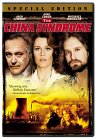
China Syndrome: Special Edition, The
The China Syndrome can best be described as a "disaster suspense" film: unlike a conventional disaster film, in which the catastrophe happens in the first 15 minutes and the rest of the story focuses on how people deal with it, The China Syndrome's suspense comes from whether or not the disaster is going to happen... and how people deal with the uncertainty. It all starts when a reporter and her cameraman (Jane Fonda and Michael Douglas) witness what looks very much like an accident at a Los Angeles nuclear power plant. But despite some concerns from the shift supervisor (Jack Lemmon), the managers of the plant are more interested in preserving their investment than making sure the plant is totally safe.
What ended up making The China Syndrome famous is that 12 days after the film's theatrical release, the nuclear power plant at Three Mile Island melted down. Possibly as a result of the eerie coincidence in timing, The China Syndrome has been rather unfairly pegged in some circles as an "anti-nuclear power" film, but that's not even remotely accurate.
The China Syndrome is in reality critical of human stupidity and greed, and our seemingly endless capacity for self-delusion. The nuclear power plant in The China Syndrome could just as easily be replaced by something else, say a hydroelectric plant – perhaps one with cracks in the foundation – though the impact is certainly heightened by the sheer power of nuclear energy. What makes it so attractive as a source of energy is also what makes it all the harder to handle. Sure, this lightning-in-a-bottle is safe and secure when all the precautions are taken... but human nature being what it is, can we really, truly trust people not to cut corners? Looked at in that light, The China Syndrome is even more chilling, because it's all too believable.
The film also handles the potentially controversial material quite cleverly in terms of its point of view. Kimberly Wells (Fonda) isn't particularly pro- or anti-nuke; she's just a reporter who wants a hot story to break herself out of the rut of fluff reporting she's stuck in. Engineer Jack Godell (Lemmon) firmly believes in the inherent safety and stability of the plant he helped build, and with good reason; it's only when big-business issues start conflicting with safe operating procedures that he starts getting worried.
As an entertaining film, The China Syndrome has aged extremely well. Apart from the lack of cell phones, and Michael Douglas' hippie hairstyle, it could just as easily have come out last year as in 1979... except that now, I wonder if it would have been crafted in the same way. The China Syndrome is a sharp, intelligent thriller, but one that doesn't have a single explosive special-effects shot in the entire film. It draws its effectiveness from our imagination, as we realize just what could be the consequences of a failure at the nuclear power plant. A vibration causing a ripple in a cup of coffee... a needle hovering just above the red line on a gauge... finding a suspicious x-ray... these are the events that ratchet up the suspense. And it's remarkably effective: through its entire 122-minute running time, The China Syndrome keeps the story moving at a brisk pace, and keeps the viewer thoroughly engaged in what's going on.
It's also worth nothing that one of the reasons why The China Syndrome works is that it knows what not to put in the film. For instance, there's a notable (and highly refreshing) absence of the seemingly obligatory romantic sub-plot. I'm sure that a modern rendition of the film would feel compelled to shoehorn some sort of "thing" between Wells and Adams, but as it is, their friendly but strictly professional relationship keeps the story focused on what's important. Similarly, the story ends just about where it should; we have an indication (or at least a hope) of what might happen as a result of the story's events, but we're left to think about it, rather than having it spoon-fed to us.
The DVD
Video
Columbia has given The China Syndrome a solid transfer here: it's anamorphic widescreen, in the film's original 1.85:1 aspect ratio, and it looks like it's been cleaned up quite well. The 1979 film has a clean, bright look to it, with only a hint of the brown tinge that's so common to 1970s films. Close-up shots look remarkably good, with the picture looking sharp and detailed. Some of the longer-distance shots are distinctly lower in quality, with noticeable noise and a generally soft appearance, but overall it's a fresh and attractive transfer.
Audio
The original Dolby mono soundtrack is included here, but most viewers will be more interested in the remastered Dolby 5.1 track, which sounds very good. There's never any distortion or noise in the background. The sound is crisp and clean, with the dialogue always easily understandable.
Extras
A reasonable selection of special features has been assembled for this Special Edition release. Of most interest is a pair of featurettes: "The China Syndrome: A Fusion of Talent" (27 minutes) and "The China Syndrome: Creating a Controversy" (29 minutes). Despite the specific-sounding subtitles, these are basically just two parts of an interesting making-of documentary that covers a variety of topics related to the film. In each, we get a variety of modern-day interviews with Michael Douglas, Jane Fonda, Jack Lemmon, and others involved with the film, reflecting on the process of creating it.
We also get three deleted scenes (running a total of four minutes), filmographies, and trailers for Fog of War, Fail Safe, and Secret Window.
Final thoughts
Even 25 years after its theatrical release, The China Syndrome remains a genuinely chilling and intense thriller. It's intelligently written, creating tension through small but effective details rather than big-budget special effects, and its underlying message of the danger of human greed and short-sightedness remains all too relevant. Especially since the transfer is quite respectable, The China Syndrome: Special Edition warrants a "highly recommended."
|



| Popular Reviews |
| Sponsored Links |
|
|
| Sponsored Links |
|
|
| Release List | Reviews | Shop | Newsletter | Forum | DVD Giveaways | Blu-Ray | Advertise |
|
Copyright 2024 DVDTalk.com All Rights Reserved. Legal Info, Privacy Policy, Terms of Use,
Manage Preferences,
Your Privacy Choices 
| |||||||