
| Reviews & Columns |
|
Reviews DVD TV on DVD Blu-ray 4K UHD International DVDs In Theaters Reviews by Studio Video Games Features Collector Series DVDs Easter Egg Database Interviews DVD Talk Radio Feature Articles Columns Anime Talk DVD Savant Horror DVDs The M.O.D. Squad Art House HD Talk Silent DVD
|
 DVD Talk Forum |
|
|
| Resources |
|
DVD Price Search Customer Service #'s RCE Info Links |
|
Columns
  


 
|
|
|
Easy Rider (35th Anniversary Deluxe Edition)
Easy Rider is the watershed movie that dismantled the studio way of doing things in 1969. Executives thought they'd tapped the youth market by making Juvenile Delinquency films, Rock 'n Roll musicals, Beach Party pictures, Biker films, and finally Acid Head movies, but Easy Rider threw them for loop - this movie about a pair of drug dealers' aimless wanderings through the South packed audiences into theaters. There wasn't a single thing in it that a production chief could imitate for a knock-off follow-up. They threw their hands up and started replacing old pros with guys with long hair and bell-bottomed pants. It was a time of clueless opportunity. As seen in the extras on THX 1138, Warners opened their doors for Francis Coppola's Zoetrope pictures to make eight movies - only to slam them shut after the first flop.
Easy Rider has good qualities (mainly Jack Nicholson), but is far better known for what it's not rather than what it is. It wasn't made by the establishment (check), it accepted drugs as a lifestyle (check) and it's only message was that America was Evil (double check). In 1969, that was all that disaffected youth needed to know. 1
Easy Rider started as a project by two Hollywood insiders trying to find the next rung on a career ladder. Promising actor Dennis Hopper was reduced to doing an occasional bad-guy appearance in big pictures (True Grit) while struggling in the AIP trenches with Peter Fonda, a pretty boy with no discernable acting ability but blessed with a fine Hollywood name. Along with their co-star Jack Nicholson, they'd been scraping along, name talent lacking a career springboard.
Easy Rider has good writing and a little style but mostly was the right movie in the right place at the right time. The style can be attributed to the camera of László Kovács and the writing to willing scribe Terry Southern, a man-on-fire liberal looking for an opportunity to work without studio interference. On that score Columbia ended up being much more reasonable than American-International; the house of Arkoff was not seeing big profits with sex and drugs, and interfered with Roger Corman's movies so much that he just quit directing a couple of years later. Easy Rider went out with all of its drug use and nudity intact.
Is the movie any good? Fonda and Hopper free-form the road movie aspect with nice travelling shots backed by their favorite songs from the period - Easy Rider is noted as the first movie to use hit singles as soundtrack material, rather than stop-the-show musical numbers. Since any song sounds good over a pair of motorcycles on the open road it's a smart gambit, if not great filmmaking. Four years later George Lucas and Walter Murch would set the standard for sound-tracking with greatest hits in American Graffiti. 3
Terry Southern reportedly ceded sole script authorship to Fonda and Hopper (no humble souls, they) and his dialogue is only as good as who is saying it. Jack Nicholson bursts forth as a great interpreter of Cassavetes-like character material, completely overturning his earlier ten years as one of the youth movement's least-promising talents; time and again he came off as stiff, forced and silly. He nails his character, the film's sole 'normal' hero who earns the respect of his too-hip road buddies.
Dennis Hopper delivers his fast-talking BS brand of patter and is just fine, even though his character isn't as a coherent as Nicholson's. Wyatt and Billy are unknowing prophets, man, voyagers on the highway of life .... they don't explain themselves, man, it's, like your job to get into their heads.
Although Peter Fonda strikes the perfect pose as Wyatt aka Captain America in a leather outfit with the American flag on his back, he has the same empty, clueless face that's dogged him throughout his career, and can't handle dialogue to save his soul. Every word he speaks comes out like a lead ingot, especially the 'far out' phrases. He does look convincingly stoned now and then. Doubtless many a critic more savvy than I can reach into Easy Rider and come out with an analysis that elevates the movie to the status of The Odyssey. When looked at objectively, it's a road film with three or four okay dialogue scenes, some bad escapades in a commune (although the wonderful Luana Anders is there, neglected as usual) and several very credible run-ins with Southern rednecks. Toni Basil and Karen Black enliven the New Orleans scenes but the LSD party in the graveyard is no great showcase for acting. I'm told many viewers think it's the best presentation of an acid trip on film, however.
There's nothing particularly cinematic happening here. I'm not moved by Hopper's visuals in the graveyard acid trip or his comical stagger-cut scene transitions (do I detect the influence of The Monkees here? There is one near-miraculous shot of Fonda's chopper disintegrating as it flies by the camera at high speed, and a few serendipitous visuals on the road, but that's it. What the movie neatly avoids is the usual "it's happening" baloney found in the AIP losers like Psych-Out and parts of the not-bad The Trip. It drops any notion of explaining itself through exposition or other audience-friendly techniques. It doesn't provide a road map for its own content, or a viewer surrogate character to interpret events for us.
I was only 17 when an older cousin, a real biker type, took me to Easy Rider. I had the typical teen reaction of the time - I liked it but couldn't say why. My cousin wasn't very hippie-friendly and had no use for it at all. I still like the film, in a way, but there's definitely something missing in this 'too hip' road trip by a pair of egotistical Hollywood boys. Wyatt's final utterance, "We blew it man, we blew it" is as fake as phony 'right on' movie dialogue gets.
So Easy Rider is much more significant than it is 'good.' There was The Graduate a couple of years before, but this is the movie that made Nixon's Silent Majority decide that there was a thing called The Generation Gap.
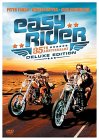
Columbia TriStar's 35th Anniversary Deluxe Edition of Easy Rider appears to be a repackaging of older special edition goodies in a package that includes a second CD with six or seven songs from the soundtrack 4, and one of those cool BFI pamphlet-film books with an excellent extended essay by Lee Hill. I never realized that those books were the same size as DVDs, very clever.
Charles Kiselyak's 1999 docu Shaking the Cage is an uncritical but beautifully constructed opportunity for Fonda and Hopper to tell the tale of their coup de cinema. Fonda is gratingly full of himself and his accounts of drug use on the road are nowhere near as amusing as he thinks they are. But Hopper allows other testimony to affirm that he was a director on a power trip and an unforgivable control freak. He says that after cutting the film for a year (!) (!!!) Fonda, Nicholson and others took over and whittled the picture down to its final modest running time. At least the film is not an overblown endurance test. Hopper told his friends to never let him cut a movie again! 2
The enhanced transfer looks fine and the audio has been remixed in 5.1 for those of you with a yen for the mellow lyrics of Bob Dylan sung by Roger McGuire, The Band, Jimi Hendrix, etc.
On a scale of Excellent, Good, Fair, and Poor, Easy Rider rates:
Movie: Good +
Video: Excellent
Sound: Excellent
Supplements: Commentary by Dennis Hopper, docu Easy Rider: Shaking the Cage, production notes, soundtrack CD, BFI book Easy Rider by Lee Hill
Packaging: Double disc (1 DVD , 1 CD in slim Keep case with book in card sleeve.
Reviewed: October 21, 2004
Footnotes:
1. This wisdom is from William Bayer's great book Breaking In, Selling Out, Dropping Dead, and not this author. I love America.
Return
2. I think his assessment is true. I saw dailies for two months on The Hot Spot and thought Hopper was directing a potentially great movie. The final edit of the picture throws out most of what was good and wastes time on all kinds of annoying and unnecessary material. So let me re-cut it, Dennis ... there's a great picture there. Really.
Return
3. Song Lyric from I Wasn't Born to Follow: "And if you think I'm ready .... you may lead me to the chasm ... where the rivers of our vision ... flow into one another." At age 18, I thought that was the greatest sex come-on ever committed to vinyl.
Return
4. ... and some cover-version replacements and a from-left-field Moody Blues cue.
Return
| |
|



| Popular Reviews |
| Sponsored Links |
|
|
| Sponsored Links |
|
|
| Release List | Reviews | Shop | Newsletter | Forum | DVD Giveaways | Blu-Ray | Advertise |
|
Copyright 2024 DVDTalk.com All Rights Reserved. Legal Info, Privacy Policy, Terms of Use,
Manage Preferences,
Your Privacy Choices 
| |||||||