
| Reviews & Columns |
|
Reviews DVD TV on DVD Blu-ray 4K UHD International DVDs In Theaters Reviews by Studio Video Games Features Collector Series DVDs Easter Egg Database Interviews DVD Talk Radio Feature Articles Columns Anime Talk DVD Savant Horror DVDs The M.O.D. Squad Art House HD Talk Silent DVD
|
 DVD Talk Forum |
|
|
| Resources |
|
DVD Price Search Customer Service #'s RCE Info Links |
|
Columns
  


 
|
|
|
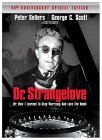
Dr. Strangelove - 40th Anniversary Special Edition
Dr. Strangelove is a landmark satire and one of the few that actually had an effect on public opinion; after 1964 only the ignorant talked about waging nuclear war as a constructive process (until the neo-con present, that is). Audiences had already grown weary of serious alarm movies like On the Beach, which inevitably ended in masochistic doom - in 1962, the subject of nuclear crisis was such a hot topic that that the low-key English science fiction film The Day the Earth Caught Fire was a surprise hit.
Stanley Kubrick originally planned to make sober thriller like the Sidney Lumet's Fail-Safe. His decision to opt for a broad black comedy was an inspired stroke. 1 Dr. Strangelove may be the first hit film that was a bona-fide black comedy; I don't recall anybody using the expression much before it came out. The backbone of the story remains 100% serious on the issue of the nuclear threat. This was no Hellzapoppin crazy comedy where anything funny was okay. Kubrick and Terry Southern create a cold-sweat crisis and then populate it with insane caricatures with ridiculous names. No matter how stupid any of them act, none are really that exaggerated. Peter Sellers serves triple duty in a trio of characterizations, effectively outdoing previous champion chameleon Alec Guinness. George C. Scott steals the show as an infantile Air Force General who acts like a Looney Tunes cartoon character. And the rest of the inspired cast nail completely original quasi-comic characters.
Stanley Kubrick is better known for ponderous seriousness than comedy, but Dr. Strangelove is one of the funniest films ever made. It's divided between three main locations, each with its own deadly-serious function and each overlaid with a different comedic tone. In his locked executive office in the Alaskan Air Force Base, the sexually obsessed American General Ripper faces off with a veddy proper English officer in a farcical one-act. Beady-eyed and intense in his anti-Communist convictions, Sterling Hayden contrasts beautifully with Seller's genial Group Captain, who simply can't fathom the depth of his commanding officer's madness.
Up in the B-52, the show becomes a throwback to gung-ho WW2 action films, where the racially and ethnically diverse attack team uses brains and guts to barrel through their suicide mission like traditional heroes. Even though their pilot is a cowboy clown (Slim Pickens doing his only characterization, Slim Pickens) they're an admirable bunch, seemingly the only humans capable of doing anything without red tape or Coca-Cola machines getting in their way. Here's where the screenplay becomes conflicted - our boys are on a mission that's totally against our vital interests. The B-52 scenes are further amplified in the gritty newsreel-like footage of the taking of Burpelson AFB, with American troops fighting American troops. Nothing could be more traumatic for the kind of patriotic film fan that expects our forces to be portrayed in glorious missions for freedom and righteousness. Kubrick has the audacity to place a big sign saying "Peace is our Profession" in the middle of it all. The grainy authenticity of these scenes would come back to haunt us when similar footage started being seen nightly on television, straight from Vietnam.
The center of activities is the War Room, a fictional Camelot-like round table of Death supposedly located in the basement of the White House. The rational President Merkin Muffley finds himself up against an ideological roadblock in the form of Buck Turgidson, a gum-chewing military nutcase itching to go to war and secretly overjoyed that Jack Ripper has "exceeded his authority." The President is hardly in charge of foreign policy at all, what with 50 silent advisors sitting by and not one coming to his aid. He has to be shepherded through protocol by an assistant, as if he were the stranger and the military brass were in command. Here's where Southern and Kubrick make their biggest points, basically asserting that the American stance is a military one and that a showdown with "the Russkies" is inevitable.
The comedy is all over the place, and it's a miracle that it works. The stand-up humor on the hot line is very much like a Bob Newhart routine. At Burpelson, it's the Goon Show all over again, with Sellers' RAF twit ineffective in swaying General Ripper or the moronic Major Bat Guano (Keenan Wynn), the one who suspects him of being a "deviated prevert." Up in the bomber, it's Mad Magazine craziness grafted into combat realism. The only previous look at modern Air Force flying were already a decade old from enlistment booster films like Strategic Air Command. Kubrick drove his English craftsmen to fake the entire bomber interior right down to the switches and gauges, and the film's serious aerial combat is more realistic than that in escapist films, even with the inadequate exterior views of the jet bomber in flight.
There's a constant tug at work in Dr. Strangelove between comedy and morbid unease. Kubrick's main career themes - sexual madness, treacherous technology and the folly of human planning - come into strong relief. We're pulled to root for the soldiers who are going to destroy the world, and then fret over the President's pitiful lack of control. Dour, glowering Russian Ambassador Sadesky (Peter Bull) tells all in the War Room about his country's answer to an already overextended defense budget, the Doomsday Machine. Countering all this is Muffley's security advisor, Dr. Strangelove, who enters the film in the last act to serve as sort of an angel of Death. Based loosely on Rand-corporation experts who calculated eventualities in nuclear war scenarios, Strangelove is a throwback to German Expressionism, a Mabuse in a wheelchair, black-gloved like Metropolis' Rotwang. He enters like the specter of Death itself, and he grins like a skull. He advocates the contemplation of 'megadeaths' as if it were part of his sex appeal. The detonation of the first bomb seems to liberate Strangelove, as if the chaos and evil of nuclear war restores this representative of apocalyptic Nazi vengeance to full power. Hitler has somehow packed the entire population of the world into his suicide bunker, twenty years after the fact.
For first-time viewers, Dr. Strangelove needs no prior explanations. Only the truly uninformed will not recognize James Earl Jones' baritone voice as one of Major Kong's flight crew. Those going back for a repeated peek will derive added enjoyment from Kubrick's perfect control over his several visual styles and his deft avoidance of standard suspense scenes that deflate tension: We only hear about the recall code being issued but are spared any view of the responsible military personnel who must have sent it. Some of the best fun is finding details in the War Room, such as the pies already laid out in preparation for the aborted pie-fight finale. Even better is watching all the extras in the War room keep rock-steady sober no matter how funny the Sellers and Scott get; that contrast is what makes the comedy so brilliant. Watch Peter Bull carefully. He starts to smile at Sellers several times and catches himself, and then is clearly on the verge of cracking up, forcing Kubrick to cut away.
Columbia TriStar's 40th Anniversary DVD of Dr. Strangelove or: How I Learned to Stop Worrying and Love the Bomb finally presents the film in a reasonable aspect ratio. Criterion's impressive laserdisc from about 12 years ago jumped between 1:37 and 1:66 depending on what scene was up, showing that even the aesthetic leaders can get confused. Due to some convenient baloney about Kubrick preferring flat transfers, previous DVD releases stayed in an 'authorized' 1:37, which completely threw off many compositions and revealed cables, lights and lighting flags in the B-52 scenes (Only the impressive War Room set seemed to benefit from the taller composition). The transfer is good, and much sharper in enhanced widescreen, even though it hasn't been digitally scrubbed for tiny flaws. One nice touch is the overall darkening of many scenes that previously were printed way up, revealing flat matte paintings for Burpelson AFB, etc. The original show's often gritty look has been better approximated.
There's a new 5.1 remixed track and the original mono, as well as a French track.
The second disc contains several good docus. The first two seem to cover similar ground, although the second goes much deeper into the production, interviewing many of the surviving technicians and actors, as well as people like Robert McNamara, Spike Lee and Bob Woodward. Critics Roger Ebert and Alexander Walker are also represented. The detail is excellent; if the two shows were combined and their duplicated content honed, they'd probably constitute a definitive docu. The older shorter special edition docu from several years back is not here. My favorite material covers ad and trailer designer Pablo Ferro. His quirky trailer for Dr. Strangelove put the industry on alert for the creative posibilities in the coming attractions format.
Another docu piece covers Peter Sellers' career and features several choice film clips of him from the 50s, including an almost perfect takeoff on a William Conrad-like hired killer. A Stanley Kubrick career piece uses UA, MGM and Universal trailers to cover his days from 1951 to 1964 and is less compelling, only because so much is glossed over so quickly.
A great extra are a pair of 'split screen' fake interviews with Sellers and Scott intended for publicity use. Each gets to project his chosen PR image. They're charming, especially when Sellers takes us on a lightning tour of English accents. Robert McNamara's interview is also here uncut; a glossy booklet contains a Roger Ebert review plus a lot of photos.
On a scale of Excellent, Good, Fair, and Poor, Dr. Strangelove 40th Anniversary rates:
Movie: Excellent
Video: Excellent
Sound: Excellent
Supplements: Docus on film, Peter Sellers and Stanley Kubrick, booklet, Robert McNamara interview
Packaging: Two discs in normal keep case in card sleeve
Reviewed: October 30, 2004
Footnote:
1. There's nothing in particular wrong with Fail-Safe; it has its share of truly gripping moments. But by using the book's idea that a technical malfunction could start WW3, it flummoxes its anti-nuke message by making it seem as if better engineering & better bombs will solve the problem. There was a popular pamphlet publication called The Fail-Safe Fallacy that refuted the entire premise of the Burdick-Wheeler novel, further miring that movie in the particular politics of its year. The pamphlet's best argument was that the Soviets would never ask for the counterdestruction of NYC but instead demand much more useful political concessions. At any rate, Fail-Safe remains an artifact from the sixties, while Strangelove is an undying work of art.
Return
| |
|



| Popular Reviews |
| Sponsored Links |
|
|
| Sponsored Links |
|
|
| Release List | Reviews | Shop | Newsletter | Forum | DVD Giveaways | Blu-Ray | Advertise |
|
Copyright 2024 DVDTalk.com All Rights Reserved. Legal Info, Privacy Policy, Terms of Use,
Manage Preferences,
Your Privacy Choices 
| |||||||