
| Reviews & Columns |
|
Reviews DVD TV on DVD Blu-ray 4K UHD International DVDs In Theaters Reviews by Studio Video Games Features Collector Series DVDs Easter Egg Database Interviews DVD Talk Radio Feature Articles Columns Anime Talk DVD Savant Horror DVDs The M.O.D. Squad Art House HD Talk Silent DVD
|
 DVD Talk Forum |
|
|
| Resources |
|
DVD Price Search Customer Service #'s RCE Info Links |
|
Columns


 
|
|
|
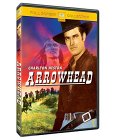
Arrowhead
The early 50s were liberal times for Westerns, especially where Native Americans were concerned. Broken Arrow re-configured Bird of Paradise as the story of an Indian maid and an open-minded Army scout. Devil's Doorway was an early plea for civil rights with Robert Taylor as an Indian Civil War veteran cheated of his rights and his land and killed in a battle against the U.S. Government. No longer viewed as the noble savages of Stagecoach, Indians were transformed into an oppressed minority.
Arrowhead sees things differently. In the early 1970s, when The Wild Bunch put a re-evaluation of the western on the academic fast track, Charles Marquis Warren's humble "Army scout vs. Apache renegade" tale was re-interpreted as a sagebrush depiction of the threat of Communism, just this side of the rabid likes of I Was a Communist for the FBI and I Married a Communist (The Woman on Pier 13). 1
I think the critics were right. The McCarthy witch hunters constantly alluded to insidious Communist messages in films by the likes of the Hollywood Ten, when there are far more examples of outright anti-Communist propaganda. As a narrative Arrowhead is nonsense, unless it's meant to kindle xenophobic hatred. I'll try to explain myself below.
Wily, tough Indian scout Ed Bannon (purportedly based on the real-life Al Sieber, a scout depicted by name in Robert Aldrich's Apache) sneaks up behind some braves waiting none-too-innocently on a bluff. "Hey you - dirt!" Bannon says, and then shoots them all dead. Arrowhead immediately sets up Bannon as an Apache-hating white man who lived with the Indians as a child and has an innate understanding of them that the cavalry lacks. To Bannon they're all treacherous scum incapable of honoring any agreement except oaths to their own religion.
In this cockeyed vision of the U.S. Cavalry out west, the yellow-legged troopers are the pacifists, a conception that goes against every known interpretation of history. In this movie, it's the Indians who enter into treaties and then callously renege. Writer-director Charles Marquis Warren chooses as the cavalry leader Lewis Martin, the actor who played the solemn Priest in The War of the Worlds, the one that martyred himself under the Martian death rays while holding up a bible. Martin's Col. Weybright (a name that gets my vote for wishy-washy liberal baiting) is convinced that the Apache are all going to happily disarm, put themselves under Army control and be shipped off to live on that real estate nobody could sell in Florida. The soldiers, even the reasonable Captain North (a very effective Brian Keith in an early role) assume that all is hunky-dory with the Indians, and only Bannon's provocative presence is preventing peace and harmony. Arrowhead can't wait to prove them to be pacifist fools.
The arrival of Jack Palance's Toriano changes all that. A fanatic itching to run amuck, Toriano stares and grins like Charlie Manson when he knows he's putting a fast one over on whitey, even his own blood brother, the storekeeper who has named his own son after the Indian. Toriano has just come back from college in the East but seems all the more savage and rebellious for it; it's laughable to think of Jack Palance attending classes looking like he's ready to disembowel the professor at the drop of a wrong phrase. 2 As author Philip French remarked, when Toriano takes off his white man's hat to shake down a shoulder-length mane of black hair, the ultimate 60s student radical nightmare is created - fifteen years early, and before The Wild One or Rebel Without a Cause.
Toriano is a triple threat. He's a religious maniac committed to the destruction of civilization for no reason other than pure hatred. He's a product of the University System, which in right-wing terms means he has learned just enough to be a dangerous pseudo-intellectual (although there's no evidence that he can write his name). And embodied by the excessively physical Jack Palance, he seems a sexual threat as well.
Toriano, as Bannon has guessed, has returned to foment rebellion and start a bloodbath against the whites. Author French details another historical distortion I'm not familiar with, the "ghost dance" movement, a supposedly peaceful ritual that Arrowhead makes out to be a cultish rite to inspire bloodlust against the whites, kind of a Satanic Black Mass.
So Arrowhead has: A clueless military obviously in need of a righteous ethnic cleanser like Bannon; A bitter hero eventually vindicated as a superior being over the savage Apaches; various duped civilians and soldiers; and a nasty villain identified along racial lines.
Making the Indian such a vital threat conjures ideas of Communism by association. In 1953 anti-Communism was the big issue, the stated threat to everything we hold dear and already the fast-track fear ticket that cinched political campaigns. Arrowhead proposes a world-view where we're under attack from without and within and don't even know it. Bannon sleeps with Katy Jurado's treacherous femme fatale Apache agent, another hilariously conceived character - she's like Tondelayo, but with a secret radio to enemy headquarters. The real problem are the rank & file soldiers and civilians who don't back up Bannon's hard-nosed approach - they might as well be passive fellow travelers. Why can't the nabobs just leave the fighters for freedom alone?
As it turns out, Toriano has to follow more blood-brother and ghost-dance ritual rules than Dracula, which makes him easy to out-fox. Bannon forces him into a one-on-one duel that spares us from yet another shoot out for a resolution (always a good sign in a creative western). The fight is suspenseful because it's been well-established that in most situations Toriano can wipe the floor with Bannon.
Arrowhead must have been a strong influence on Sam Peckinpah's Major Dundee, in which almost every character is divided against himself along lines of racial allegiance. Instead of a melting pot, America is a wolf pit with every nationality and tribe out for itself. Peckinpah's philosophy was more liberal but also cynically direct: When asked why the Indians commit crimes against the settlers, Dundee's old Apache replies simply, "Because it's our land, all of it." Manifest Destiny and Terrorism for Dummies.
Arrowhead reduces Major Dundee's North/South theme to one remark - Captain North chides Bannon for scouting for the Yankee Army while wearing Confederate-style pants. Bannon is a bundle of contradictions just like any of Peckinpah's characters.
Oh, back to the movie! Arrowhead is reasonably exciting, well-made and acted. It does tend to drag going into the final act. Warren's direction is unfussy and even elegant ... Peckinpah could have used some of that in Dundee. Aloof leading lady Mary Sinclair may have gotten the role because she starred with Heston in Wuthering Heights onstage (source: IMDB). Milburn Stone's sidekick Sandy perhaps fared the best from the film; after a 140 film career in smallish parts, he found an almost permanent TV home home on director Warren's 1955 Gunsmoke.
Robert J. Wilke is a standout as the sergeant. A freshly widowed officer's wife is said to be an uncredited bit by Kathryn Grant before she married Bing or took on Ray Harryhausen's monsters in The Seventh Voyage of Sinbad.
Paramount's DVD of Arrowhead is a great-looking show. The picture has good color and shows off Ray Rennahan's careful pre-dawn photography. Filters were used to show the sky turning from pitch black to a reddish yellow with the dawn. The movie is flat, and the compositions demonstrate it was definitely meant to be that way. This must have been one of the last Academy 1:37 releases before everyone started matting their films to 1:66 and calling it widescreen: two years later 'widescreen' matting officially became 1:85 but the compromise Aspect Ratio was often closer to the 1:78 of our present widescreen TVs.
There are a lot of shots that have slightly misregistered colors but it's only truly noticeable two or three times; most of the other instances are very subtle. Only one shot of wide-shouldered Heston walking toward the camera is so off that you feel like reaching for 3-D glasses.
There are no extras. Arrowhead has always been considered a minor western but the Heston-Palance confrontations are genre choice cuts. The library titles get more interesting as Paramount digs deeper into the vault.
On a scale of Excellent, Good, Fair, and Poor, Arrowhead rates:
Movie: Very Good
Video: Very Good
Sound: Excellent
Supplements: none
Packaging: Keep case
Reviewed: November 9, 2004
Footnotes:
1. I'm thinking of Philip French in his great book Westerns (Viking 1973). That's the book with the fascinating schematic dividing 50s westerns along political lines - Kennedy, Goldwater, McCarthy westerns. French quotes John Wayne on the 'Indian problem' in the frontier, and it reads like pure rationalization for aggression: "I don't feel we did wrong by taking this country away from them. There were great numbers of people who needed new land, and the Indians were selfishly trying to keep it for themselves." Gee, that applies to oil, too.
Return
2. Then again, I'll bet a lot of high school teachers face that every day.
Return
| |
|



| Popular Reviews |
| Sponsored Links |
|
|
| Sponsored Links |
|
|
| Release List | Reviews | Shop | Newsletter | Forum | DVD Giveaways | Blu-Ray | Advertise |
|
Copyright 2024 DVDTalk.com All Rights Reserved. Legal Info, Privacy Policy, Terms of Use,
Manage Preferences,
Your Privacy Choices 
| |||||||