
| Reviews & Columns |
|
Reviews DVD TV on DVD Blu-ray 4K UHD International DVDs In Theaters Reviews by Studio Video Games Features Collector Series DVDs Easter Egg Database Interviews DVD Talk Radio Feature Articles Columns Anime Talk DVD Savant Horror DVDs The M.O.D. Squad Art House HD Talk Silent DVD
|
 DVD Talk Forum |
|
|
| Resources |
|
DVD Price Search Customer Service #'s RCE Info Links |
|
Columns
  



 
|
|
|
Fritz Lang Epic Collection
"To begin with, I should say that I am a visual person. I experience with my eyes and never, or only rarely, with my ears — to my constant regret."
- Fritz Lang
After watching the films of Fritz Lang, it is easy to see how true that statement is. His films are filled with wonderful images; often strange, sometimes eerie, and occasionally unsettling, but always unique and captivating. They make his movies a joy to watch, and his films have influenced generations of filmmakers.
Lang started out studying art and architecture, but enrolled in the Austrian army when WW I started. He was wounded in battle three times (some sources say four) and was discharged, shell shocked, in 1918. It was while he was enlisted that Lang met Erich Pommer, the famous German producer. After the war he took a job in Pommer's production company, first as a writer, and then as a director. Lang started out on modest projects, but his vision was grand and he soon began directing epic films.
Lang was a perfectionist, insisting that every aspect of the filming be very precise. Critic Roger Ebert once stated that Lang "made even Stanley Kubrick's mania for control look benign." It has been reported that Lang often crueling mistreating cast and crew members who didn't preform up to his impossibly high expectations. Both in Germany and later in Hollywood he had a reputation as being a taskmaster, and many people would refuse to work with him.
Whatever his personality, he was able to create amazing films, many of which are considered classics, and some that are still influential today. Kino has now gathered restored versions of Lang's last four silent films and released them in a splendid boxed set. The Fritz Lang Epic Collection includes the epic Die Nibelungen, Lang's influential and stunning Metropolis (both previously released,) the cloak and dagger film Spies, and his last silent feature the SF film Woman in the Moon. Four fantastic movies that all look wonderful in these editions. After screening these films, it is easy to see why Fritz Lang is considered a film genius.
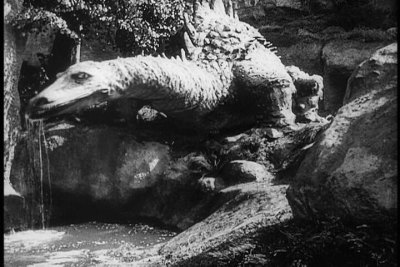 Produced over a two year period, and with an amazing 31 week shooting schedule, 1924's Die Nibelungen is a grand movie of epic proportions. Based on a thirteenth century Nordic saga, this film is larger than life. It has a fire breathing dragon, treacherous dwarfs, magic swords, and barbarian attacks. Filled with intrigue and epic quests, this movie was the Lord of the Rings of the silent era.
Running at nearly five hours in length, Die Nibelungen is split into two film, Siegfried and Kriemhild's Revenge. But it is really one larger work divided, much like Peter Jackson's Ring trilogy. The film starts with Siegfried, the son of King Sigmund. He has been apprenticed to a sword maker, but has learned everything the master has to teach him. Hearing the a story about the beautiful Kriemhild, brother of King Gunther of Worms, he sets out to win her hand in marriage. On his way through a dark forest, Siegfried encounters a dragon. They fight, and Siegfried defeats the beast. Before he leaves, a bird tells him to bathe in the dragon's blood and he will become invincible. While doing this, a leaf lands on Siegfried's back, leaving one area of skin untouched by the blood, and therefore still vulnerable.
Traveling onwards, Siegfried is attacked by an invisible Nibelungen, Alberich. This dwarf has the a cloak that will the user to become invisible or to assume any shape he wishes. After Siegfried bests him, Alberich promises the hero untold riches if he will only spare his life. Siegfried agrees and gains the magic sword Balmung, and a king's ransom in treasure.
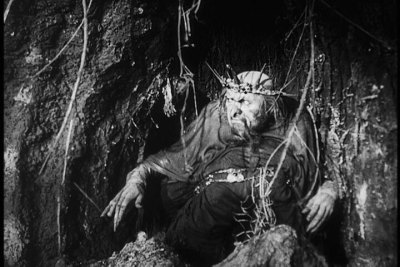 Meanwhile in Worm, a bard is singing the praises of Siegfried. He tells of his conquest of the dragon, the Nibelungen treasure, and how he has conquered twelve cities. Hearing of his deeds, Kriemhild falls in love with the hero. When Siegfried does arrive at Worm, he meets King Gunther. The King is enraptured by Brunhild of Iceland, a fierce female warrior who will only marry the man who can best her in three contests of strength. To fail to beat her is death. Siegfried promises to help Gunther win his bride if Gunther will allow Siegfried to marry Kriemhild. Gunther agrees and they all set off.
Brunhild's castle is surrounded by a moat of fire. Crossing it, they are led in for an audience with Brunhild. She is intrigued by the masculine Siegfried, but is disappointed to find that he is not challenging her, Gunther is. Using his invisibility cloak, Siegfried makes it look like Gunther is the one to out perform Brunhild in the three tasks. Crushed by her defeat, Brunhild agrees to return with him to Worm, where she and Gunther are married along with Siegfried and Kriemhild. Things are looking well, until Brunhild discovers that she was not beaten by Gunther and turns to destroying Siegfried for tricking her.
Note: It is impossible to describe the second film without giving away the ending of the first. If you'd rather not know how Siegfried ends, skip down to the red *end of spoiler* tag below.
*Spoiler Warning*
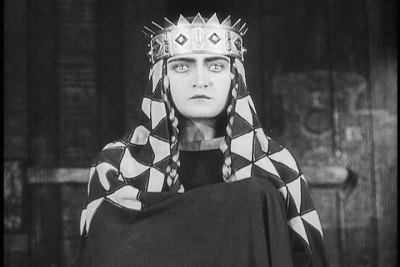 At the end of Siegfried, Hagen , King Gunther's aide, kills Siegfried. Kriemhild discovers this, and vows to avenge her murdered husband. The second film, Kriemhild's Revenge, is much less mythical than the first. It has no dragons or magic weapons. It is more grounded, and illustrates how one woman is willing to go to any lengths to get vengeance.
As the film starts, Kriemhild is still morning her loss. Attila the Hun send an ambassador to propose marriage to Kriemhild. Seeing her chance, she has the envoy swear on oath on his sword that he will avenge any injustice that she suffers.
Fearing that Kriemhild will use the vast treasure that she still has against his people, Hagen steals in and throws it in a lake. When she hears this, Kriemhild realizes who did it. She leaves Worm with the envoy.
After many months of traveling, they arrive at the Hun village. Kriemhild is astonished at how primitive it is. But Attila is enraptured by her beauty, and wants to marry immediately. Kriemhild has a condition: Attila must vow to kill anyone who would treat her wrongly. He does this without hesitation.
Time passes and while out pillaging, Attila learn that Kriemhild has bore him a son. He speeds back and is overjoyed to have an heir. Says he'll grant Kriemhild anything she wishes, and she asks Attila to invite her brothers to come visit her. He does.
After months of traveling, her brothers, arrive with their entourage. When Kriemhild finds out that Hagen is with them, she demands that Attila kill him. He refuses, since they are all guests of his and therefore under his protection. Enraged at this, Kriemhild goes to the Huns themselves, and offers a reward of a shield full of gold to the person who brings her Hagen's head. This sets forces in motion and things soon spin out of control for everyone involved.
*End of Spoilers*
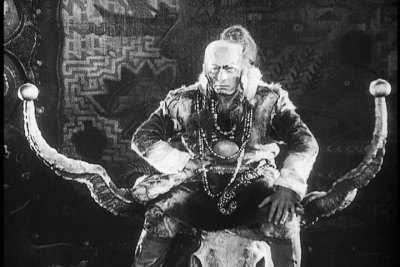 The full might of the German Ufa studio, which rivaled Hollywood for many years, was behind this production, and you can tell. Every aspect of the production is extraordinary. From the lighting to the costumes to the dazzling special effects, each facet of this movie was carefully crafted to create a mythical world.
The sets are large in scale, and finely detailed. From the huge mist filled forest to the castle of Worm to the barbarian camp, no expense was spared to make this production look gorgeous.
The cinematography was stunning. Lang blocked the images carefully and almost every shot looks like a photograph. The composition is faultless. The pace, while not fast and furious like today's films, fits the material well. It is more careful and deliberate, but not plodding or slow.
The musical score is preformed by the Munich Radio Orchestra from the original 1924 score composed by Gottfried Huppertz. The music fits in well with the visuals, accenting the drama on the screen. Thought Huppertz did reuse a lot of passages making the score a bit repetitive at times, it is still a superb score.
The best part about this film is that it is entertaining. You can appreciate it for the cinematography or the direction, or on any number of levels. It is an enjoyable movie to watch.
The DVD:
Audio:
The orchestral stereo sound track was reproduced very well. The bass wasn't as forceful as I was hoping it would be, but that's a minor quibble. The sound was clear, though there was some hiss on the soundtrack. On the first disc the hiss is only noticeable at very high volumes and not a problem at all. Curiously enough, it was much higher on the second disc. It varied in level but was noticeable in most sections. The hiss wasn't at a level that made it bothersome, but it was present.
Video:
The video quality is very good for a film that is over 75 years old. This is a restored version, and was pieced together from prints in Germany, Austria and England. While it looked very good, it wasn't perfect. The biggest imperfection was that the whites were a little to bright in some scenes, which led to a loss of detail. There was some slight emulsion damage in one scene, but it was very minor, as was the speckling and dirt. The image is very easy on the eyes. It has a broad range of gray tones and there was excellent detail. You can see the scales on the dragon's hide and even the mist is the forest has a good amount of detail. The bark on the trees and the feathers on Brunhild's helmet are all clearly visible.
This version is not tinted. While there are prints that have tinting in existence, it is believed that Lang did not like the process. The film is not poorer for the lack of tinting at all. A very good looking DVD, with only minor flaws.
The Extras:
On the set with Fritz Lang: A 1 ½ minute excerpt from a German short. It shows Lang working at Ufa and filming a scene. Note the two cameras that are being manually cranked while filming.
Production Design: Five minute reel of production sketches intercut with scenes of the finished product from the movie.
Slaying the Dragon: Information about the most memorable scene in the movie. The section contains the original production design, A photo of Lang filming the sequence, the sequence itself, and a similar scene from Douglas Fairbank's Thief of Baghdad, released the same year, where that star fights a dragon too.
Photo Gallery: Behind the scenes photos with captions. Very interesting pictures.
About the Master: A text piece detailing the origin of the master and the lack of tinting on the print.
Often called the first real science fiction film (though there are some other contenders for the title) Metropolis is certainly the most famous early SF film. Lang spent two years making this early classic, at a cost of 5.3 million marks. It was the most costly production ever made in Germany at that time, dwarfing the costs of Die Nebulung and The Cabinet of Dr. Caligari. The incredible cost threatened to shut down production several times, and was a major contributing factor to Ufa studios going bankrupt.
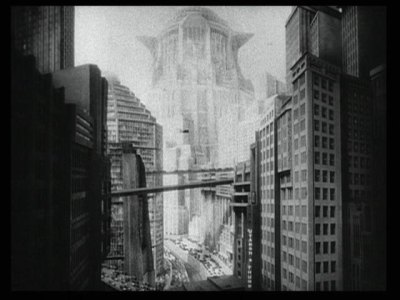
It is easy to see where the budget went. The film is filled with fantastic visuals and enormous sets that give the film a feeling of grandeur. The huge machines and futuristic cities are still impressive over 75 years later. The effects of this film are still being felt today, with movies such as Dark City and Blade Runner being directly influenced by Lang's powerful work.
Though the film is widely praised today, when it was released in 1926 it didn't do very well. Part of this was because the film was edited frequently. At its premier, the film ran 4189 meters. Soon after that though, it was cut down to 3241 meters for wide scale release in Germany. In the US, Paramount obtained the license to distribute the film, but thought it was too long and cut it to 3100 meters. With each of these cuts the movie became less and less coherent. While the dynamic visuals were still present, the story made no sense.
The version presented on this DVD is a 2002 restoration that was commissioned by Friedrich-Wilhelm-Murnau-Stuftung. It is the most definitive restoration to date, and measures 3341 meters. There is still about 25% of the original film missing and that material is most probably no longer in existence. Using the novel and other sources, the missing scenes have been described on intertitle cards (using a different font to distinguish them from the dialog cards.) These added descriptions fill out the movie and make the plot more clear filling in a lot of holes that previous versions had.
A word about film speed: This restoration was shown in several theaters in 2002 running at a rate of 20 frames per second. This DVD has reproduced the movie at 24 fps, which matches the speed the movie was projected at during its premier. Fellow DVDTalk columnist DVDSavant has stated that he feels 20 fps is the correct speed and that the film is shown to fast on this disc. I didn't have the pleasure of seeing the film during the tour in which Glenn viewed it, and while I respect his opinion, I think that Kino made the right decision in presenting this movie the way it was first shown. It is very hard to determine a director's intentions regarding film speed lacking any concrete instructions, and there are no indications that Lang wanted the film to be shown at 20 fps. The fact that the it was shown at 24 fps at the premier, that the Murnau foundation recommends a 24 fps speed for this film and that the score seems to be cued for that speed leads me to believe that Kino has the correct speed on their film.
The Movie:
Set in the year 2026, Metropolis is a fantastic city. With towering skyscrapers, elevated roads and air taxi's, it is a true wonder and a paradise. For those living in the towers that is. Under the city are huge machines that keep the city powered and running. Manned by workers who are little better than slaves, these poor wretches toil long hours at hard work, and live in the depths of the earth. In these man made caverns the workers live out their existence never seeing the sun or sky.
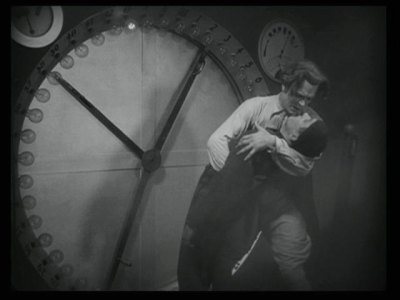
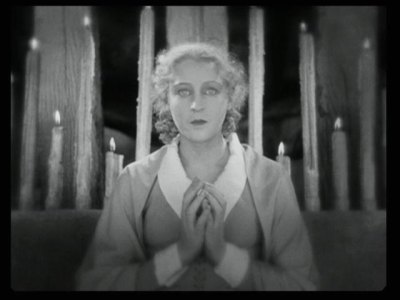
Freder (Gustav Fröhlich) is the son of the industrialist that constructed Metropolis, Joh Fredersen (Alfred Abel.) He has grown up in the lap of luxury, but one day Freder travels to the machine rooms under the city and sees for himself the misery that the workers have to endure. His pleas for these poor souls falls on deaf ears when he tells his father of the horrors he's seen, so Freder goes to the underworld again determined to help. There he trades places with a worker who is nearly fainting from exhaustion, and experiances true labor for the first time in his life. After the shift ends, Freder attends a secret meeting in some forgotten catecombs where Maria (Brigitte Helm) preaches a sermon of peace and understanding. She prophesies that a 'mediator' will come and be able to reconcile the elite who live above with the workers who toil below. Freder is so moved my Maria's speech and her beauty that he falls in love with her.
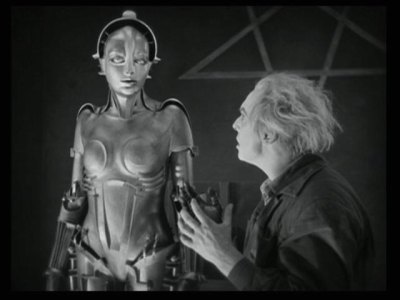
Meanwhile the scientist Rotwag (Rudolf Klein-Rogge) has perfected his latest invention, a mechanical man. He is an old rival of Joh Fredersen's and is planning on using the robot to bring down his enemy. Rotwag kidnaps Maria and uses her likeness as a template for the robot. He then sends the robot-Maria into the depths to entice the workers to revolt. Freder finds out about the plan, but can he save his love and the city?
There has been a lot written about this film over the years, and it has been analyzed and dissected more than it probably should have been, so I'll keep my comments to a minimum.
This restored version of the film works much better than a lot of the previous edits. A lot of things are explained, and the plot makes more sense and hangs together much better. The plot is still the weak link of the film though. While technically brilliant and gorgeous to look at, the story is a little too convoluted in parts, and has too many sub-plots, some of which are not fully developed. The love-at-first-sight gimmick that starts the movie moving was a little trite, and I never really felt any passion between Freder and Maria. If you can look past that, which is easy to do, this is an absolutely wonderful film.
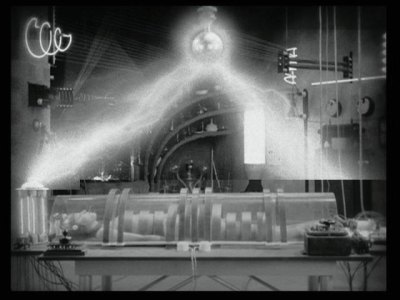
The visuals are still amazing after all these years. Some of the scenes are the most stunning and remembered images from the silent film era. Rotwag's laboratory would be the standard image of a mad scientist's lair's from then on, and would be remade in Frankenstein and countless other horror and SF movies. The scene where Freder sees a giant scene malfunction, killing several workers, is particularly striking too. As he stares at the carnage, the machine turns into a giant monster, with workers calmly walking into its giant mouth. Both the allegory and the images are quite profound.
The acting is good, but not outstanding. While not exuberant and overacted like some American films of the time, the actors did tend to put a little too much emotion into their performances. This is never comical or ludicrous, but a little more subtlety would have made the acting much better. Brigitte Helm does an excellent job playing the dual role of Maria and the Robot-Maria. Just by looking at her you can tell which role she's playing. Her body language tells it all.
Even with these minor complaints, this is on of the great German expressionist films. Lang was able to take the problems associated with the coming of the industrial age and address them susinctly without being preachy or taking one side to the exclusion of the other. He was able to comment on society while still creating a spellbinding movie, and that is something rare.
The DVD:
Audio:
This DVD comes with a newly recorded version of Gottfried Huppertz original orchestral score in both stereo and 5.1. This score is very powerful and matches the movie perfectly, adding a lot to the viewing experience. The fidelity was excellent, and the music was sound clear and clean with no hiss or other audio defects. A truly wonderful accompaniment to this impressive movie. There are subtitles in English, Spanish and French.
Video:
Unless new footage is discovered, this will be considered the definitive restoration of this film. Meticulous research was conducted to attempt to determine Lang's original vision for the film. Not only has the film been reconstructed, but the image has been restored to a near perfect state. Of course the image does vary some and a few sections had to be taken form inferior prints, but the vast majority of the movie is astounding. The contrast is excellent, and there are a wide amount of shades of gray. Though a few sections have a little grain to them, this DVD makes the film look better than it has since it was originally show.
Extras:
This disc is filled with some great bonus material. Starting off is a 43 minute documentary The Metropolis Case. This is the most fascinating extra on the disc and does a wonderful job of telling the film's history. Film historian Enno Patalas discusses the film's place in history and the featurette is filled with some wonderful production shots and includes some vintage interviews with those who worked on the film.
Enno Patalas also provides the commentary for the film. While this is filled with some very interesting facts about the film and generally enjoyable to listen to, Patalas does have the tendency to be a little dramatic in his description of the scenes and talks a little too much about what we should be feeling, rather than just filling us in on the background of the movie.
There is also a nine minute featurette on the restoration of the film, several still galleries, cast and crew biographies and some text pages about the film.
Altogether a very nice edition of an important film.
After Metropolis' financial failure, Lang created his own production company and turned his attentions to a simpler film. Looking back at his earlier successes, Lang created another suspense/action film in the mold of Dr. Mabuse: Spies. It was a good choice. Written by his wife, Thea von Harbou, who also penned the Mabuse film (and all of the movies in this set for that matter,) Spies is not as grand in scale as Lang's previous two films, but what he loses in grandeur he makes up for with style. Spies uses sparsely decorated sets and many closeups along with generally shorter scenes. While it may have been solely a money saving technique, Lang's decision to film in this fashion had wonderful results. The nearly empty sets have an abstract, minimalist feel to them which helps set the film's tone, and the frequent near shots give the film a sense of urgency.
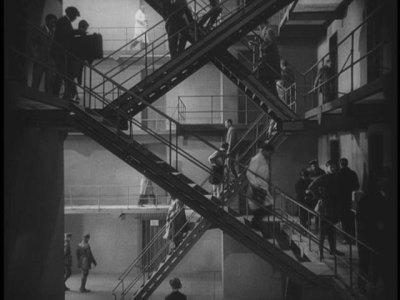
This film is usually show in a very truncated 89 minute version. (In the US, Rykodisc has released this edit of Spies on DVD.) This Kino DVD sports a beautiful restoration was done in 2003-2004 by Friedrich-Wilhelm-Murnau-Stuftung. No negative survives so this version was pieced together from three different 35 mm prints from film archives around the world.
According to Kino, with this 143 minute version the film is "at last restored to its proper length." This is a confusing statement though because there is also a 175 minute older restoration that was done by Munich Filmmuseum which has not been released on DVD. I have not seen the longer edit, so I don't know what extra scenes, if any, are incorporated into it. It could be that the longer version was shown at 20 fps and this restoration was projected at 24 fps, which would make up for most of the descrepancy. In any case, this DVD is still much longer than previously available editions of the movie by nearly an hour.
The Movie:
Set in the world of espionage between the wars, Spies deals with secrets, traitors, and megalomaniacal villains. The head of a large bank, Haghi (Rudolf Klein-Rogge who also played the master criminal in Lang's Dr. Mabuse and Rotwag in Metropolis) is a man who has an elaborate and thorough network of spies. He has stolen secret documents, had people killed, and has generally had the British Secret Service running in circles. To combat this outbreak of crime, the government puts one of their best spies on the case, Number 326 (Willy Fritsch.) Hagen knows of this man though, and assigns his best agent, the Russian Sonja (Gerda Maurus,) to seduce him. Sonja tries, but when she and 326 meet, they both fall in love.
With Sonja unable to betray her love, Haghi recalls the agent and keeps her under lock and key. Meanwhile, the criminal's latest plot involves trying to obtain a secret treaty that the Japanese and British have signed.1When he obtains it, the document still needs to be smuggled over the border. But 326 is on the trail of this mysterious mastermind, and getting closer all the time. Haghi promises Sonja to leave her lover alone if she'll transport the papers for him, but can a criminal mastermind be trusted?
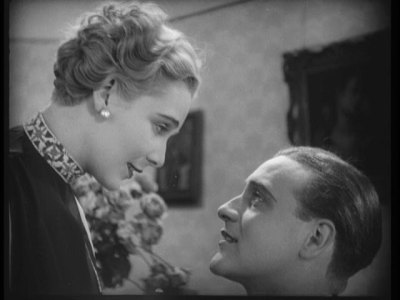
In a lot of ways, Spies is reminiscent of Dr. Mabuse, with its criminal mastermind and ordinary man trying to track him down. But this film also deviates from Lang's earlier works. It doesn't have any of the elements of fantastic cinema that some of his other films offer, instead he turns to the world of pulp fiction and fills the movie with train wrecks, hari-kari, motorcycle chases, spy cameras and double agents.
These elements make the movie very exciting and fun. The first two minutes of the film were masterful. It consisted of a quick series shots showing various government documents being stolen from different embassies and offices. It concludes with an agent running into his superior announcing that he knows who is behind all of the thefts, only to be shot dead before he can reveal anything. The inspector turns to the camera and exclaims "Almighty God - - What power is at play here?" Not only did this segment start the show off with a bang, it set the tone of the film.
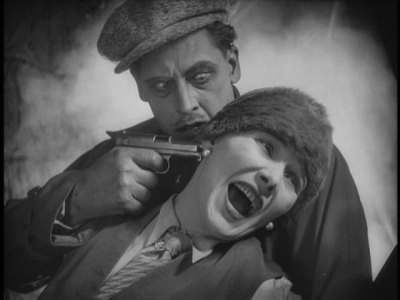
The ending of the picture was very exciting too. There were several suspenseful false endings with the heroes getting out of one jam only to fall into another. The last half an hour is filled with chases, gun fights and gas attacks, raising the tension and quickening the pace before ending abruptly.
The film itself contained many stunning visuals that Lang's silent films are noted for. There are a few expressionist touches included, with interesting camera angles and geometric images. Haghi's desk for example, with his wheel chair centered between the twin pillars holding it up, filled with rows of buttons and featuring a circular 24-hour clear plastic clock in the center looked futuristic and menacing at the same time.
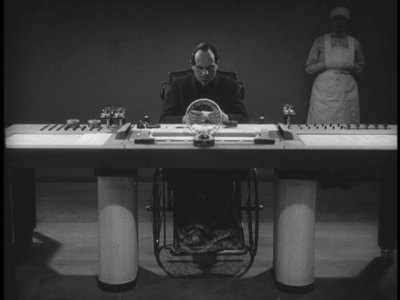
There were also a lot of interesting scene that were well crafted. The dead Japanese spies offering their packages that they failed to deliver to the ambassador was both eerie and sad. Another effective scene was the cross cutting of a female spy getting a string of pearls for stealing a document as the man she stole it from lays dying on a floor from a self inflicted wound.
The only qualm I have with this film, and it's a minor one, is that the pace does slow down in the middle of the film. After 326 and Sonja have fallen in love, it seems that the intrigue and mystery slow down a little. The film never gets boring or dull, but it does loose some of its momentum. The action packed climax makes up for this though and when all is said and done, Spies is an excellent thriller.
The DVD:
Audio:
The two channel soundtrack was composed and preformed by Donald Sosin. Sosin has also scored Ozu's 1934 A Story of Floating Weeds for Criterion and The Cabinet of Dr. Caligary for Kino. His score on this movie was just as good as those too. His music complimented the visuals on the screen very nicely, accentuating the suspense and drama. Sosin uses a synthesiser for this track with sampled instruments and it sounds like a small orchestra at times, making it feel much more full than a single piano. The audio track itself was very clear, thought there were a few seconds of his at the very beginning of the film that inexplicably had some hiss present. Aside from this slight error, this is a very good soundtrack.
Video:
The full frame video looks absolutely brilliant. This restoration is almost as good as the Criterion version of Passion of Joan of Arc. There were very few spots or dirt on the print, and no emulsion damage that I noticed. There was an occasional frame missing, but that was fairly rare. The image boasted many shades of grey with excellent detail and fantastic contrast. Digital defects were practically nonexistent and there wasn't any cross coloration, something that effects black and white movies frequently. A fantastic looking DVD.
Extras:
This disc also includes an image gallery of production photos and advertising for the film and a trailer for the 2002 reissue of Metropolis.
Final Thoughts:
1) Secret treaties were a cause of concern between the wars. One of the things that caused WW I to grow to the extent that it did was the confidential signing of treaties. When one country was attacked, these treaties would require other countries to join the fray and in no time most of Europe was engulfed in war. Because of this, secret treaties were used in spy films in the 20's the same way nuclear plans were used in the 50's and 60's. Return.
For his last silent movie, Lang settled on a realistic science fiction adventure. To make sure that everything was accurate, Lang with his wife and co-writer Thea von Harbou consulted rocket scientists on the fine details of space travel. The results were so accurate that when Nazi Germany started its V-2 program the Gestapo seized the models used in the film as state secrets. While not the most engaging film, 1929's Woman in the Moon (Frau im Mond) is often cited as the first accurate look at space travel.
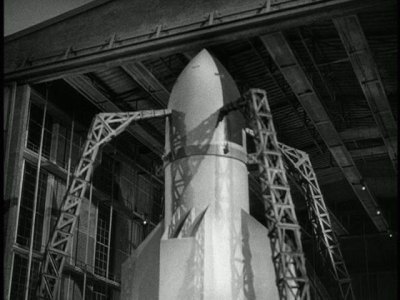
Wolf Helius (Willy Fritsch,) is an industrialist who is friends with a disgraced scientist, Professor Georg Manfeldt (Klaus Pohl.) Years ago the Professor hypothesised that there were abundant supplies of gold on the moon, only to be ridiculed and laughed at. Helius beleived him though, and has been building a rocket to travel to the moon.
Things don't go smoothly though, a group of rich business men who control the world's gold supply feel threatened by Helius' project, and steal all of his plans. They also bomb one of his hangers and promise more destruction unless their agent, the sinister Turner (Fritz Rasp,) is allowed to go on the expedition. Reluctantly, Helius' agrees and Turner is allowed on board along with Professor Manfeldt, the chief engineer, Hans Windegger (Gustav von Wangenheim,) and his fiancé Friede (Gerda Maurus.) But with Turner on board, and tensions between Hans and Helius running high, the trip does not go as planned.
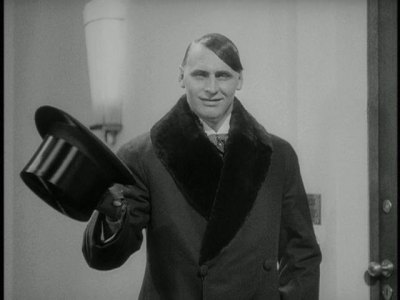
The most impressive thing about this film is how much they got right when it comes to space travel. They used a multi stage rocket propelled by liquid fuel and correctly discussed escape velocity and orbits of both the Earth and the Moon. They illustrated weighlessness during the flight, and even put weights on their shoes when walking on the moon. Many SF films from the '50's don't get that much right. Of course, there were some mistakes that shouldn't have been made, like the odd notion that the dark side of the moon has an atmosphere, although the bright side is airless. Even so, this is still an impressive movie as far as the science goes.
The problem I had with this film was that the plot moves at a very slow pace. With a run time of nearly three hours (169 minutes,) the film would have been much better if Lang had shortened it by about an hour or more. It's not that Lang put a lot of subplots in this film like he did in Metropolis, the problem is that a lot of the individual scenes last way too long. There are many scenes with people standing and talking for minutes on end. If this had been a sound film, that could be forgiven, and even expected, but in this movie the long conversations with few intertitles just make the film seem plodding. Even when they land on the moon, the most interesting section of the film, included a lot of shots of people walking across the whole frame while exploring. There's a good deal of excitement on the moon, but this is dulled by scenes that are held too long. Most of Lang's epic movies had a much better sense of rhythm and pace, but for some reason he lost his touch with this movie.
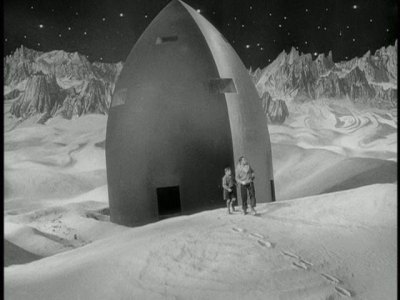
The film is saved by the visual images that Lang is famous for. The rocket ship, the caverns on the moon, and the moon itself are all wonderful to look at. It is unfortunate that you have to wait through the first hour and a half or so to get to them. Lang also includes an interesting montage in the beginning of the show: Helius is telling Windegger and Friede about his eventful evening. To illustrate what he's relating to his friends, Lang projects a series of images that represent what has already occurred. This is an effective use of shorthand and one place where the story doesn't get bogged down in detail.
While I did find this movie slow moving, I was still glad I saw it. While not as gripping as Spies, or as visually interesting as Metropolis, this movie is still an influential film that is well worth watching.
The DVD:
Audio:
The piano score is composed and preformed by the multi-talented Jon C. Mirsalis. It fits the movie well and Mr. Mirsalis does a very good job. The sound is clear and bright without any audio defects. There aren't any optional subtitles. The only complaint I had about the production of this DVD is that the English translations of signs and writings that are on screen are not removable. This isn't a big deal though, since most people would watch this with the subtitles on. It still would have been nice if they were optional.
Video:
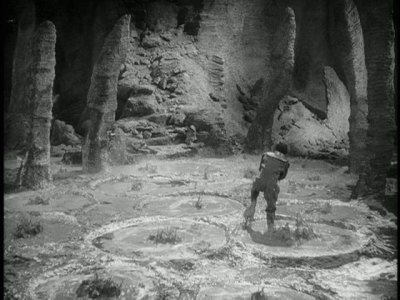
Ironically, this movie was showing its age more than the others in this set. The first 10 or so minutes have a fair amount of spots and a couple of vertical lines running the length of the screen. There are a couple of other scenes that are taken from lower quality prints, but only a couple, and they don't last very long. Aside from these sections, the film looks very good. The clarity is excellent, and the movie has a very good amount of detail and contrast. The image is a little grainy is several parts, and there are some infrequent spots and dirt, but this doesn't distract from the overall enjoyment of the film. Even thought this is the least impressive looking restoration in this set, they have done an excellent job and the film looks great. Only in comparison with the other films in this set does it pale.
Extras:
The only extra is a photo gallery of production stills and promotional material.
Final Thoughts:
This is a magnificent set. Four entertaining and significant silent movies by an important director all packaged together, what more could you want? The restoration that was done on all four films was excellent, making these look as good as they did when they were first shown 75 years ago. Kino has put out anther great collection of silent films. Highly Recommended.
|




| Popular Reviews |
| Sponsored Links |
|
|
| Sponsored Links |
|
|
| Release List | Reviews | Shop | Newsletter | Forum | DVD Giveaways | Blu-Ray | Advertise |
|
Copyright 2024 DVDTalk.com All Rights Reserved. Legal Info, Privacy Policy, Terms of Use,
Manage Preferences,
Your Privacy Choices 
| |||||||