
| Reviews & Columns |
|
Reviews DVD TV on DVD Blu-ray 4K UHD International DVDs In Theaters Reviews by Studio Video Games Features Collector Series DVDs Easter Egg Database Interviews DVD Talk Radio Feature Articles Columns Anime Talk DVD Savant Horror DVDs The M.O.D. Squad Art House HD Talk Silent DVD
|
 DVD Talk Forum |
|
|
| Resources |
|
DVD Price Search Customer Service #'s RCE Info Links |
|
Columns


|
|
|
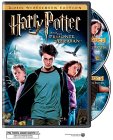
Harry Potter and the Prisoner of Azkaban
Harry Potter and the Prisoner of Azkaban has, in a way, the toughest challenge of any of the three Harry Potter films to date, in trying to live up to the merits of J.K. Rowling's book. The Sorcerer's Stone did a nice job of capturing the book's charm while introducing us to the characters and setting of Harry Potter's world, and The Chamber of Secrets even improved on the source material, making a highly entertaining adaptation of the weakest of the Harry Potter books. To me, though, The Prisoner of Azkaban stands out as the best of Harry Potter books yet published, combining a distinctly darker tone with a tense, tightly-plotted, often frightening story.
And overall, the film rises to the challenge. The film version of Harry Potter's third year at Hogwarts is not a totally smooth ride, but it's one that has enough punch in its story and enough surprises up its sleeve to more than make up for a weak opening. At this point, audiences know the characters and setting very well, so The Prisoner of Azkaban is able to focus on the engaging (and often rather frightening) plot to good effect.
The film is very faithful to the original book, which ironically is the source of the one real weakness of the film. The opening fifteen minutes or so of The Prisoner of Azkaban aren't handled well at all: we get what amounts to a scene of slapstick humor at the Dursley's home, complete with obtrusive theme music that sounds like it came out of a sitcom. While this is precisely how the book opens, on screen it plays out badly, seeming as though the filmmakers are deliberately catering to the youngest audience members rather than those who have "grown up" along with Harry Potter. Harry's eventual burst of temper and rebellion make sense in the book, since we're privy to his thoughts, but in the film, his actions seem abrupt and slightly out of character. All in all, it's a rather inauspicious start for what turns out to be an excellent film.
Fortunately, however, once Harry leaves the Dursleys, the film settles down to telling its real story, and one useful marker of how well it succeeds is that the nearly two-and-a-half-hour film doesn't feel nearly that long. While never feeling rushed, the story moves along at a brisk pace, with new events always unfolding, and with something always keeping us intrigued by what's going to happen next. Here, the film takes a more assertive tack with adapting the original book, to good result. For instance, the Quiddich matches that that take up a considerable share of the book, and which would have slowed down the film's storyline for no particularly good reason in the film, are cut down to a single scene and altered to incorporate a brush with the Dementors, serving to advance the plot.
All in all, The Prisoner of Azkaban is a nicely plotted film, with the various suspenseful threads dealing with Sirius Black, the fate of Buckbeak, and Professor Lupin unfolding in a very interesting manner, with some solid twists and turns toward the end of the film. As with the earlier films, we get some well-known actors in new supporting roles, but once again it's great to see how the actors immerse themselves in their characters. Emma Thompson is nearly unrecognizable in an excellent small role as the professor of Divination, and while Gary Oldman doesn't fit my own personal image of Sirius Black, he's spot-on for the way Rowling describes the character. Alan Rickman continues to be delightfully nasty as Snape, and Michael Gambon steps in with an admirable performance as Dumbledore, replacing the late Richard Harris.
The Prisoner of Azkaban is a film that relies heavily on CGI: there's hardly a scene that doesn't call for some sort of special effect, however small. What's really impressive, though, is the way that CGI seems to have grown up and taken its place as just another tool in the filmmaker's kit. All the magical effects and fantastical creatures in The Prisoner of Azkaban are there because the story, setting, or mood of the scene demand their presence... not because the filmmakers want to show off their cool CGI. The result is a feeling of "wholeness" to the film, and a sense that we've really stepped into Harry's world. When we meet Buckbeak, we share Harry's awe... but most importantly, we're awed because of the beauty and majesty of the creature in the story, rather than by the technological wizardry that created it. When we see the Marauder's Map, we're intrigued by its potential for mischief, not just by how cool it looks. (Well, to be honest, I also admired the technical wizardry behind these effects, but it's secondary and we're not drawn out of the film to do it.)
This is a film that's going to be a favorite of young viewers as well as adults, so I'll mention that parents will want to make sure to watch it along with younger (under 13 kids). While it's only rated PG, not PG-13, there are quite a few disturbing and frightening elements in the film, from the chilling Dementors to the appearance of a giant spider. This shift toward a darker tone is very effective in terms of the overall story, and it is well suited to the audience who has grown up with Harry Potter; it just means that younger siblings might find it quite scary.
The DVD
Harry Potter and the Prisoner of Azkaban is a two-disc set, packaged in a single-wide plastic keepcase. It's a different style of packaging than the first two films, but I'm glad to see the switch, since the plastic case stands up better to wear and tear and is easier to access.
Video
I'm pleased to report that Harry Potter and the Prisoner of Azkaban has an excellent transfer. The widescreen edition presents the film in its original theatrical 2.35:1 aspect ratio and is anamorphically enhanced.
The image is crisp and clean, with no noise or print flaws appearing anywhere; it's also a nicely detailed transfer, with only a slight amount of edge enhancement appearing in some of the more visually demanding scenes. Colors are handled very well; everything looks natural while also having a bright, vibrant feel. I did notice that contrast seems to be a bit on the heavy side, but I think that we're looking at an artistic decision to make the film, overall, look darker; dark scenes tend to have a lot of black areas, but there's always enough light and detail where it matters. All in all, we're looking at a very nice transfer that will allow you to sit back and thoroughly enjoy the ride.
Audio
The Dolby 5.1 soundtrack is, like the video transfer, handled very well, and it certainly adds to the enjoyment of the film. The "meat and potatoes" of the soundtrack is taken care of with crisp, clear dialogue and an effective balance of voices, background music, and special effects. It's the surround sound that gives the track its extra sparkle. Throughout the film, the side and rear channels are used very effectively to create a sense of immersiveness; on many occasions, the directional effects create the impression that you're really in the middle of things, which is particularly effective in the scarier scenes.
Dubbed Spanish 5.1 and French 5.1 tracks are also included, along with English closed captions.
Extras
Unfortunately, my first impression of The Prisoner of Azkaban on DVD was negative, thanks to a truly horrible menu design. The film begins playing automatically when it's inserted in the player, which is always annoying, but what's worse is trying to go to the main menu. There's a long animated menu opener, which gets a failing grade from me on two counts: 1) It contains numerous spoiler images from the film, and 2) It is not skippable. Navigating between sub-menus is also slowed down by the non-skippable animations.
Once you get past the menus, the bonus content is reasonable, if not mind-blowing. Disc 1 is mainly devoted to the film; the only special features there are a cast and crew list (just a list of characters and names, with no additional information) and trailers for the three Harry Potter films.
On Disc 2 we find the bulk of the special features. (Incidentally, viewers can choose to have the menus in either English or French.) In an example the kind of cutesy menu design that's been an affliction of the Harry Potter DVDs so far, the features are categorized not by their actual content, but by different areas of Hogwarts.
The most interesting material is found in the "Divination" section. First of all, five unfinished/deleted scenes are presented in "Trelawney's Crystal Ball," ranging from about 30 seconds to 2 minutes. They're in rough format, sometimes with blue-screens still in evidence, but will be of mild interest to fans. Next up in this section is "Creating the Vision," a 12-minute featurette that focuses on the overall making of the film and its adaptation from the book; we hear from director Alfonso Cuarón and J.K. Rowling, among others.
The most substantial single bonus feature is the "Head to Shrunken Head" featurette in the Divination section. This is actually a compilation of 43 minutes of interviews with cast and crew, in which the actors and crew members discuss their experiences with making the film. There's a "play all" feature, or viewers can select individual interviews with the "Heroes," "Gryffindors," "Slytherins," Lupin, Sirius Black, Dumbledore, Hagrid, the Dursleys, and the filmmakers (the director, the production designer, and the director of photography.) The actors are listed by their characters' names rather than their own, probably to help younger viewers who don't know the actors' names.
The "Great Hall" section is, in my opinion, a great waste of time, as all we get here are some rather lame DVD games, which incidentally contain quite a few spoilers, so it's best to avoid them until after seeing the film. "Catch Scabbers!" is a puzzle-type game in which viewers "help Crookshanks catch Scabbers," as the name implies, and "The Quest of Sir Cadogan" also asks viewers to help the knight complete his quest. "Choir Practice" is a rendition of the song from the film, played to a montage of clips from the film with the lyrics printed on-screen.
The "Defense Against the Dark Arts" section is likewise rather pointless. "Magic You May Have Missed" is a memory/observation game using clips from the film, and "Tour Lupin's Classroom" is just a 360-degree rendition of the room from the film that viewers can rotate through. The "Tour Honeydukes" section is even more pointless, as it's nothing more than another 360-degree room tour, this time of the sweet shop.
We finally get to some more interesting material once again in the "Hogwarts Grounds" section. Inside "Hagrid's Hut" there's a 5-minute featurette called "Care of Magical Creatures," which is an intriguing look at the animal trainers and the animal stars of the film. The 15-minute "Conjuring a Scene" is also quite interesting, as it gives us a look at the makeup and special effects that were used on characters like Sirius Black and Professor Lupin. Lastly, the "Hogwarts Grounds" section has a preview of the game based on the movie, and a link to DVD-ROM content.
Final thoughts
Harry Potter and the Prisoner of Azkaban is a worthy installment in the Harry Potter series of films, offering an entertaining, well-paced story and shifting quite effectively to a darker, scarier tone for the film. The DVD transfer is excellent, with great video and sound quality, and while the special features fall more on the "quantity" rather than "quality" side of the scale, there are still several features that will be worth watching for fans of the films. Overall, the film earns a "highly recommended" mark from me.
|



| Popular Reviews |
| Sponsored Links |
|
|
| Sponsored Links |
|
|
| Release List | Reviews | Shop | Newsletter | Forum | DVD Giveaways | Blu-Ray | Advertise |
|
Copyright 2024 DVDTalk.com All Rights Reserved. Legal Info, Privacy Policy, Terms of Use,
Manage Preferences,
Your Privacy Choices 
| |||||||