
| Reviews & Columns |
|
Reviews DVD TV on DVD Blu-ray 4K UHD International DVDs In Theaters Reviews by Studio Video Games Features Collector Series DVDs Easter Egg Database Interviews DVD Talk Radio Feature Articles Columns Anime Talk DVD Savant Horror DVDs The M.O.D. Squad Art House HD Talk Silent DVD
|
 DVD Talk Forum |
|
|
| Resources |
|
DVD Price Search Customer Service #'s RCE Info Links |
|
Columns
  


 
|
|
|
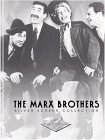
Marx Brothers Silver Screen Collection, The
The middle 1960s brought forth a wave of fan nostalgia that got major media coverage: Starting at the college level, Americans were rediscovering classic-era Hollywood greats like Humphrey Bogart. Mostly ignored for twenty years, 1930s movies had been reduced to mentions in the TV guide and jokes on The Tonight Show until the 16mm non-theatrical market boomed with students going crazy over Casablanca and other greats their parents hadn't bothered to tell them about.
Soon thereafter, college bookstores and head shops overflowed with posters of Bogart, along with legends Marilyn Monroe and James Dean. Campus hipsters reacting to counterculture trends flocked to the 30s comedians and their 'original mint' styles of rule-breaking humor: W.C. Fields, Mae West and perhaps most of all, The Marx Brothers.
Groucho had been a major hit on television, but before 1966 or so The Marx Brothers had all but slipped off the cultural radar. From that point on and until the advent of home video, a main memory for every college kid was being introduced to Groucho, Chico, and Harpo. Duck Soup became a rite of passage along with Janet Leigh's fateful shower and Charles Foster Kane's forgotten sled.
Universal's five-film, six-disc Marx Brothers set lines up their first run of features starting with two stage show adaptations and finishing with their increasingly sophisticated Hollywood pictures. The boxoffice flop of their acknowedged masterpiece Duck Soup got them bounced off the Paramount lot, and they were quickly snapped up by Irving Thalberg over at Metro.
| The Cocoanuts 1929 / 96 min. Co-Starring: Oscar Shaw, Mary Eaton, Margaret Dumont, Basil Ruysdael Original Music: Irving Berlin Written by Morrie Ryskind and George S. Kaufman Produced by Walter Wanger Directed by Joseph Santley and Robert Florey Monkey Business 1931 / 77 min. Co-Starring: Thelma Todd, Rockcliffe Fellowes, Ruth Hall, Tom Kennedy, Harry Woods Written by Arthur Sheekman from a story by S. J. Perelman, Roland Pertwee, W.B. Johnstone Produced by Herman J. Mankeiwicz Directed by Norman Z. McLeod | Animal Crackers 1930 / 97 min. Co-Starring: Lilian Roth, Margaret Dumont Written by Morrie Ryskind from the musical play by George S. Kaufman, Bert Kalmar & Morrie Ryskind, Harry Ruby Produced by Walter Wanger Directed by Victor Heerman Horse Feathers 1932 / 68 min. Co-Starring: Thelma Todd, Florine McKinney, David Landau Written by Burt Kalmar, Harry Ruby and S. J. Perelman Directed by Norman Z. McLeod |
Duck Soup
1933 / 68 min.
Co-Starring : Margaret Dumont, Louis Calhern, Edgar Kennedy, Raquel Torres
Written by Burt Kalmar and Harry Ruby
Directed by Leo McCarey
The Marx Brothers are 20th century American originals. Their nervy, lowbrow, smart aleck brand of Vaudeville comedy is pitched at and derives its power from the immigrant experience and the streets of New York City, and was formed when show biz was a working trade handed down from generation to generation.
The mother of Groucho, Harpo, Chico, Zeppo and Gummo (Gummo?) had to have been an amazingly strong woman to channel all that filial energy into performing acts. Just keeping them in line long enough to serve meals must have been a chore. Although their stage personae define total anarchy, it's obvious that the Marx boys were studious musicians and hard working performers. They started out as kids, but didn't hit the big time until the mid-1920s.
The Cocoanuts came out the same year as the St. Valentine's Day Massacre and the Wall Street Crash, making the Marx Brothers a Depression-era phenomenon. Synchronized-dialogue movies came along at the perfect time to cinch their success. Juggler and physical comedian W.C. Fields also benefitted from the ability to showcase his voice, but the Marxes were primarily verbal. They were the first big comedy stars of the talkies.
The twisted verbiage, out-of-control puns, elaborate insults, thinly-disguised dirty jokes and other dialogue stuntwork are all obviously adapted from years of work on stage before live audiences. The characters are masterfully drawn, and even the dumbest jokes become funny through clever delivery and timing, making excellent use of repetition and audience involvement. If the word "zany" existed before these guys, it can't have found its true meaning without them.
The few people I know that didn't like the Marx Brothers were older folks who thought them too vulgar, especially Groucho. To everyone else they're a riot, and their comedy hasn't dated. Every once in a while a topical reference will surface in their non-stop patter, but it all goes by so fast that it becomes a blur. 99% of the jokes are just as funny now as they ever were - and most remarkably - just as fast-paced as modern comedy. If anything, they're even faster.
The 'immigrant experience' evident in the films refers to what some might term lower-class comedy revolving around stupid foreigners, accents, language misunderstandings, and the bigoted notion that late-coming immigrants are clueless clods. The Marx boys play to these stereotypes and overturn them at the same time. With his 'dumb Italian' character, Chico in particular represents every good-hearted but frustratingly indecipherable immigrant. The boys are often penniless outsiders, party crashers and social misfits. For one film, they're actual immigrant stowaways. The main point is that although they never fit in with their Society surroundings, they prevail just the same. Groucho, Chico and Harpo get the last laugh while Zeppo gets the girl.
The Cocoanuts and Animal Crackers are creakingly literal filmings of original stage hits; we're told that on one of them the boys filmed during the day while performing on Broadway at night. They're not as primitive as some of MGM's 'dawn of sound' spectaculars - the ones where the camera was nailed down in the twentieth row and never seemed to move - but all the stage business is kept intact, right down to entrances from the wings and regular musical interruptions by leggy, chubby dancing girls. Everything is played to the missing front wall. The pacing drags with gags that are still timed for the stage. The movies are far too long but Animal Crackers has the edge musically - it has Groucho's terrific Hooray for Captain Spaulding number. The Marx Brothers themselves are fully developed, their stage characters apparently having found their optimal form years before.
Harpo is an infantile sprite in baggy pants who has to play all of his silent schtick off of straight men or one of his brothers. He's also a bonafide sex maniac, chasing blondes with complete abandon. His eyes widen and he's off in pursuit, like a dog after a bone. The objects of his attention often detect what's up and run for their lives even before he goes after them. Why he honks his horn at them isn't immediately understandable, but we do know he's easily distracted, especially if he passes another woman going the other way.
Chico reminds of every slippery foreigner we ever suspected of hiding behind the language barrier in order to take advantage. He's the master of the malapropism - no matter what he hears, he understands the words in terms of sound-alikes that make strange comedy sense. His Italian accent is the soul of un-PC stereotyping but without a hint of malice; Marxian insults and derogatory remarks are almost never mean-spirited. Chico is also the only Brother presented as having a normal menial job one might expect of an unskilled immigrant. Dumb he may be, but he's been here long enough to know that it's a lot more fun to ignore work in favor of plain having fun.
Zeppo is unfortunately along for the ride; he doesn't really have a role except to fill in when a handsome male ingenue is needed. Groucho, on the other hand, is a really complex character. He's a pompous pretender, charlatan, mountebank, you-name-it. He's the con-man that can fool the supporting cast of snobs and hypocrites only because they're so stupid. His insults and snide remarks are the most cutting because he's actually very intelligent, yet he continually outsmarts himself. He dances like a giddy clown and makes love as if playing the male and female roles simultaneously. Groucho's most frequent verbal gimmick works the same way - he talks so fast, he can act out not only his role but the person he's talking to - he's too impatient to wait for answers to his crazy questions so he fills them in himself.
The real fourth Marx Brother is Margaret Dumont, the perfect foil for Groucho's ham-handed insults and grinning romantic advances. She seems to have the memory of a gnat, reacting to vile insults and then letting them roll away without a shred of bitterness. And her girlish responses to Groucho's advances are a perfect match.
There isn't much intellectual humor in these first two pictures, but the writers and Groucho do attempt a truly bizarre take-off on Eugene O'Neill. At one point, Groucho brings up the author and then punctuates lines by stepping forward to the camera to perform strange little existential moments of drama. The effect is hilarious, even if it left a lot of the audience in confusion.
Monkey Business and Horse Feathers are film originals that make good use of Broadway talent that must have been emigrating to Hollywood on every train between 1929 and 1934 or so. As the scenes are conceived for film, they're a huge improvement. There aren't many special effects but clever use is made of crazy entrances and exits that become abstracted parodies of stage business, the kind of thing that would culminate in the packed stateroom gag in A Night At The Opera.
These first Hollywood productions also hold together better at the plot level. The gags are better organized than just one story thread (art thievery, hotel bankruptcy) broken up by arbitrary comedy routines and songs. There's at least some kind of story going on. Critic Andrew Sarris bemoaned the interruptions for piano and harp solos, but Savant always valued them as sort of a seventh inning stretch to let us recover from the onslaught of verbal jokes.
Horse Feathers is Savant's favorite piece of Marx madness, even though it doesn't have Margaret Dumont. The songs are the funniest, with the ditty Everyone Says I Love You seeming somehow the perfect Paramount tune of the time. The college satire is terrific, split between academic pigheadedness (Whatever It Is, I'm Against It!) and the old throw-the-big-game cliché. Thelma Todd's college widow is a sexy pre-code charmer and if you look closely there's quite a bit of risqué petting going on. For this reviewer Groucho is in his finest form, with his best gag the bit where Todd makes her voice go baby-doll, like Betty Boop.
Todd:"If Icky baby don't learn about the football signals from the big stwong man, Icky baby gonna cry!"
Groucho: "If Icky girl keep talking that way big stwong man gonna kick all her teeth right down her thwoat!"
Film aesthetes favor Duck Soup, the only Marx Brothers film that puts intellectual ideas right out in the open. As not even Groucho came out from behind his stage persona in most interviews, there was no stated intention to make an anti-war film, but that's exactly what Paramount got - a satirical look at international politics dominated by petty madmen willing to wind up a giant patriotic war machine over nothing at all. Big musical numbers (with wonderfully sloppy choreography) mark "Freedonia's" decision to fight and celebrate the undying appeal of armed hostility, while the Marx Bros. lead the chorus in a gospel chant of "All God's Chillun's Got Guns," or play a line of helmeted guards like a giant xylophone. Margaret Dumont is back as the only sane person in the film, working for peace while Groucho's mad high minister continually insults the foreign minister of "Sylvania," played by The Asphalt Jungle's Louis Calhern. 1
Duck Soup is also a movie officially exalted by the surrealists. Yep, this comedy is up there with absurdist intellectual prank pictures like Luis Buñuel's L'Age d'Or. Choosing such a serious subject for its satire is the obvious source of appeal. But I can't help but think that the French critics and artists that championed the film couldn't have followed its lightning-fast dialogue and were assessing it as being more abstract than it actually is. The non-sequitir war sequence at the end, with the boys changing uniforms between eras between every shot must have excitied the dadaists, but Duck Soup is really a lot more straightforward than that. At its best it has some sublime clowning, like the celebrated mirror sequence.
Universal's disc set of The Marx Brothers Silver Screen Collection is an excellent buy, to say the least; with the usual discounts available the individual movies come down to as little as seven or eight dollars each. The transfers vary but in general are good. What flaws are there, are the result of past neglect, not bad restoration work.
These are all Paramount films that became MCA property in the late 40s. The story I was told, by a frustrated Universal film transfer producer, is that Paramount simply hired an outside company to make new duplicate negatives for all the features to go to Universal. For each nitrate title in their library, a couple of new printing negatives were made in a process not far removed from a "one setting fits all" assembly line. The sources for the new safety negatives weren't carefully chosen.
In most cases these cheap dupes are all that has survived. All the printing materials that might have existed, including alternate versions, odds and ends and copies that might be in better condition, were destroyed in a massive house-cleaning, recycled for the cellulose nitrate or just dumped.
For the average Paramount picture, attempts at restoration can be stymied when the only existing dupe negative has flaws, or is just too dark, or the audio sounds distorted or dupey. And there's nothing else. Hard digital work can pep these materials up for video presentations, but an awful lot of these films just can't be reconstructed for decent theatrical showings.
Fortunately, most of the Marx Brothers films look very good on video. The only feature in this set that really suffers is The Cocoanuts. A big chunk of it, more than a couple of reels, looks like a public domain copy. It's obvious that decent replacement footage just wasn't available. The rest of the shows are surprisingly intact, with robust audio. There's only one scene in Horse Feathers that suffers. It's when Groucho and the boys make a shambles of College Widow Thelma Todd's boudoir, with Harpo bursting in at regular intervals to toss iceblocks out the window. There are at least five big splices that clearly are covering up lost frames - I don't think any censorship is involved. I remember the same damage in the same places on the UCLA Film Archive's original print back in the early 70s ... I suppose that it's possible that it came off the same negative, or that the actual transfer we're seeing is from the UCLA copy!
The movies are wonderful, but the boxed set is a bit perplexing when it comes to extras. There are some trailers on the individual discs (which, by the way, drop fancy animation to get right to the important "play" menu) but an entire sixth disc has been set aside for supplements, of which there are less than twenty minutes' worth. They're three excerpts from appearances on The Today Show. An elderly but still silent Harpo shows up to plug a book, and chases a girl around the studio table, from 1961. Then in 1963, Groucho comes on to plug his book, and demonstrates his leering walk by following one of the show's hostesses, who seems mortified. He tells a short story about Marilyn Monroe, and gets interrupted for a commercial break before he can tell a story about his brothers' cheating at cards. That's the end of the piece, as we never come back from the station break. Finally, Harpo's son William joins Gene Shalit in 1985 and shows about 30 seconds of nice home movies. This segment is as short as the others. Seeing how much empty space must be on the disc makes us think that some licensing deal for a longer docu must have fallen through at the last minute.
The 'spectacular' 40 page Collector's Booklet has a lot of pictures and some tame text about the comedy team and is bound into the book-like folding disc case. These new packages unfold like packets of surgeon's tools in old movies, and I'm always afraid I'm going to kick it onto the floor, or otherwise harm it. But the marketers know how an attractive-looking gift box can boost Christmas sales.
On a scale of Excellent, Good, Fair, and Poor,
The Marx Brothers Silver Screen Collection rates:
Movie: Excellent
Video: Good + to Good -
Sound: Excellent
Supplements: Three Today show interviews
Packaging: six discs in folding card and plastic case
Reviewed: December 4, 2004
Footnote:
1. Can't resist - after most every Kindergarten-level Presidential announcement about war I see on television, I can hear an invisible chorus raising their arms in song: "Hail, Hail Freedonia, land of the bra-ave and fre-ee!"
Return
| |
|



| Popular Reviews |
| Sponsored Links |
|
|
| Sponsored Links |
|
|
| Release List | Reviews | Shop | Newsletter | Forum | DVD Giveaways | Blu-Ray | Advertise |
|
Copyright 2024 DVDTalk.com All Rights Reserved. Legal Info, Privacy Policy, Terms of Use,
Manage Preferences,
Your Privacy Choices 
| |||||||