
| Reviews & Columns |
|
Reviews DVD TV on DVD Blu-ray 4K UHD International DVDs In Theaters Reviews by Studio Video Games Features Collector Series DVDs Easter Egg Database Interviews DVD Talk Radio Feature Articles Columns Anime Talk DVD Savant Horror DVDs The M.O.D. Squad Art House HD Talk Silent DVD
|
 DVD Talk Forum |
|
|
| Resources |
|
DVD Price Search Customer Service #'s RCE Info Links |
|
Columns
  


 
|
|
|
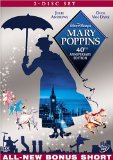
Mary Poppins 40th Anniversary Edition
By the time of Mary Poppins Walt Disney had been making live-action films of all kinds for ten years. He'd conquered television and the big screen with just about every kind of picture suitable for family audiences. The economics of animated films had slowed his cartoon feature output considerably. Mary Poppins became his last, best entertainment project; one of the most popular films of its time, it showed the Disney organization capable of putting on a show equal to anything in the industry. It presented the enormously talented Broadway star Julie Andrews in her first movie, forever associating her and Dick Van Dyke with children's fare. The family-film genre often reached no further than cute animals and mechanical sentiments, but the Disney team's keen story sense, musical and ease with whimsical magic brought class and charm to yet another children's classic.
Disney's 40th Anniversary Edition of Mary Poppins has so much entertainment value, it's hard to believe it's nearly two hours and twenty minutes long.
I'm convinced that Mary Poppins is a superior picture, but my opinion is clouded by the fact that it completely charmed me when I saw it at about the age of thirteen. I was just young enough to respond to its visual imagination in the perfect spirit. Everything about it pulled me in and it wasn't until I saw the movie as an adult that I realized that Dick Van Dyke played a second role in old-age makeup.
Already known to theater and musical fans, Julie Andrews sprung up as the best Disney actor ever, embodying every known virtue plus the added benefit of being English. Disney had returned time and again to English settings for his movies - he seemed to imagine the British as more civilized and 'special', a midwesterner's idea of the exotic.
Buttressed by a great score of catchy ballads and ersatz music hall songs, Mary Poppins also has some deeper melodies that change its mood radically from scene to scene. The principal cast enjoys a fantastic trip to an animated world inside a sidewalk chalk painting, but there is also a strangely reverent song about feeding the birds, played out against a background of atmospheric matte paintings. A trip to Uncle Albert (Ed Wynn, not the "We're so sorry" Uncle Albert) finds us in a hilarious musical scene where laughter is its own motivation and its own reward.
Mary Poppins 'gets it right' in just about every aspect. The cute Banks children (Karen Dotrice & Matthew Garber) have actual personalities, which is more than can be said for the little blonde ankle-biters in Chitty Chitty Bang Bang. Mother (Glynis Johns) is an addled suffragette, leading the housekeepers in chants for militancy (!) while seeing off the previous nanny, a washout (Elsa Lanchester). Father (David Tomlinson) is an annoying prig but a nice guy too, who merely needs to appreciate his family as being more than just a token of his status as a bank executive. 1
The Banks's little neighborhood is a mixture of stereotyped eccentrics given a veneer of storybook stylization. Admiral Boom (Reginald Owen) sets off a cannon to mark the time, a daily house-shaking event that all accept as business as usual. Off by the park entrance, the sweep Bert (Dick Van Dyke) makes chalk artwork and busks the crowds with songs that imply that he intuits a deeper, more magical reality afoot in London.
Disney's screenwriters and musicians prepare a terrific entrance for Mary Poppins, drifting down from the stratosphere by benefit of a magical umbrella to answer a small child's warrant for a suitable, agreeable nanny. A dozen other nanny wannabes waiting outside the Banks house are blown away in the breeze like so many Fantasia pachyderms. Poppins retains a mysterious and unexplainable aspect throughout the picture. The first words said about her are to wonder that she might be a witch. Poppins has only to assert herself to seize the job. She makes almost no contact with the adults of the family while dazzling her moppet charges with feats of everyday magic - sliding up the bannister, cleaning a room by snapping her fingers, singing a duet with a robin.
Every episode is different and none are predictable. Poppins hersefl seems to be unflappable, providing an entertaining security blanket of reliable efficiency. The kids have their spirits lifted, while the real problem in the family, the wet-blanket father, undergoes the most change by realigning his priorities so that just flying a kite (as suggested early on by Arthur Treacher's dour constable Jones) becomes an important bonding ritual. Poppins' purpose is only then made clear; with another family cured, she prepares to depart as mysteriously as she came. She's rather the Lone Ranger of domestic servants.
Why does Mary Poppins succeed where so many other family films fail, even many from Disney? The answer is commitment. Walt Disney made this film the way he tackled other big personal projects, like his earlier animated classics, Disneyland or his first live-action film 20,000 Leagues Under the Sea: Making a commercial entertainment was never allowed to supercede making a superior one. The development time of two years was used for a lot more than having a screenwriter tinker with a script. Disney was able to juggle twenty projects at a time, while having various departments of his studio attack a single project from multiple angles simultaneously. Art was being designed and songs written long before the plotline was nailed down, in many cases influencing the direction of the story. The artists didn't waste money, but if Disney wanted to make major changes halfway through a show, the expense didn't matter. Last-minute studio rescue jobs on ailing films rarely worked, but Disney's changes were almost always beneficial. Knowing their best efforts would be appreciated, his artisans continually outdid themselves. I know plenty of Hollywood artist-technicians; all they ever ask is to contribute to something, for their work not to be wasted.
Mary Poppins ends up being as satisfying for adults as it is for little kids. Director Robert Stevenson made plenty of good movies before, and this is probably his best Disney film.
Disney's DVD of Mary Poppins will please just about everyone. The transfer itself is bright and colorful with a lot of hue correction over older discs. The enhanced image is dirt-free and I only noticed a couple of instances where pixels appeared to be doing strange things in tiny details - and those might be the result of special effects. Mary Poppins always had fat matte lines in some of the complicated optical sequences and they haven't been eliminated - it doesn't look as though the film has been digitally repainted as has been complained about some earlier cartoon efforts on DVD. There is evidence of image enhancement - at least I think that's what it is - in characters' teeth. On some other DVDs such as the musical Star!, Andrews appeared to have a mouthful of broken porcelain. Although not as pronounced as that, closeups of teeth here have strange silvery patches, while longer shots lean toward the Bruce-the-Shark look.
The audio options are a remixed 5.1 track, and an original 2.0. The 5.1 appears to have taken liberties with the original sound design - they put a thick dull reverb on all the orchestration, and added a big slap in the rear channels, but kept the dialogue and vocals relatively bright. And then they added a lot of sweeteners and foley. There's wind noise under the opening bars, and Mary Poppins' bag now thumps when she places it in the clouds.
One very happy change in Disney DVDs in the last year or so is the menu structure. Some promos do pop up at the front, and they're a nuisance, but getting to special extra content no longer means waiting through long animated passages while doors and curtains open, etc.
The extras here are a fine bunch. The new making-of docu is quite good and uses many new transfers of outtakes and incomplete travelling matte material. There is also an entertaining new featurette in which composer Richard Sherman takes us through the development of the songs for the film. Only fourteen of the thirty-two or so written were used, and the leftovers found their way into many another Disney production. Sherman also has a piano-side sitdown with Julie Andrews and Dick Van Dyke; they're so professional with their performances, it will probably play to some as unscripted. Neither Sherman nor Van Dyke ask Ms. Andrews about her decidedly less prim and proper appearance in the later S.0.B., understandably - this is the straight Disney Version of film history. There are no filmmakers attributed by name to the snappy, fun extra docus, which doesn't bode well for making careers in this corner of the business.
A song called Chimpanzoo is reconstructed from concept art; there's a special effects featurette and a new cartoon-live action short subject effort with Andrews that's markedly short of magical feeling. The rest of the galleries have plenty of errata, archival film clips and games for kids. A very nice package indeed.
On a scale of Excellent, Good, Fair, and Poor, Mary Poppins rates:
Movie: Excellent
Video: Excellent
Sound: Excellent
Supplements: Commentary by actors Julie Andrews, Dick Van Dyke, Karen Dotrice, composer Richard Sherman, and archival recordings from others including Walt Disney; The Cat That Looked Like A King new animated short; Supercalifragilisticexpialidocious: The Making of Mary Poppins - new 50-minute documentary; Deleted song Chimpanzoo; A Musical Journey with Richard Sherman; A Magical Musical Reunion with Julie Andrews, Dick Van Dyke and Richard Sherman; Sing Along Songs; Deconstruction of a Scene: Jolly Holiday & Step In Time; Special Effect featurette; Dick Van Dyke Make-Up Test; The Gala Movie Premiere, trailers, stills, publicity & art galleries, I Love to Laugh Set Top Trivia Game, Pop-up Fun Facts Track
Packaging: Keep case
Reviewed: December 12, 2004
Footnotes:
1. Although the music is of course excellent, I prefer Mary Poppins by far to Julie Andrews' The Sound of Music. There's something false about the whole setup in that musical, with nanny Julie effectively stealing Christopher Plummer away from his fiancée by charming his children. The way the nuns and the Nazis are used veers dangerously close to bad taste; the Germans seem to be evil more because they threaten Andrews' new family than for any other reason. And what about Plummer, a naval officer? Austria, as Mad Magazine pointed out in its lampoon 40 years ago, is a landlocked country. Could our Edelweiss-singing daddy have his commission with .... hmmmmmm ..... Hitler? (I know these issues are straighter than that in the movie proper - but these are the impressions the movie's always given me.)
Return
| |
|


| Popular Reviews |
| Sponsored Links |
|
|
| Sponsored Links |
|
|
| Release List | Reviews | Shop | Newsletter | Forum | DVD Giveaways | Blu-Ray | Advertise |
|
Copyright 2024 DVDTalk.com All Rights Reserved. Legal Info, Privacy Policy, Terms of Use,
Manage Preferences,
Your Privacy Choices 
| |||||||