
| Reviews & Columns |
|
Reviews DVD TV on DVD Blu-ray 4K UHD International DVDs In Theaters Reviews by Studio Video Games Features Collector Series DVDs Easter Egg Database Interviews DVD Talk Radio Feature Articles Columns Anime Talk DVD Savant Horror DVDs The M.O.D. Squad Art House HD Talk Silent DVD
|
 DVD Talk Forum |
|
|
| Resources |
|
DVD Price Search Customer Service #'s RCE Info Links |
|
Columns
  



 
|
|
|
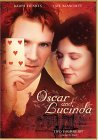
Oscar and Lucinda
It's hard to figure out what angle the 1997 film Oscar and Lucinda is coming from. At times it's a love story, and at its most romantic it's engaging and touching. But it goes off-track in strange and unexpected ways that don't always add to the film.
Starting in the mid-19th Century, the film follows two independent thinkers as they grow in wildly different environments: Oscar Hopkins (played as an adult by Ralph Fiennes) is raised by his ultra-conservative father, a minister in a Christian order called The Brethren. He's forbidden from simple pleasures like Christmas pudding ("The food of Satan," according to dad) and eventually leaves his path up to God, when he essentially creates a game of chance to choose a religious direction. When one toss of a pebble after another comes up Anglican he leaves his father's home and joins the parish of Hugh Stratton (Tom Wilkinson).
Eventually he finds himself in college, living by very limited means. "Odd Bod," as his classmates teasingly call the awkward student, discovers that he has an unusual aptitude for gambling and soon he's betting on anything: Horses, dice, cards, dogs, anything that gives odds. He keeps only what he needs and gives the rest to charity.
Meanwhile, Lucinda Leplastrier (Cate Blanchett as an adult) lives on a farm in remote Australia, happily communing with nature. When her father dies her mother reveals a desire to move back to England, but they stay in Australia until Lucinda's mother dies as well, selling off their farmland and leaving the young woman a pretty impressive inheritance. She moves to Sydney and buys a glass factory. Lucinda, like Oscar, finds that she enjoys gambling and excels at taking other people's money. In her case it's extra shocking thanks to the prevailing notion that gambling is for men (although not much is made of this concept.)
Oscar and Lucinda don't cross paths until about 40 minutes into the film but when they do there is mutual curiosity: Lucinda invites the terrified Oscar to her oceanliner room to take her confession (Oscar is scared of the sea thanks to childhood trauma) and they discover their shared love of gambling. When they return to Sydney, the pair develops an interesting connection and the film avoids standard Hollywood cliche. The characters are rich, complex adults who discover more about themselves as they grow closer to each other.
But then the film veers off on a weird tangent that it never really returns from: Oscar has the idea to build a glass church and deliver it to Lucinda's old business advisor at his new post as pastor of a remote church. Lucinda doesn't think he can do it over the rugged landscape and he won't take a ship, so they bet their mismatched inheritances on it. This weird turn combines every thematic element in the film (glass, religion, the ocean, and gambling) but I'm not sure to what end. Suddenly what has been a slow-building romantic drama becomes a weak remake of Fitzcarraldo complete with an impossible journey, surreal imagery (the glass church floating on a raft) and the cruel murder of Aboriginal natives. This plot also introduces the film's first boo-hiss villain, a striking bit of characterization that seems out of place in a film that otherwise has shown the inner strength in some pretty unsympathetic characters.
This left turn also separates Oscar and Lucinda in a way that kills the momentum of their relationship. It's a shame since both Fiennes and Blanchett had been doing such beautiful work together until that point. Fiennes, who was best known until then for his frightening performance in Schindler's List, displays an incredible ability to play a youthful, innocent, nervous young man. He has a real spark as Oscar and is as different from Schindler's List's Nazi officer and Strange Days' jaded cyber-punk as can be. And Blanchett, in her first major role, really shines. Her energy is infectious, as is her smile. Lucinda is a free-spirit, uninterested in what society tells her a woman can do, and Blanchett makes this charming, energetic woman absolutely real.
But these fine performances (and director Gillian Armstrong's beautiful direction) aren't served by a script as focused as it could have been. Somewhere in this story (and perhaps in Peter Carey's original novel) is a complete tale of love between two people who understand each other better than anyone else in the world, but Oscar and Lucinda gets too distracted to fully explore that story.
VIDEO:
The anamorphic widescreen video is quite beautiful. It's not razor-sharp (it's a touch soft) but the colors are true and the transfer is clean. For such an inexpensive release it's very nice looking.
AUDIO:
The Dolby Digital 5.1 soundtrack is mostly clear. Some of the dialog is a bit soft, but it's fine. The surrounds are used sparingly: This isn't a blaring mix, but it's nicely done. There is also a stereo Spanish track as well as subtitles in English, French and Spanish.
EXTRAS:
Just a trailer.
FINAL THOUGHTS:
Oscar and Lucinda is a film with a few too many metaphors and a few too many plot threads (there are a number of subplots that I didn't even mention) that ultimately outweigh the tender love story at the core. Still, there is a lot to enjoy about the central story, from the rich characters to the fine performances. Fans of the film's stars must see the film and anyone interested in quiet, thoughtful films should give it a shot.
|



| Popular Reviews |
| Sponsored Links |
|
|
| Sponsored Links |
|
|
| Release List | Reviews | Shop | Newsletter | Forum | DVD Giveaways | Blu-Ray | Advertise |
|
Copyright 2024 DVDTalk.com All Rights Reserved. Legal Info, Privacy Policy, Terms of Use,
Manage Preferences,
Your Privacy Choices 
| |||||||