
| Reviews & Columns |
|
Reviews DVD TV on DVD Blu-ray 4K UHD International DVDs In Theaters Reviews by Studio Video Games Features Collector Series DVDs Easter Egg Database Interviews DVD Talk Radio Feature Articles Columns Anime Talk DVD Savant Horror DVDs The M.O.D. Squad Art House HD Talk Silent DVD
|
 DVD Talk Forum |
|
|
| Resources |
|
DVD Price Search Customer Service #'s RCE Info Links |
|
Columns
  


 
|
|
|
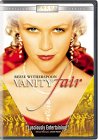
Vanity Fair
There's something about a lavish period film, one with plenty of gorgeous costumes and exquisitely designed sets, that seems to suggest that it ought to be good. Unfortunately, the reality of Vanity Fair is that it is simply a long, muddled mess, and the only effect of the lavish visuals is to sucker the viewer into sticking it out through far too much of the bloated 141-minute film.
Vanity Fair gets off to a rocky start, with a series of abrupt transitions from one time and place to the next, with little indication of a connecting thread apart from the presence of Becky Sharp. We see her as a little girl with her father, then suddenly she's an orphan and apparently working as a maid, and then before we can quite figure out her situation, she's grown up into a young woman (now played by Reese Witherspoon) at the same school... except that she's suddenly a student apparently on equal standing with the other girls, not a servant. There's no time to puzzle that out, though, because Becky is swiftly swept away to yet more circumstances: first her best friend's family, then the impoverished gentry for whom she's a governess. And so it goes...
By the third or fourth sudden change of scene, I had come to the conclusion that Vanity Fair was going to be more or less a picaresque story, with Becky encountering various different people and situations as she attempted to climb her way up the social ladder. With that impression, I didn't even bother trying to keep track of the maddeningly large and poorly introduced cast of secondary characters... only to find that some of them (though certainly not all) turned out to be recurring characters after all. That by itself is a serious blow against Vanity Fair; adequately presenting who's who is essential to a film that pretends to deal with intrigue and complicated relationships, and Vanity Fair fails miserably on that count.
If it were just the opening sequence of the film that jolted viewers around, it might be possible to get over it, but Vanity Fair continues to feel choppy and poorly paced throughout its running time. We get even more jumps in time, sometimes over a number of years (yet somehow none of the characters ages so much as day over the course of decades), with little rhyme or reason in terms of narrative or character development.
Vanity Fair is just as much a one-character story as something like Moll Flanders, even if Becky Sharp doesn't get billing in the title. Because of that, the weight of the film really falls on the shoulders of the actress in that role. I wasn't a big fan of Reese Witherspoon coming into this movie, but neither did I particularly dislike her. After seeing her here, I'd say that she really wasn't up to the task that Vanity Fair sets her. She tries to give emotional depth to Becky, but it all feels forced; it seems like she's most comfortable in the scenes that ask her to do nothing more than prance around and look pretty. Her British accent, while not the worst I've ever heard, certainly has its moments of inauthenticity as well. Was she really the best choice for the role? I don't think so.
The rest of the cast suffers from their characters getting lost in the shuffle. The mis-handling of characters at the beginning of the film is carried through the rest of the film: Vanity Fair is crowded with characters and their sisters, brothers, aunts, cousins, fathers, and so on, all of whom intrude upon the story enough to muddle things up and complicate the story, and none of whom actually seem to matter all that much in the big picture. Rhys Ifans is really the only actor in Vanity Fair who seems to be putting something of substance into his performance, beyond dressing up in period costume, but his decent performance is wasted here.
What it really comes down to is that Vanity Fair has had its fangs pulled: from William Makepeace Thackeray's original novel, Becky Sharp is supposed to be a schemer, willing to do anything to get what she wanted, backstabbing and going for revenge with gusto. Here, Becky is an almost passive character, being drawn from one circumstance to another without much energy on her part. Eventually we get the sense that she's supposed to be a bit of a schemer, trying to make her way into an upper class that she's excluded from by birth, but frankly this idea comes more from comments that the other characters make about her, than from her own actions. It's hard to even tell the difference between what Becky does in the hope of gain, and what she does for genuine love; it all comes across as simply "things that happen" and nothing more. It's no surprise, then, that the dramatic developments in the film, like the outbreak of war, feel equally flat. Becky is too sweet, too one-dimensionally kind and good, to be interesting as a character. If there'd been a bit of a love/hate relationship between viewers and Becky here, it would have given the film a bit of much-needed bite, but let's face it: she's bland, no matter what circumstances she finds herself in. And so too is the film as a whole.
The DVD
Video
Vanity Fair appears in an anamorphic widescreen transfer that presents the film in its original 2.35:1 aspect ratio. The image quality is satisfactory, with colors looking consistently vibrant and natural, and the print appearing free of noise or flaws. Edge enhancement shows up in some scenes, and contrast is a bit on the heavy side at times, but overall it's an attractive transfer that does justice to the visual appeal of the film.
Audio
The Dolby 5.1 soundtrack handles the film's audio needs quite well, with a generally clean sound and a satisfactory balance between the musical score and the other elements of the track. Some surround sound is used, and the overall sound is pleasing to the ear. A dubbed French 5.1 track is also included.
Extras
The commentary track from director Mira Nair will interest any viewers who actually liked the film; there are some silent moments but she offers a reasonably interesting perspective on her choices in making the film. The other main special feature is a 14-minute set of deleted scenes. The two featurettes, "Welcome to Vanity Fair" (11 minutes) and "The Women Behind Vanity Fair" (9 minutes) are complete promotional fluff and not worth wasting your time on.
Final thoughts
Vanity Fair is a film that only die-hard fans of Reese Witherspoon are going to like. Poorly structured, badly paced, with bland, one-note characters and a complete lack of an engaging narrative, Vanity Fair really only has its lavish costumes and sets to fall back on for viewer appeal, and that's just not enough. Skip it.
|



| Popular Reviews |
| Sponsored Links |
|
|
| Sponsored Links |
|
|
| Release List | Reviews | Shop | Newsletter | Forum | DVD Giveaways | Blu-Ray | Advertise |
|
Copyright 2024 DVDTalk.com All Rights Reserved. Legal Info, Privacy Policy, Terms of Use,
Manage Preferences,
Your Privacy Choices 
| |||||||