
| Reviews & Columns |
|
Reviews DVD TV on DVD Blu-ray 4K UHD International DVDs In Theaters Reviews by Studio Video Games Features Collector Series DVDs Easter Egg Database Interviews DVD Talk Radio Feature Articles Columns Anime Talk DVD Savant Horror DVDs The M.O.D. Squad Art House HD Talk Silent DVD
|
 DVD Talk Forum |
|
|
| Resources |
|
DVD Price Search Customer Service #'s RCE Info Links |
|
Columns
  


 
|
|
|
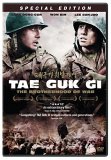
Tae Guk Gi - The Brotherhood of War
If you only watched the first few minutes of Tae Guk Gi: The Brotherhood of War, you'd be excused for thinking that it's a clone of Saving Private Ryan. We get the same modern-day framing device with the old character at a grave, the same sappy music reminding us that it's an emotional moment, the same flashback to the war with all its horrors. Fortunately, once Tae Guk Gi settles into its stride, it becomes clear that it's very much its own film. It's part of the genre of war films, to be sure, but it has its own story to tell, and it tells it reasonably well.
Tae Guk Gi is the story of Jin-tae and Jin-seouk, two brothers from South Korea who are drafted into the Korean War against their will. Jin-tae is determined to protect his younger brother and get him sent home, but as time goes on and the brothers deal with the experience of the war in different ways, it becomes apparent that nothing will turn out the way any of them expect or hope that it will.
What impressed me most about Tae Guk Gi is how it refuses to take a simplistic approach to the subject matter. As the story opens and the brothers are first thrust into the fighting, there's a definite sense of the "good South Koreans" versus the "bad North Koreans": after all, the former are fighting to defend their country, preserve freedom, etc. The two brothers are cast as innocents in a terrible situation out of their control, trusting to their love for each other and their family to pull through. Sounds like typical feel-good patriotic stuff, doesn't it? Just hold on.
As we follow Jin-tae and Jin-seouk through their experiences, it becomes more and more apparent that the line between good and bad, oppressed and oppressor, is not just blurred, but entirely obliterated. Director Kang Je-Gyu is more daring in his clear-eyed look at the horrors perpetuated by his countrymen than, I think, most U.S. directors would be in handling material in the same circumstances.
What's most effective about this critical look at the war is the perspective we're given on it. The two brothers are affected by the war in very different ways: while both start out as passive victims of the draft, equally horrified by the mayhem around them, one of them becomes increasingly seduced by the war machine while the other remains keenly aware of the larger perspective of right and wrong. Since we've come to see both brothers as decent people, and because their relationship remains central to the story, it's disturbing (yet all too plausible) to see how one of them gradually becomes more and more brutal. While the graphic battle scenes hammer home the visceral hellishness of the war in simply physical terms, it's in this psychological dimension that Tae Guk Gi makes its stronger and more frightening point. War crimes and atrocities aren't committed by a select few, psychopathic individuals, but by ordinary people in circumstances that twist them into behaving in ways they'd never have thought possible.
While the chaotic battle scenes are an essential part of Tae Guk Gi's main themes, at times the graphic violence and gore goes a little over the line. There's a fine line between strongly emphasizing a point so that the audience is deeply affected, and overdoing it so that the audience becomes inured to the effect. For the most part, Tae Guk Gi handles its material well, using it to show how truly desperate the situation is, and to illustrate the way the war affects the characters, but it's occasionally too much.
All in all, Tae Guk Gi is a solid and worthwhile film; it tells an interesting story and effectively makes some important points about the psychological effects of war. It's also a sharp reminder that when it comes to violent conflict, intolerance, and despotism, "democratic" nations are far from being the guys in white hats; the savagery on both sides of the line has nothing to do with the "right" ideology. It's particularly interesting to see, in Tae Guk Gi, a Korean filmmaker's view of this terrible era in his own nation; while the style undoubtedly owes a lot to Hollywood war films, the perspective is much more interesting than if a U.S. director had taken on the same subject. It's one thing to be critical of how "that other country" conducts its wars; it's another thing entirely – essential, but all too rare – to turn that same critical gaze on the conduct of one's own nation and fellow citizens.
The DVD
Tae Guk Gi: The Brotherhood of War is a two-disc set, neatly packaged in a single-wide keepcase.
Video
Tae Guk Gi appears in an attractive anamorphic widescreen transfer, at its original theatrical aspect ratio of 2.35:1. The subtitles are optional (viewers have the choice of English, French, or none), and they are handled well, with the text being placed mainly in the black bar underneath the image. The result is that there's minimal overlap of text and film image, so the subtitles are easy to read without ever being distracting.
The image quality is quite good overall, with colors looking subdued (as is stylistically appropriate for the film) but natural. The main fault that's apparent is the prevalence of edge enhancement: wide halos are visible around the edges of objects throughout the film.
Audio
The Korean 5.1 soundtrack does a respectable job of re-creating big battle scenes while also handling quieter dialogue scenes competently as well. While the overall sound isn't as rich as it could be, the surround sound is moderately aggressive, with many scenes creating a fairly complete audio environment for the viewer, though that immersive feeling doesn't extend throughout every scene in the film. Overall, it's a clean track that handles extremes of volume well.
Optional English and French subtitles are available. A cringe-inducing dubbed English 5.1 track is included as well; it's on a par with the original Korean track in terms of sound quality, but I found the dubbing to be handled poorly.
Extras
The second disc contains a substantial amount of bonus material, mainly in the form of six different featurettes. Each takes a slightly different angle on the making of the film, and while I'm sure that fans of the film will find a lot of interest here, the overall effect is somewhat disjointed.
The first featurette, "6-25 and Us" (24 minutes) discusses the historical background of the film. "Creation" (12 minutes), "War Project" (15 minutes), and "Preparing for Tae Guk Gi" (18 minutes) offer different variations on the making of the movie and what went into the overall production. "The People Behind the Camera" (18 minutes) is fairly self-explanatory, giving us interviews with various people on the crew. The 44-minute "Making History" is a bit of a disappointment; it's long but rather pointless, as all it does is follow the making of the film from first shooting to wrapping up. Various on-the-spot interviews are included, along with a lot of behind-the-scenes footage, but the other featurettes have more to offer in terms of insight into the making of the film.
Several minor special features are included as well. A ten-minute multi-angle storyboard comparison runs through several scenes from the film. A photo montage (10 minutes) and a set of trailers for Tae Guk Gi, Steamboy, The House of Flying Daggers, Warriors of Heaven and Earth, and Shiri finish off the disc.
Final thoughts
Tae Guk Gi: The Brotherhood of War has a few uneven spots, but taken as a whole it's an effective and thoughtful war film... though not one for the squeamish. With a solid transfer and a moderately interesting set of special features, it's a respectable addition to the ranks of modern war films. Recommended.
|



| Popular Reviews |
| Sponsored Links |
|
|
| Sponsored Links |
|
|
| Release List | Reviews | Shop | Newsletter | Forum | DVD Giveaways | Blu-Ray | Advertise |
|
Copyright 2024 DVDTalk.com All Rights Reserved. Legal Info, Privacy Policy, Terms of Use,
Manage Preferences,
Your Privacy Choices 
| |||||||