
| Reviews & Columns |
|
Reviews DVD TV on DVD Blu-ray 4K UHD International DVDs In Theaters Reviews by Studio Video Games Features Collector Series DVDs Easter Egg Database Interviews DVD Talk Radio Feature Articles Columns Anime Talk DVD Savant Horror DVDs The M.O.D. Squad Art House HD Talk Silent DVD
|
 DVD Talk Forum |
|
|
| Resources |
|
DVD Price Search Customer Service #'s RCE Info Links |
|
Columns
  


 
|
|
|
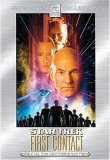
Star Trek: First Contact - Special Collector's Edition
"Resistance is futile." That's the chilling motto of the sinister half-organic, half-cybernetic Borg. No longer content to remain outside Federation space, they've turned their collective attention toward a very tempting target for assimilation: Earth. It's up to Starfleet to stop them, but the powers-that-be have decided to sideline the one ship whose captain and crew have the most experience dealing with this threat: the Enterprise. It's not like Captain Picard to just remain on the sidelines, though...
Star Trek: First Contact was the first totally stand-alone Next Generation feature film, and it remains the best of the Next Generation film series. While it doesn't live up to the epic grandeur that the Original Series films captured in The Undiscovered Country, First Contact gets almost everything right... things that for one reason or another seem to have been missed in Insurrection and Nemesis (which I consider to be reasonably entertaining but far from exceptional).
What does First Contact do right? First of all, it picks up on a great storyline that draws directly on the backstory developed in the Next Generation television series. Rather than inventing a new villain from scratch, or putting the crew through their paces as if they're just any old group of spacefaring heroes, First Contact takes Next Generation's most innovative and scary foe: the Borg. Let's get this straight from the start: these Borg are not the watered-down, familiarity-breeds-contempt Borg of the Voyager television series. No, these are the kick-ass Borg as introduced in the Next Generation series, back when one cube was enough to make your hair stand on end, and when the booming "Resistance is futile" message had a very believable ring to it. First Contact delves gleefully into its use of the Borg, with a fantastic space battle early in the film along with excellent use of the Borg as an invasive presence on the Enterprise.
What's more, the film ties in the use of the Borg with character development from the series (Captain Picard's experience of being assimilated). For viewers who have seen the series, that gives the film a great deal more depth, and it calls upon one of the biggest strengths of the Next Generation show: its character development and the interactions of its ensemble cast. The use of backstory elements doesn't mean that the film casts adrift new viewers, though: First Contact does a good job of getting viewers up to speed on Picard's past history with the Borg. It's a smart move, capitalizing on the depth of story available from the series' excellent seven-year run.
That's not to say that First Contact makes as good use of its cast and backstory as it could have. The character of Lily (Alfre Woodard) is patently a stand-in for the new-to-Star-Trek viewer, seeing the Enterprise and meeting its crew for the first time. I found Lily to be utterly extraneous the first time I saw the film, but after a few more viewings, I'll concede that her character's function is probably useful, and for the most part her role doesn't intrude too much on the forward movement of the narrative. The one glaring exception is her confrontation with Picard late in the film, in which Lily challenges him on a crucial decision. It's an element in the film that would have worked far better if one of the Enterprise crew had been used in that confrontation in place of Lily. Commander Riker, Dr. Crusher, or even Counselor Troi could all have served very well as the opposite pole to Picard in this crucial scene, with the essential difference that their challenge to Picard would have drawn on years of character development and shared experiences, giving an extra depth and significance to the scene. It's an example of the trend that, I think, expands and further weakens Insurrection and Nemesis: the sidelining of the ensemble cast of Next Generation.
In many ways, the storyline echoes Star Trek IV with its use of time travel to save the future, just as Nemesis echoes Star Trek II, but whereas Nemesis is basically just a remake of the earlier film, First Contact develops its material in a fresh and interesting manner. Again, the film makes intelligent use of Star Trek's extensive backstory by setting the story at the key moment of "first contact," which offers us a plot line that's quite engaging (and James Cromwell is absolutely perfect as Zefram Cochrane). I do think that the time-travel aspect of the story could have been used to give a bit more of a twist at the end, but in any case, the storyline on Earth is as satisfying as the parallel one involving the Borg. Jonathan Frakes does a very solid job in directing the film, which shouldn't come as a surprise, considering that he directed some of the very best Next Generation episodes; in addition to having a good story, First Contact is well paced and visually interesting from start to finish.
The DVD
As with the other Special Edition releases of the Star Trek films, First Contact is a two-disc set, packaged in a double-wide keepcase.
Video
The transfer for the Special Edition looks phenomenal. The film appears in its original 2.35:1 aspect ratio and is anamorphically enhanced. Since the earlier release was already anamorphic, I wasn't anticipating a huge improvement in image quality, but in fact the Special Edition is a step up in quality on all counts.
Colors are richer and more vibrant, making formerly ordinary-looking scenes have a new visual appeal. Additionally, the contrast looks like it's handled better: blacks are deep and dark, but even in the film's many dark scenes, the right amount of detail is always present, and it never looks too dark. By comparison, the same scene in the original release looks murky and overly dark. The print is noticeably cleaner, with not a trace of any dirt, noise, or grain to be found. The image as a whole is crisper and more finely textured, and there's no trace of edge enhancement as far as I could see. From live-action to CGI, and from tight close-up to long-distance shot, the film looks fantastic, and earns full marks for video quality.
Audio
The biggest appeal of the Special Edition's audio mix is the brand-new DTS soundtrack, which blows the 5.1 track out of the water. It's not that the 5.1 track is bad, because it's not; it's a respectable surround soundtrack, and the Dolby 2.0 is an acceptable, if limited, stereo track. But the DTS is an auditory delight, adding a hefty dose of increased enjoyment to the experience of watching the film.
The DTS track has a rich, textured feel to it, and makes excellent use of all the channels to create a convincing immersive experience. It's not just in the major fight scenes that we get great surround sound, either: throughout the film, the side and rear channels are put to great use for various environmental sound effects as well as music to give the impression that we're really in the middle of the action. The dialogue is always clear and crisp, the music is perfectly balanced with the rest of the track, and the action sequences pump up the audio adrenaline without overdoing it on volume increases.
It's worth pointing out that the sound design for First Contact is really outstanding. The film takes advantage of the fact that the Star Trek world is really a very sound-effect-intensive one, from the turbolift doors opening, to the computer beeping, to the sounds that the Borg make as they move around. All these little sounds, and more, are seamlessly incorporated into the film, somehow making it feel more detailed and real.
English and Spanish subtitles are also included.
Extras
First Contact: SE comes with a lavish spread of special features that are sure to appeal to all fans of the film. The first disc, which contains the film itself, also contains three commentary tracks. The first is a full-length audio commentary by director and actor Jonathan Frakes. He doesn't seem like he has a lot of experience doing commentaries, and there are some silent spots as well as some narrating-the-action (I suspect he'd have done better if he'd shared the commentary with someone else) but overall it's a track that offers some interesting thoughts on the film. The second audio commentary is by writers Brannon Braga and Ronald Moore, who provide a somewhat more detailed and interesting commentary. A text commentary by Michael Okuda and Denise Okuda is the third offering; it provides various bits of trivia and background information about the film on little pop-up bubbles on screen. It's possible to turn on the text commentary at the same time as either of the audio commentaries, which is quite nice.
Disc 2 contains the bulk of the special features, mainly in the form of short featurettes assembled under various topic headings. For the most part, these are interesting pieces; there's some use of clips from the film, but these are primarily informative rather than promotional pieces.
Under "Production" we get seven featurettes, running a total of 81 minutes. "Making First Contact" offers an overview of the making of the film, "The Art of First Contact" is a slideshow of design sketches, "The Story" focuses on the writing of the film, "The Missile Silo" and "The Deflector Dish" take a look at the making of specific scenes in the film, and "From "A" to "E"" considers the transition from Original Series films to Next Generation films. All these featurettes are reasonably interesting, with an assortment of interview clips from various cast and crew.
"Scene Deconstruction" gives us about 19 minutes of commentary on the art design of the film, focusing specifically on three scenes: the "Borg Queen Assembly," "Escape Pod Launch," and "Borg Queen's Demise." We get to hear from the art director and visual effects supervisor, and see the concept art for the scenes.
"The Star Trek Universe" section broadens the scope a bit. "Jerry Goldsmith: A Tribute" is a 20-minute appreciation of Star Trek's premier composer. "The Legacy of Zefram Cochrane" (12 minutes) is an interesting look back at the character of Cochrane as introduced in the Original Series, and how the writers of First Contact decided to change the character. Lastly, "First Contact: The Possibilities" (20) takes a look at the idea of first contact itself.
The last main section is "The Borg Collective," which seems to be more aimed at viewers who are relatively new to the Star Trek universe. "Unimatrix One" (14 minutes) provides background information on the Borg, drawing on clips from the relevant Next Generation episodes. "The Queen" is a rather light-weight eight-minute interview with actor Alice Krige, and "Design Matrix" (18 minutes) takes a look at the costume and makeup design for the Borg in the film.
The final section, "Archives," contains a set of storyboards for the 1930s nightclub scene, the hull battle, alternate shots for the hull battle, and alternate shots for Worf vs. the Borg. There's also a design gallery of art images, and trailers for the film: a teaser trailer, the theatrical trailer, and a trailer for the "Borg Invasion" ride.
Final thoughts
Star Trek: First Contact is my favorite of the Next Generation feature films, and it's a pleasure to see it getting a significant upgrade in video and audio quality on this Special Edition. Even without the generous selection of special features, this DVD set would be worth the upgrade for viewers who have the earlier edition. Highly recommended.
|



| Popular Reviews |
| Sponsored Links |
|
|
| Sponsored Links |
|
|
| Release List | Reviews | Shop | Newsletter | Forum | DVD Giveaways | Blu-Ray | Advertise |
|
Copyright 2024 DVDTalk.com All Rights Reserved. Legal Info, Privacy Policy, Terms of Use,
Manage Preferences,
Your Privacy Choices 
| |||||||