
| Reviews & Columns |
|
Reviews DVD TV on DVD Blu-ray 4K UHD International DVDs In Theaters Reviews by Studio Video Games Features Collector Series DVDs Easter Egg Database Interviews DVD Talk Radio Feature Articles Columns Anime Talk DVD Savant Horror DVDs The M.O.D. Squad Art House HD Talk Silent DVD
|
 DVD Talk Forum |
|
|
| Resources |
|
DVD Price Search Customer Service #'s RCE Info Links |
|
Columns
  


 
|
|
|
Panic in the Streets
Panic in the Streets is a terrific noir thriller in the Fox studio's docu-drama style of the late 1940s. It's also powerfully directed by Elia Kazan, who extends his superior dramatic staging to the new use of authentic settings. The effort to stem an outbreak of deadly contagion paints a nervous portrait of an unstable society; the threat to America crosses all boundaries and all social classes. The suspense builds to a high pitch of excitement as Richard Widmark's frantic health official tries to find the source of the disease that could easily kill hundreds of thousands.
This is Elia Kazan's breakout film, the transitional picture between being primarily a stage director and a director of movies that move. His Boomerang! was a noir shot on real locations, but most of the action was confined to interior scenes. On this film Kazan and his writers balance Dr. Reed's normal home life with a wild manhunt in the city's older district and on its teeming waterfront; at one point they even fly out to a ship at sea. Even the bad guys are unusually credible. Intimidating menace Jack Palance (in his first movie) runs a laundromat as a front for his crooked schemes.
Still shaking his evil Tommy Udo persona from Kiss of Death, Richard Widmark plays an ordinary guy burdened with a tremendous responsibility and very little authority to carry it out. The clever screenplay introduces him beautifully - we see him being called into the office, and as his wife Nancy (Barbara Bel Geddes) talks with him, he puts on a uniform. We don't know yet what his job is and assume for a minute that he's a Navy officer or something.
Dr. Reed isolates the germ and then hands the gathered authorities (who actually show up for the meeting - what kind of city is this?) the messy problem. The police naturally resent bearing the responsibility for turning the city upside-down on the say-so of just one doctor - who has already had the body of the murdered man cremated. Widmark and Paul Douglas make a great pair of mismatched companions on an almost hopeless search.
On the other side of the law, Blackie and Fitch are convinced there's some kind of deal they can muscle in on. The hulking Jack Palance intimidates and cajoles his easily frightened partner, especially well-played by Zero Mostel. The feeling of the underworld is complete when a doctor Blackie finds does a fast fade at the arrival of the authorities ... all of these people are so slippery. This is one movie where we notice each time a character touches another or breathes too closely ... we 'feel' the disease spreading even when we can't see it.
Panic in the Streets creates an unusual noir sensibility that operates on political lines. In a free society, destructive elements like Blackie are as hard to control as a disease run wild. We don't want to restrict human rights, but even the Police Captain sees the momentary need to have a reporter held incommunicado, when it seems that breaking the story might start a panic. In Japanese thrillers like High and Low, the press and the cops work together in the best interest of the city. In 1950 New Orleans, nobody expects any such cooperation. When one of the Mayor's men excuses himself to evacuate his own family from the city, Widmark turns to Douglas and says, "Here we go ..."
Panic in the Streets is a desperate manhunt for a foreign invader - an undocumented alien killer. Part of the story seems to advocate the need for draconian measures or martial law - as Charlton Heston says in Touch of Evil, "A policeman's job is only easy in a Police State." Plague carriers Palance and Mostel are forever being compared to vermin, explicitly so in the movie's famous (if a bit too overtly symbolic) final scene.
The need to protect society against monstrous invaders is a natural for critics to propose Panic in the Streets as a right-wing allegory about Communists, as they often do for Gordon Douglas' science-fiction monster thriller Them!. The defenders of America in both movies do the same things - break rules, sweep the city, and secretly imprison individuals who might jeopardize the mission. The giant ants in Them! are ruthlessly incinerated, while the disease carried by the criminal scum in Panic in the Streets transforms them almost literally into human rats in need of extermination.
Widmark makes for a great husband and father (his son is Tommy Rettig, soon to be ten of The 5,000 Fingers of Dr. T) and his scenes with Barbara Bel Geddes are superb. She's conceived neither as 'the wife' or even as a supportive ornament, as in Call Northside 777. The many local non-actors in the cast blend seamlessly with the real locations, with the occasional professional ringer (like Emile Meyer of Sweet Smell of Success or Alexis Minotis of Land of the Pharaohs) fitting in perfectly.
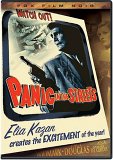
The Fox Film Noir DVD of Panic in the Streets looks as though it was shot yesterday, from its iconic title background shot through the windshield of a car moving down Bourbon street, to the last desperate attempt by that rat Blackie to escape the authorities. There is an extra English track in 2.0 stereo, a new adapted mix, I assume. Without star billing, Jack Palance's name appears nowhere on the box, but nobody could mistake his face on the cover art, an original poster.
Noir authorities Alain Silver and James Ursini do a fine audio documentary, trading off with observations and insights that never let up. They're particularly good at pointing out the finer points of Kazan's direction, especially involved and kinetically alive action scenes that are often shot in only one or two angles, and dramatic scenes invisibly blocked to favor a camera that cuts only when necessary.
Panic in the Streets may not have the cachet of Laura or the star power of Call Northside 777 but it's easily as entertaining. I'm looking forward to more entries in Fox's noir series.
On a scale of Excellent, Good, Fair, and Poor, Panic in the Streets rates:
Movie: Excellent
Video: Excellent
Sound: Excellent English (Dolby Digital 2.0 Stereo), English (Dolby Digital 1.0), French (Dolby Digital 1.0)
Supplements: Commentary by authors and historians James Ursini and Alain Silver
Packaging: Keep case
Reviewed: March 17, 2005
| |
|


| Popular Reviews |
| Sponsored Links |
|
|
| Sponsored Links |
|
|
| Release List | Reviews | Shop | Newsletter | Forum | DVD Giveaways | Blu-Ray | Advertise |
|
Copyright 2024 DVDTalk.com All Rights Reserved. Legal Info, Privacy Policy, Terms of Use,
Manage Preferences,
Your Privacy Choices 
| |||||||