
| Reviews & Columns |
|
Reviews DVD TV on DVD Blu-ray 4K UHD International DVDs In Theaters Reviews by Studio Video Games Features Collector Series DVDs Easter Egg Database Interviews DVD Talk Radio Feature Articles Columns Anime Talk DVD Savant Horror DVDs The M.O.D. Squad Art House HD Talk Silent DVD
|
 DVD Talk Forum |
|
|
| Resources |
|
DVD Price Search Customer Service #'s RCE Info Links |
|
Columns
  


 
|
|
|
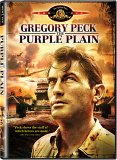
Purple Plain, The
The Purple Plain is one of those movies that people never forget, even if they can't remember its title. It's an odd English wartime movie about characters instead of combat; because it stars Gregory Peck as an emotionally confused flier, it will probably draw comparison to Twelve O'Clock High. What we really have here is a unique drama that plays like a slightly subdued Powell/Pressburger film - the intense visuals seem plugged directly into the heart of the drama. Couple that with sensitive direction and some offbeat casting, and The Purple Plain is a strange, hypnotic experience. Savant highly recommends it.
The Purple Plain is a strong favorite that hits an emotional chord with audiences; Robert Parrish's subdued direction and Eric Ambler's story details have an unspoken feeling of faith and abiding inner peace. It's a basic "theraputic" tale in that we see the emotional healing of a flyer that the R.A.F. thinks may have gone 'round the bend. Instead of making a big melodramatic deal out of Bill Forrester's mental state, The Purple Plain shows him as a man with a simple adjustment problem - rather than deny the memory of his lost wife, he'd rather fly like a madman in hopes of joining her. Mechanics hate Bill, his bunkmate lectures him, and everyone shakes their heads when Bill purposely flirts with death by strolling across a landing strip while airplanes are landing. A wounded navigator is relieved that he will no longer have to fly with Forrester.
The kindly doctor (Bernard Lee of The Third Man) knows that the cure is to get Bill back among the living, and so takes him to meet missionary Miss McNab, played beautifully by Brenda De Banzie. She evacuated Rangoon with thousands of refugees, and saw 300 of them die. Bill has to appreciate that he's not the only one to have suffered, especially when he meets nurse's aide Anna, a Burmese who quickly falls in love with him.
Anna is played by Win Min Than, an unusual beauty with a strange combination of features. Giant Technicolor closeups treat her with the reverence accorded icons like Jennifer Jones, but after all these years she takes on the mystery of other leading ladies with just one or a few credits, like Roberta Haynes in the similarly wistful film Return to Paradise (another half-forgotten UA gem). Win Min Than's eyes sparkle and her lip curls up in a mysterious smile, and the 50 years that have passed seem like nothing.
Bill's jungle survival problem is well-directed, but what we remember more are the film's odd details. Forrester watches impassively as a Burmese kid torments a little lizard, and contemplates both death and human nature. Miss McNab is a psalm-singing ball of energy who commands respect even as Bill and the Doctor (and Anna) smile at her excess of enthusiasm. Anna gives Bill what is supposed to be a precious ruby, which the scientist later dismisses as worthless. But the ruby is from Anna, and as such represents everything of value to Bill. To get back to Anna, he'll perform a miracle of endurance.
The Purple Plain is realistic without being cynical or overly sentimental. Bill's mental problems - his nightmares are a Technicolor vision out of The Red Shoes - are not presented as more important than the chaos of war around him. Because his mechanics lose respect for Bill they ignore his repair instructions, making his instability indirectly responsible for the airplane crash. Likewise, Bill's "we're going to walk out of this jungle" courage can only go so far when the scientist has no faith in his judgment. Bill eventually has to carry on alone, and ask a wounded buddy to trust in him.
(spoiler)The understated ending to The Purple Plain is a thing of beauty, a visual representation of a reward earned and peace regained. There's no emotional reunion, just the anticipation of one, and the effect is sublime. Bill and Anna will be reborn in a figurative marriage bed, whole people once again. We see none of this happen, but we don't need to. The ending is a wonderful transposition of the kind of moment that is supposed to work only in literature. If you see The Purple Plain, make sure to watch the last half of the film without interruption.
Director Robert Parrish was an editor for John Ford with an erratic directing career that yielded several notable films but never a breakthrough hit. The Purple Plain is perhaps his best, followed by the exceptionally rich United Artists western The Wonderful Country, yet another film kept from DVD by music rights problems. Perhaps there are other undiscovered gems in his filmography, but the other films readily available are less than stellar: Fire Down Below, Casino Royale, Journey to the Far Side of the Sun (Doppelganger).
I don't know where The Purple Plain was filmed, but the locations are impressive. Some relatively poor models are used for flying scenes early on. Director Clive Donner was Parrish's editor. I'm sure that the story of how Gregory Peck came to be in this picture would make good reading - at the height of his American success (Roman Holiday), he must have believed in the project to commit himself to such a modest production.
MGM's DVD of The Purple Plain has a great Technicolor look, with rich images and vivid colors. The character closeups are worth freezing to appreciate. The audio is good as well but perhaps a tiny bit distorted and lacking in detail.
MGM has presented the film full frame, which is probably a good call. Although the main titles appear to be composed for 1:66, a 1:78 crop-off is too much. Released in 1954 and shot by an English crew, it could easily have been planned as a 1:37 release.
On a scale of Excellent, Good, Fair, and Poor, The Purple Plain rates:
Movie: Excellent
Video: Excellent
Sound: Very Good
Supplements: None
Packaging: Keep case
Reviewed: April 19, 2005
| |
|



| Popular Reviews |
| Sponsored Links |
|
|
| Sponsored Links |
|
|
| Release List | Reviews | Shop | Newsletter | Forum | DVD Giveaways | Blu-Ray | Advertise |
|
Copyright 2024 DVDTalk.com All Rights Reserved. Legal Info, Privacy Policy, Terms of Use,
Manage Preferences,
Your Privacy Choices 
| |||||||