
| Reviews & Columns |
|
Reviews DVD TV on DVD Blu-ray 4K UHD International DVDs In Theaters Reviews by Studio Video Games Features Collector Series DVDs Easter Egg Database Interviews DVD Talk Radio Feature Articles Columns Anime Talk DVD Savant Horror DVDs The M.O.D. Squad Art House HD Talk Silent DVD
|
 DVD Talk Forum |
|
|
| Resources |
|
DVD Price Search Customer Service #'s RCE Info Links |
|
Columns


|
|
|
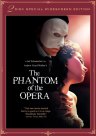
Phantom of the Opera: Collector's Edition, The
 There have been numerous film versions of The Phantom of the Opera over the years. The most famous is probably Lon Chaney's frightening turn as the Phantom in the classic silent version of the film. Up until 2004, however, there has never been a film made of Andrew Lloyd Webber's musical version of The Phantom of the Opera. After it's enormous success, as a musical, on Broadway and around the world, the idea of bringing Phantom… to the silver screen was an obvious one. So obvious that Webber contacted Director Joel Schumacher about doing a film adaptation fourteen years ago. That version, unfortunately, never materialized and the idea went onto the shelf. The resurgence of the musical in recent years - and the success of films like Moulin Rouge and Chicago - made the idea of bringing The Phantom of the Opera to the big screen a no-brainer.
The question on everyone's mind, however, was this: How do you turn one of the most famous and beloved musicals in the world into a film? The answer: You let Joel Schumacher turn it into a lavish action-adventure film that'll get all the young people in the seats. I'm kidding, of course, although there are a few elements of that ridiculous notion in the finished product. The true answer to that question was to make sure that Andrew Lloyd Webber was closely involved and to find a young, talented cast that could do justice to the classic musical. And on most accounts, this is exactly what Schumacher has done. He has created a film that is visually breathtaking, full of gothic romance, and balances all that on top of some wonderfully orchestrated musical performances. Is it the perfect adaptation of the Webber's musical? No. Are all The Phantom of the Opera fans going to be happy with the film version? No. But does it succeed in more places than it fails and provides a wonderful alternative to people that might not be able to afford to see the musical? The answer is a resounding "yes."
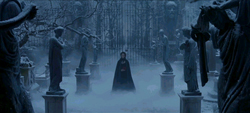 While discussing the film version with Andrew Lloyd Webber, one thing that Director Joel Schumacher insisted on having was a young cast. He wanted Christine to be as innocent as possible, and he wanted the love triangle between her, the Phantom, and Raoul to be believable and passionate. The young cast, Schumacher thought, could only help bring these elements to the film. In two out of three choices, Schumacher was exactly right. Patrick Wilson plays Raoul with ambition and brings his tremendous Broadway voice to the character in a way that nearly matches the range and power of Emmy Rossum's Christine. Their passion for each other, however, never seemed to me to be all that believable. It's clear that Christine loves him, but she lacks the same passion for Raoul that she so clearly has for the Phantom.
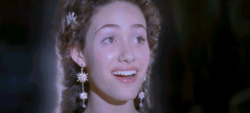 The true find, however, of The Phantom of the Opera is Emmy Rossum. Not only is she beautiful, innocent, and full of passion and fear, but she also has one of the most beautiful voices you're likely ever to hear. She outshines her counterparts in every single musical number, and puts Minnie Driver's Carlotta to shame. Rossum seems confident in her role and her doe-eyed performance is nuanced and passionate. She does an excellent job of balancing the fear and attraction her character feels toward the Phantom, and never allows the more veteran actors to take away the spotlight. Rossum is the real gem of this film, and she shouldn't have any trouble finding work in Hollywood from now on.
The other big concern of the Phantom… devotees was the casting of the Phantom himself. This, unfortunately, is one of Schumacher's bigger mistakes in the film. He casts Gerard Butler in the famous role and, although at times he seems a capable actor, Butler simply cannot match the power and vocal range of his counterparts. He is overshadowed in every single scene with the Emmy Rossum. His voice just isn't quite good enough to match up with her. I understand that Schumacher wanted him to play a more rugged, less trained, and less "angelic" Phantom, but it sometimes becomes distracting how much better of a vocalist Rossum is than Butler. His ruggedness does, however, make him a more believable attraction for Christine. Still, the casting of Butler in the role of the Phantom is easily one of the larger missteps taken by Schumacher.
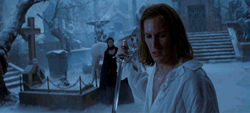
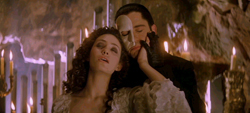 If you're going into this film expecting to see an exact replica of the stage musical, than you will most likely be disappointed. While the main story is there, and most of the elements are in place, Schumacher does take quite a few liberties with the material. Remember that "action-adventure film" I mentioned before? Well, let's just say that Schumacher adds a fairly needless swordfight that made me think the film was turning into The Pirates of the Phantom of the Opera. Sure it looks pretty in the snow, but it seems like an addition that was made simply to make the film more action-packed. Nevertheless, I won't begrudge Schumacher his tendency for flare because, in the end, The Phantom of the Opera is a highly entertaining and absolutely beautifully designed film. It may not be equal to seeing the musical on Broadway, but it is certainly a suitable alternative for those without the means to see the stage musical. Even if you're a hardcore Phantom… fan that detests the idea of a film version, this one is worth seeing if for nothing more than the performance of the up-and-coming Emmy Rossum.
The DVD
Video:
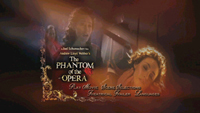 The Phantom of the Opera is presented in an absolutely stunning anamorphic 2.40:1 widescreen format that beautifully captures the highly stylized look of the film. The range of colors used in this film is vast, and every single hue comes across perfectly. From the opening scenes in grayish black and white to the vibrant gold tones in the opera house and the blue-gray scenes in a snowy cemetery, The Phantom of the Opera is one of the most visually lavish and stylish films to grace the screen in quite some time. This transfer is nearly perfect in its execution of light and shadow, the richness of its colors, and the deepness of its black tones. While there are several scenes that are purposely shot in soft-focus, the detail in the rest of the film is incredibly deep and intricate. The only that keeps this transfer from being reference-quality is a barely-noticeable layer change and the slightest hint of edge enhancement. There is a fair amount of grain present in scenes that are lit by gaslight or candlelight, but it is clearly part of the inherent look of the film. Aside from those two minor quibbles, this is one of the most gorgeous transfers that I have seen in a while.
Sound:
The audio on this disc is presented in a Dolby Digital 5.1 format that does a fine job of capturing the elegance and beauty of the opera performances, while also knowing exactly when to turn it up a notch to knock you out of your seat. Dialogue is always clear, crisp, and distinct, and spatial separation across the front channels is excellent. The best, and most important part, of The Phantom of the Opera is easily the musical performances, and here is precisely where this track really shines. The orchestra is intricately balanced throughout every channel, and the surround channels do a great job of providing even more ambience to the performances. When the Phantom sings (and even when he speaks) the surround channels come alive with his eerie, deep voice. They, of course, also come alive during several major sound effects sequences, but they are most affective in their use of the Phantom's dialogue. Even the LFE channel gets involved in providing a nice low rumble that makes the masked-man's speech seem even more ominous and foreboding. Overall, this is a very well balanced and dynamic audio presentation.
Extras:
It was a wise move to allow this lengthy film one disc basically all its own. The only extra included on the first disc is a theatrical trailer, and the addition of the second disc (for all the extra features) really allows the film to thrive in the audio-visual department on its own disc.
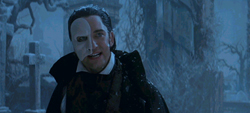 The first, and best, feature on the second disc is "Behind the Mask: The Story of The Phantom of the Opera," which takes just over an hour to detail the journey of the story from Gaston Leroux's novel to the silent screen, to Andrew Lloyd Webber's stage version, and finally to Joel Schumacher's feature film. Included in this documentary are interviews with basically everyone that's been involved with the various productions in one way or another. The real treat, however, are the clips from some never-before-seen performances. We get to see a promotional video made to sell an earlier screen version of the musical (which was never made), and several clips from early performances that took place in Andrew Lloyd Webber's own estate before the musical was completed. Always interesting and entertaining, this documentary is a fairly exhausting look at the progression of The Phantom of the Opera from its start as a novel to its adaptation into several different mediums.
Also included on the second disc is a 45-minute feature called "The Making of The Phantom of the Opera." You have the option of either watching it in three separate segments or as one long feature, which actually cuts together pretty cohesively. The first segment is called "Origins and Casting of The Phantom of the Opera," and it features interviews with Director Joel Schumacher and most of the other principles. Schumacher explains how the film finally got made after fourteen years of waiting. He also tells us a lot about the casting process and how each part was chosen. We also get to see interviews with the major players, as they talk about how daunting it was to step into a film based on one of the world's most popular plays.
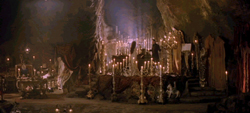 The second segment is called "Designing The Phantom of the Opera," and it basically details the creation of the elaborate sets and highly detailed miniatures. We also get to see interviews with the film's costume designer and many of the other artistic crewmembers. The third, and final, segment is called "Supporting Cast and Recording the Album of The Phantom of the Opera," and it not only allows Schumacher to explain his choices for a mostly British supporting cast, but also provides a glimpse into the recording studio as each actor records their parts for the musical performances. It would have been great to be able to see even more of this, but what we have here - including a look at the recording of the huge orchestra - is really entertaining. Overall, "The Making of The Phantom of the Opera" isn't your typical studio EPK fare. It is, rather, a detailed and intriguing look behind-the-scenes at "the most expensive independent film ever made."
In addition to those two great documentaries, the second disc also contains an additional scene. The excised scene features Gerard Butler as the Phantom singing his part in "No One Would Listen." The scene is short and, although it isn't clear why it was deleted, makes for a nice little bonus feature.
Finally, we have a very funny Easter Egg that is pretty easy to find, and also a DVD-ROM weblink to the Phantom's Online World.
Final Thoughts:
 Andrew Lloyd Webber's The Phantom of the Opera is undoubtedly the most famous version of Gaston Leroux's novel to ever be created. It has been seen on the stage by 80-million people worldwide and continues to play on Broadway to this day. Webber has seen his musicals make their way to the silver screen more than a few times (with some mixed results), but The Phantom of the Opera took upwards of fourteen years to make the transition. Nevertheless, the timeless gothic romance still manages to send chills up my spine every single time those Phantom chords come pounding out of the organ. While Joel Schumacher's version may not be the perfect adaptation, there is certainly more good than bad to be found in his film. Emmy Rossum's performance alone is worth the price of admission. The film alone would make for a simple recommendation, but the inclusion of two excellent documentaries makes this disc highly recommended. If you were only lukewarm to the film in theaters, do yourself a favor and pass up the one-disc version that Warner Bros. is also offering. This is a case where the extra features actually make you appreciate and enjoy the film even more.
|



| Popular Reviews |
| Sponsored Links |
|
|
| Sponsored Links |
|
|
| Release List | Reviews | Shop | Newsletter | Forum | DVD Giveaways | Blu-Ray | Advertise |
|
Copyright 2024 DVDTalk.com All Rights Reserved. Legal Info, Privacy Policy, Terms of Use,
Manage Preferences,
Your Privacy Choices 
| |||||||