
| Reviews & Columns |
|
Reviews DVD TV on DVD Blu-ray 4K UHD International DVDs In Theaters Reviews by Studio Video Games Features Collector Series DVDs Easter Egg Database Interviews DVD Talk Radio Feature Articles Columns Anime Talk DVD Savant Horror DVDs The M.O.D. Squad Art House HD Talk Silent DVD
|
 DVD Talk Forum |
|
|
| Resources |
|
DVD Price Search Customer Service #'s RCE Info Links |
|
Columns


 
|
|
|
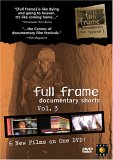
Full Frame Documentary Shorts, Vol. 3
The Full Frame Documentary Film Festival is one of the best showcases for documentaries in the US. Each year since 1998, they have been holding their festival in Durham, North Carolina and showing over 100 documentaries to enthusiastic audiences. This third collection of films submitted to the festival contains six short works that are mostly entertaining.
The films in this collection are:
A Thousand Words (8:30): A woman and her brother try to understand how their stoic father was shaped by being in Viet Nam. Told almost exclusively through the photos and home movies, many from Viet Nam itself, the offspring come to the realization that this is just something that their father will not discuss.
A good film, simple in style and form and yet thought provoking. An apolitical film, it really doesn't take a stand about the war, yet leaves the viewer knowing that the scars left on the participants will never hear.
The Great Cheesesteak Debate (12:30): Pat's, Geno's or Jim's: who has the best Cheesesteak in Philly? Each restaurant has their staunch defenders, and they were all very vocal as to why their favorite place was the best. An amusing film that'll make you want to catch the next flight to Philly and check ot out for yourself. (Don't watch this on an empty stomach!)
Rosalie's Journey (22:30): The story of a young aboriginal girl, Rosalie, from the outback in Australia who was taken by her father to a school, St. Mary's, to learn to speak and read English. While she was there the director Charles Chauvel came to look at the teenaged girls at the school. Though she had no acting experience and didn't even totally understand English, Chauvel chose Rosalie and cast her as lead in his film Jedda (1955.) Told through old home movies, stills, screen tests, and clips from Jedda, Rosalie reminisces (in her native language) about her time at St. Mary's and her brief life as an actress.
This wasn't my favorite film in this group. Though I'm very interested in film history, this didn't reveal anything that I couldn't have guessed. Rosalie didn't really understand what acting was. She had only seen one movie before being cast, and so all she talks about is how she would wait on the side lines until they called her, film a scene, and then wait some more. I also thought it would of been more dramatic if they showed the, older adult Rosalie at the beginning of the film, instead of waiting until the end, but that's a minor critique.
Texas Hospitality (4:00): A quick piece, this show the mug shots of criminals who were put to death in Texas, the crime they were convicted of, and then what they ate for their last meal. I found it ironic that a couple of these murderers were vegetarian. At the end, there are some facts about capital punishment, included how many people Texas has executed and how many are still on death row. If it was trying to be an anti-death penalty piece, it didn't succeed.
Journeys (37:00): Images of people traveling in India. The main scenes are of trains. People getting on and off and riding in India's very crowded rail system. They also show the huge traffic jams that car riders experience, and poor neighborhoods that they pass through. With only very sparse narration (that doesn't start until about 15 minutes in) and no background music, the only sounds are the dubbed in sound effects. I found the sound effects to be rather poor, with the only sound on a fully packed train being tinkling of the metal hand holds and the occasional clack-clack of the tracks.
While some of the images were striking, especially the people riding on the top of the trains, I found this film excruciating. Over half an hour of pictures of traffic jams and the interiors of trains is just too much for me. If this was 10 minutes long, I probably would have enjoyed it, but at this length it is extremely boring.
Foxhole (11:30): Two soldiers, both of whom won prestigious medals and distinguished themselves, reminisce about how they met in Viet Man and became lovers. 35 year later, they are still together. This was a good film. It was constructed very well with the revelation that the two rough and rugged men were homosexual being both surprising and a bit comical. Short and to the point, though they do talk about gays in today society at the end, the film isn't preachy. A great film to close out the DVD.
The DVD:
Audio:
The stereo soundtrack was about average for low budget documentaries. There was the occasional hum or soft dialog, but this was rare. The sound wasn't very dynamic, but that was to be expected.
Video:
As you might guess from the title, all of these films were presented in full frame with the exception of Rosalie's Journey and Journeys. (These two were not anamorphic.) The image quality varied, Journeys being a little blurry and soft in places, but the others were generally what you would expect from low budget and student films. The lighting wasn't great in several of the scenes, either too bright or too dark, and several of the shorts were obviously recorded on tape, but that didn't hurt the disc.
Extras:
The only extras on this disc are text pages about the film makers, the Full Frame Documentary Film Festival, and the DVD publisher, Docudrama. There are also a number of trailers for other Docudrama DVDs.
Final Thoughts:
These are all solid documentaries. While, with the exception of Journeys, they are all good, none of them are really great. They don't stay with you after you've watched them the way the best documentaries do. While I enjoyed watching these shorts, I can't see popping the disc in again any time soon. This would be a very good rental.
|



| Popular Reviews |
| Sponsored Links |
|
|
| Sponsored Links |
|
|
| Release List | Reviews | Shop | Newsletter | Forum | DVD Giveaways | Blu-Ray | Advertise |
|
Copyright 2024 DVDTalk.com All Rights Reserved. Legal Info, Privacy Policy, Terms of Use,
Manage Preferences,
Your Privacy Choices 
| |||||||