
| Reviews & Columns |
|
Reviews DVD TV on DVD Blu-ray 4K UHD International DVDs In Theaters Reviews by Studio Video Games Features Collector Series DVDs Easter Egg Database Interviews DVD Talk Radio Feature Articles Columns Anime Talk DVD Savant Horror DVDs The M.O.D. Squad Art House HD Talk Silent DVD
|
 DVD Talk Forum |
|
|
| Resources |
|
DVD Price Search Customer Service #'s RCE Info Links |
|
Columns


 
|
|
|
Oliver Hardy Collection
Half of arguably the greatest comedy team of all time Oliver Hardy (Babe to his friends) already had a long and productive film career before he ever teamed up with his physical opposite, Stan Laurel. Traveling to Jacksonville, Florida in 1913, then the center of much film activity, Babe joined the Lubin company where he found work as an actor. Between that time and 1927 when he would be partnered with Stan Laurel for the series that would make him famous, Hardy appeared in literally hundreds of shorts and features. Often cast as the heavy, he worked with such now forgotten stars as Larry Semon, Bobby Ray, and Billy West. (West was a Chaplin impersonator who was once publically praised by Chaplin himself.) Kino, in association with the French outfit Lobster Films, has released a nearly three hour collection of the actor's pre- Laurel and Hardy shorts: The Oliver Hardy Collection.
As with most collections of shorts, this one is a mixed bag. Hardy only has a staring role in one (Crazy to Act) and some of the comedians he was partnered with weren't all that great. While Stick Around is a very funny short that is reminiscent of the work he would later do with Stan Laurel, most of the other films don't have the charm and character that the Laurel and Hardy shorts possess. These films are interesting though, as they show a progression of Babe's skill as an actor. In the earliest films he overacts to a large extent, waving his arms and exaggerating gestures to make a point. By the late 1920's though he had refined his method and was more subtle and realistic, a style that he would continue to continue to refine and hone in his Laurel and Hardy shorts.
The films included on this disc are:
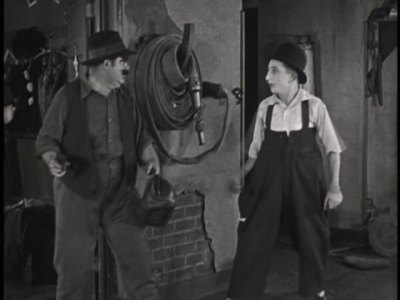
The Show (1925): This is a Larry Semon short, with Oliver playing a smaller role as the heavy. Semon was an incredibly popular comedian at the time this short was made. Know for elaborate stunts and frantic chase scenes, this short is a good example of his work. The film can really be broken into two parts, with the first having little to do with the second.
 |
| |
The first section of the movie involves the trials and tribulations of putting on a vaudeville show. A crass group in the balcony drops butter (?) and jam on the head of a well-to-do patron in the box below, a magician's chicken attacks a drunk member of the audience (played by Semon) and the prop boy (also played by Semon) causes all sorts of trouble with the giant fan and a container of ashes.
This section of the film was fairly uninspired. There wasn't much setups to the gags. In one early scene Larry starts eating an actresses make-up kit. There wasn't any real reason for him to start eating it, so it wasn't really funny. Later a chicken drinks from an open container of nitroglycerine. What was that doing back stage and why was it opened? I know these seem like nit-picky critiques, but a good comedy takes the time to explain why everything happens.
The second part of the short was much better. The stage manager, Oliver Hardy, steals some jewels from the star of the show at gunpoint. (Why he decided to do this is never explained.) Prop boy Larry bumps into the crook as he's leaving the dressing room and the chase is on. Though this chase scene involves a group of police who are helping Larry capture the thief, it is much better than a Keystone Cops vehicle. The stunts are top rate, involving Larry (and his stunt men) riding dangerously close to a fast moving train and having men running on the top of the train drop flat just inches in front of a tunnel that the train is speeding into.
Semon was know for spending extraordinary amounts on his shorts and it shows in this one. The chase at the end has houses, cars and motorcycles destroyed. It was a very entertaining and exciting chase, and nearly made up for the rather dull first half.
As for Oliver Hardy's part in this, it was very small. He hams it up as the bad guy in a ridiculous false moustache and eyebrows in a couple of scenes but doesn't have much of a chance to act. This is really a Semon vehicle, and you'd be hard pressed to see any spark of talent in Hardy's brief performance.
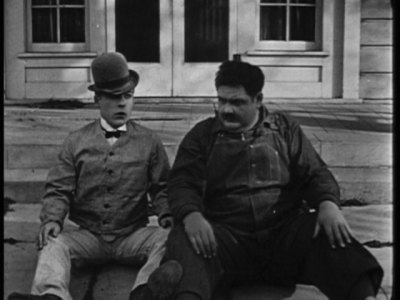
Stick Around (1925): This Bobby Ray short is very interesting because Ray and Hardy play similar characters to the ones that Laurel and Hardy would soon make famous. Babe Hardy is an overbearing boss, who's not too smart, and Ray plays his hapless employee. The two get a job to wall paper a sanitarium in "something artistic." On the way to the job site, the pair get into an accident with someone putting up a billboard ad for a circus. When they leave (in a hurry) they accidently take the circus ads instead of their wallpaper. Of course they have a hard time putting the paper up, and when the job is finally completed, they have "A room that would make the Ringling Bros. kiss Barnum and Bailey." The client is none too happy.
 |
| |
Watching this film it really strikes the viewer how similar this was to an early Laurel and Hardy short. Though Bobby Ray doesn't resemble Stan Laurel much, he is Hardy's physical opposite, as Stan was, and has an innocent attitude through most of the film. Oliver spends a lot of the picture bossing Ray around, while doing little work himself. One scene that could have come straight from a L&H picture was where Hardy and Ray were trudging to the sanitarium. Ray gets stuck pulling a heavy cart loaded with supplies up a very steep hill. He huffs and puffs and finally reaches the top, at which point Hardy yells "We climbed the wrong hill."
Though it is similar in tone an content to the Laurel and Hardy comedies, Oliver was still in his tough-guy mode and overacted a bit. Apparently it would take a comedian of Stan Laurel's caliber to realize that less is more and tone down his reactions.
Along Came Auntie (1926) (also available on The Lost Films of Laurel and Hardy Volume 3): This short was co-written by Stan Laurel, though he doesn't appear in it. This short was intended as a showcase for comedian Glen Tyron. Producer Hal Roach was hoping that Tyron would be a suitable replacement for Harold Lloyd as the studio's star comedian. (Lloyd having recently left for greener pastures.) After staring in the feature film The Battling Orioles (1924) Tyron appeared in a series of two-reel comedies, but he never made the big time. It is easy to see why in this short. Tyron is lifeless and has no screen presence. He is easily upstaged by Oliver Hardy who appears, once again, in a wild fake moustache. Based on this rilm, it's hard to see what Roach saw in Tyron.
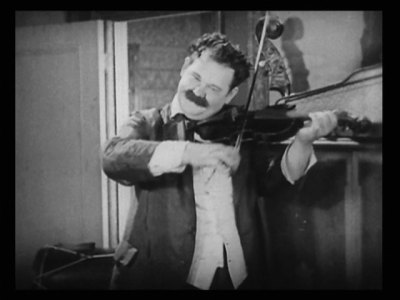
As for the film itself, it is one of the lesser efforts on this disc. The plot is fairly standard for a silent short: a woman will inherit a sizable fortune from her aged aunt, if she can convince her relative that she's still married to her first husband. As luck would have it hubby #1 (Oliver Hardy) has just taken a room in her house, while husband #2 (Glen Tyron) has just returned from a vacation. Though there are several misunderstandings and mixups, the film just doesn't have much punch to it. Tyron's character doesn't seem to have a personality, and it seems that whenever the writers were stuck, they just threw in another fight scene. It really has the feel of a Keystone comedy.
The version presented here looks better than the copy on The Lost Films of Laurel and Hardy Volume 3. It has more contrast and detail, while presenting a bit more image on the right side of the frame.
45 Minutes From Hollywood (1926) (also included in The Lost Films of Laurel and Hardy Volume 6): Another Glen Tyron film, he doesn't seem to have much comedic talent in this one either. Going to Hollywood to pay off his parents' mortgage, Glen Tyron ends up getting mixed up in a bank robbery and ends up being chased by a hotel detective and the police, all while he's wearing a dress.
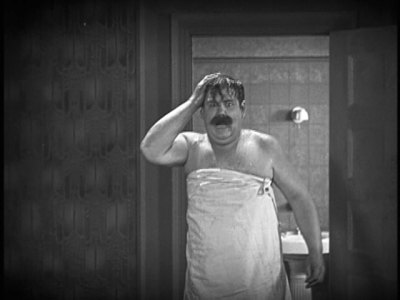
Overall a rather tepid film, it is historically important because it is the first film that Laurel and Hardy appeared together in at the Roach lot. Unfortunately, they don't even appear in a scene together. (They had first acted together in A Lucky Dog, an independent film made in 1921, in which they do share scenes.) A dull Glen Tyron film, the gags weren't that funny, and if it wasn't for the coincidence that the two future stars both have roles, this film wouldn't be as well remembered as it is.
This film is incredibly clear and crisp, and looks a bit brighter than the high quality print used in The Lost Films of Laurel and Hardy.
Crazy to Act (1927): Oliver made this film for Mack Sennett to finish out his contract. Hardy plays a rich young man who's infatuated with an attractive girl, Ethyl, who wants to be an actress. Hardy offers to marry the lady and finance her films, but she won't marry him until she's a star. They film her first movie, but the young ingenue in more interested in her leading man that she is in her fiancee.
This film was average at best. It was really padded, with the first section of the short showing the filming of Ethyl's movie, and the second part showing the screening of the film. Viewers saw the same action twice, and both of these sections focused on Hardy's reaction to Ethyl kissing her leading man. They needed to put more gags in this, as they repeat the few that are in it. Some of the title cards were amusing, especially when Oliver promised his betrothed that he'd make her the next Pola Pickford. It's a sad comment on a slapstick movie when the intertitles are the most memorable thing about it. Hardy did do a very good job in this movie though. By this time he has stopped overacting to a large extent and was much more comfortable getting laughs with more subtle actions.
The Sawmill (1921): A Larry Semon film that casts Oliver Hardy as the foreman of a sawmill. Playing the heavy once again, Hardy wears fake eyebrows and a fake bushy moustache. He really hams it up, jumping up and down wen he gets mad and cackling wildly after he whips the men working under him. Semon plays a "the dumb-bell" who likes the boss' daughter, the same girl that the foreman is sweet on.
Semon was notorious for spending huge amounts on his shorts and this is a good example of how his budgets would skyrocket. He built a full scale saw mill for this production and ends up destroying most of it all by the end of the movie. There were a few good gags in this film, but the highlight was really the stunts. The jumps and falls were very impressive and great entertainment.
Should Sailors Marry (1925) (also included in The Lost Films of Laurel and Hardy Volume Four): Australian comedian Clyde Cook stars in this Roach picture, the second one he made. His first film had been shelved and only released after extensive retakes. This was his second movie, and the first test screenings were horrible. After director/writer Jess Robbins washed his hands of the picture, James Parrot reshot some scenes and the result is a pretty funny short.
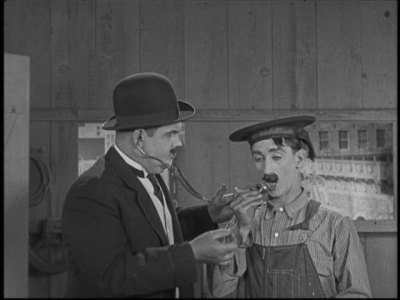
A scheming woman by the name of Verbena Singlefoot (Fay Holderness) owes her ex-husband (played by Noah Young, the tough guy in several Harold Lloyd films) alimony. She hits on a plan to marry a sailor who's getting out of the navy; Cyril D'Armond (Clyde Cook.) For reasons that are never explained, she thinks that he's loaded, when in reality he's lost all of his back pay in a shell game. After the marriage and the discovery that he's broke, Verbena and her ex-husband come up with another plan: They insure him for a lot of money, get him a dangerous job, and then help him have an accident.
 |
| |
Hardy only has a very small role in this as the insurance doctor who checks Clyde out. Even so it is an amusing film. Clyde's hapless look works well and his slight frame looks even more meager next to Noah Young. It is easy to see the effect that Harold Lloyd had on this picture. There is a 'thrill sequence' that could have come straight out of a Lloyd picture, with Cook hanging off girders and having hot rivets dropped on him from above. This section was funny and well done, but it also illustrates how proficient Lloyd was at that type of comedy. This film really pales when compared to Lloyd's action work. The thrills aren't as spine-tingling and you don't get the feeling of danger that you do with Lloyd's films. Even so, Should Sailors Marry is a fun film.
Both this disc and The Lost Films of Laurel and Hardy Volume Four have excellent prints though the Lobster restoration looks a little better.
Hop to It (1925): The collection ends with another Bobby Ray short. In this film both Ray and Hardy are bellhops in a hotel. Hardy bosses the not-too-bright Ray around and manages to get both of them in trouble. Add a bag of missing money and a pretty lady, and you've got trouble. This was a fairly straight forward slapstick short that was fun to watch. A running gag of Ray getting room nine and six mixed up because of an inverted number on a door kept getting more and more funny as it went on. There was a cameo by Frank "Fatty" Alexander who was part of the Ton of Fun Trio. He did an excellent job as a hotel guest who just wanted to get some sleep and is constantly interrupted.
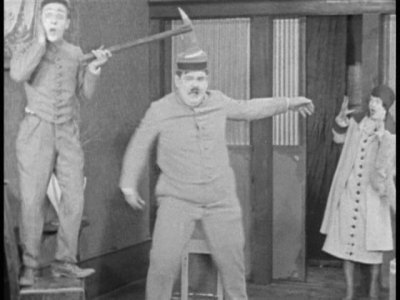
Unlike Stick Around, Hardy plays an unsavory character who not only bosses Ray around but is cruel to him and tries to kill him! Quite a change from their earlier pairing.
The DVD:
Audio:
The audio track consisted of a piano score by Eric Le Guen. I don't recall Le Guen's name from other silent films on DVD, but he did an adequate job. The scores were scene specific and generally added to the experience of watching the film. Being recently recorded, there wasn't any audio defects. A very clean sounding track.
Video:
Like the previous three Slapstick Symposium releases, Lobster films has restored the image on these shorts and has done a very good job. The video quality was outstanding in general. At their best, in films like Should Sailors Marry and 45 Minutes From Hollywood, the level of detail and the contrast is excellent, making the films look like they were recently shot. Even the worst examples look outstanding for movies this old. There are some scratches and the occasional speck or two, but these are minor problems. A very few scenes are a little faded and washed out, but these are only sections, and not the entire film. Once again I am impressed with the job that Lobster has done.
The only cause for concern with this disc is that it was transferred from a PAL master. This means that the speed of the film is accelerated by 4%, which isn't a concern for silent films since there wasn't a standard running speed. A more troublesome matter is that this results in ghosting, where there seems to be a false image during some action scenes. This isn't really a major worry since the vast majority of people won't notice it. It is a subtle defect that is more readily observed if you freeze a frame. While the film is running, it is a minor or nonexistent issue for most people.
Extras:
There are no extras on this disc.
Final Thoughts:
This was a fun disc. Not all of the shorts were great, but there were several very funny films included. Hop to It, Stick Around, and The Sawmill were all very funny. Though Hardy rarely started in his movies before teaming up with Stan Laurel, this set does give some good examples of the types of films he made in those pre-fame days. These films let the viewer discover how he matured as an actor, and how he made his roles more humorous the less he 'acted'. The restored prints that were used for this set were all very good. Avid Laurel and Hardy fans will want to get this for sure, but it is still Recommended for more casual slapstick fans.
|




| Popular Reviews |
| Sponsored Links |
|
|
| Sponsored Links |
|
|
| Release List | Reviews | Shop | Newsletter | Forum | DVD Giveaways | Blu-Ray | Advertise |
|
Copyright 2024 DVDTalk.com All Rights Reserved. Legal Info, Privacy Policy, Terms of Use,
Manage Preferences,
Your Privacy Choices 
| |||||||