
| Reviews & Columns |
|
Reviews DVD TV on DVD Blu-ray 4K UHD International DVDs In Theaters Reviews by Studio Video Games Features Collector Series DVDs Easter Egg Database Interviews DVD Talk Radio Feature Articles Columns Anime Talk DVD Savant Horror DVDs The M.O.D. Squad Art House HD Talk Silent DVD
|
 DVD Talk Forum |
|
|
| Resources |
|
DVD Price Search Customer Service #'s RCE Info Links |
|
Columns
  


 
|
|
|
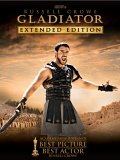
Gladiator: Extended Edition
Gladiator is a flawed film. It's also a film that I like a great deal, and one that I like more after having seen it several times. What's interesting about Gladiator is that it's almost exactly right. It stumbles, but only after reaching ambitiously high and succeeding at just about everything it tries.
Ridley Scott's Gladiator is really three films wrapped up in one, each with a distinct flavor. The first, made up of about the first half of the running time, is absolutely brilliant, telling the tale of Maximus' glory, fall, and subsequent rise as a gladiator. The film opens with a real punch, giving us an exciting battle of the Romans against the Germanic tribesmen while at the same time introducing us to Maximus, the general who is Emperor Marcus Aurelius' dependable right hand. The pacing is handled beautifully, so that stroke by stroke the big picture is revealed: the dying Caesar, his ambitious son Commodus, the uneasy relationship between the royal family and the Senators, some of whom wish to restore the Republic. The tension surrounding Maximus and his loyalty to the throne is underscored in several scenes, and is solidly based in the historical realities of the time: the men who commanded Rome's legions could, and often did, lead those legions in attempts to take the throne. This is a dark and complex world that we're thrown into, and we immediately begin to admire Maximus, who does his duty to the best of his ability while genuinely lacking any ambitions except for personal ones.
Maximus' rebirth as a gladiator is the highlight of the story; to start with, Russell Crowe gives us an excellent performance as a man who's broken down and then rebuilt in a different mold. But everything about this part of the film is beautifully done, from the gritty realism of the gladiatorial school, to the touch of bitter irony in the gladiators catering to the crowd's thirst for blood, to the build-up as the story takes us all the way to Rome and the Colosseum.
It's about this time, halfway through the film, that Gladiator shifts into its second style, which will take almost all the rest of the film except for the last twenty minutes or so. From a story of one man's struggle, the story shifts to a larger canvas of deceit, corruption, and madness in Rome. It's a distinct change of pace after the first section of the film, which is, I think, why I didn't like it as much the first time I saw it, but in fact this part of the story is well done and quite compelling. It doesn't have the power of the opening section, but then, middles are always difficult to handle: the story of a hero's origin is almost always more compelling than the rest of the story. (One clever bit of casting that shows up here is Derek Jacobi as Senator Gracchus; Jacobi is an excellent actor above all, but it also provides an allusion to the classic I, Claudius in which Jacobi played Emperor Claudius – underscored by the fact that Commodus tells young Lucius a story about Claudius in one scene in Gladiator.)
One of the things that I like about this second half of the film is its historical accuracy. Not in everything, mind you; the filmmakers have chosen (unfortunately, I think) to go for a slightly modern touch in some aspects of the film, such as Lucilla's costumes. But overall, the degree of accuracy is impressive. We see it first in the look and feel of Rome, especially the Colosseum, which represents the latest archaeological understanding of how it really looked and operated. The story itself is also true to history, with some acceptable liberties taken for the film: Commodus really was a dangerous madman, and he really was in the habit of fighting in the gladiatorial arena.
In the center of the story, we also get some of the most impressive action set-pieces of the film, such as the re-enactment in the Colosseum of the battle of Carthage. It's an example of a battle sequence done right: the lengthy scene is very exciting in its own right, but at the same time, it also serves to develop the story on several different fronts, giving it a real reason to be in the film.
Then we get to the third part, which fills the last twenty minutes or so of the film. Here Gladiator takes an abrupt turn: from its course as a gritty, sometimes bleak epic punctuated by moments of glory, it suddenly turns into a Hollywood cliche-fest. A touch of romance is shoehorned in and feels out of place, and the ending is pure eye-rolling cheesiness. Not the climactic battle, mind you, but the somewhat overdone lead-in to it, and above all, the dramatic speech-making at the end, complete with an assembled audience of characters who really have no particular reason to be in the scene. It's here that Gladiator's seriousness tips over into absurdity, and it's this ending that holds the film back from being a truly spectacular piece.
It's interesting to note, though, that the weak ending of Gladiator doesn't hamper the film nearly as much as I'd expect it to. Some movies are completely spoiled by a bad ending; Gladiator manages to stand squarely on its genuine merits despite the blow at the end. I think that's one of the things that makes it rewatchable; you can appreciate the majority of the film, and just roll your eyes at the Hollywood ending.
Repeat viewing also brings out unexpected depths in the film. One of the things that struck me on this viewing of Gladiator, in 2005, is just how well it works as a political commentary... entirely, I suspect, without intending to be anything of the sort. Gladiator depicts the Roman Empire at the height of its strength; it was the superpower of its day, either directly controlling or politically influencing a vast part of the known world. The Romans were the high technologists of their day, and the Roman army was considered invincible, again by virtue of its grasp of high-tech warfare: their regimented troops with the latest in war machines were considered to be far superior to the disorganized, low-tech "barbarians" whose lands the Romans conquered. And so they were... for a while.
So even in the historical setting, there are plenty of parallels to draw between the Roman Empire and the current-day United States; the particular events of Gladiator make the connection even more interesting. The Roman Emperor, Marcus Aurelius, feels compelled to wage war to conquer the Germanic tribes... why? For the glory of Rome, of course. And what is the glory of Rome? An idea, nothing more; Marcus Aurelius hints to Maximus that this idea of Rome may be nothing but a dangerous illusion, but Maximus rejects the thought, since he can't bear to consider that the deaths of his men in the Germanic wars were for nothing. (See any connection?) This ambivalence about the glorious (?) identity of Rome lies quiet through much of the film after this point, until it starts to rise again with Commodus' handling of the Roman people. Rome, we learn, is the mob; and the mob is happy if it has its bread and circuses, even if those circuses are bought at the price of future security (something that's made clearer in the extended cut of the film). Commodus can take away their freedom bit by bit, and brutally squash any dissidents, but as long as the mob is in love with him as a charismatic leader, his reign of terror can grow more and more complete without complaint.
I don't think that Ridley Scott meant his film to be socially critical, but I think that Gladiator does have an interesting, if perhaps unintended, critical layer beneath the epic. One of the reasons that the Roman Empire is so fascinating is that in many ways it's so similar to our own society, in both cultural and psychological terms; knowing that soon after the time of Marcus Aurelius all the glory of Rome and its civilization would collapse and usher in a long era of cultural darkness, it's hard to avoid considering the possible parallels to our own situation.
The Extended Edition
What does the Extended Edition have to offer over the theatrical version? First of all, I think it's interesting to note that in his introduction to the Extended Edition, director Ridley Scott explicitly tells the viewer that this is not the "director's cut": that in fact the theatrical version is the director's cut. The Extended Edition, then, doesn't represent his ideal film; it's simply an edition that includes a number of previously deleted scenes.
In terms of added running time, the added material is not particularly extensive, running a total of about 17 minutes. It's split up into a number of different scenes, most of them fairly short; some of these scenes are extensions of existing ones, while others are completely new. For instance, we get a scene with Maximus touring the camp hospital after the first battle; a meeting with Lucilla and Gracchus discussing Commodus' madness; Commodus presiding over an execution; and others. A list of the additional scenes can be accessed through the Supplements menu on the Theatrical Edition: a "deleted scene index" provides a capsule description of each scene, and selecting it will play the new scene. About two-thirds of the new scenes were presented in the deleted scenes section of the earlier edition of this film: "Battle Aftermath," "Looking for Strength," "Dye Market," "Meeting at Gracchus' House," "Father and Son," "The Execution," "Spies Close In," "Another Enemy," and "Fighting with Fire."
Four completely new scenes are also included in the Extended Edition: "The Scribe," in which a hapless new gladiator recruit gets some advice; "Stage Directions," in which Maximus is advised to entertain the crowd; "Grain Reserves," providing a new insight into Commodus' madness; and "Quintus Obeys," adding a bit more substance to a scene near the end of the film. In addition, there's at least one very short unmentioned additional shot worked into the Extended Edition; I noticed a brief glimpse of Proximo's giraffes.
The effect of the additional material on the film is subtle but positive. I felt that the characters gained in depth from the new material, with both Maximus and Commodus becoming slightly more well-rounded as characters in this cut of the film. I also found the situation in Rome to be more clearly explained, so it makes more sense why the senators would be conspiring to depose Commodus. It may not be the "director's cut," but all in all I'd say that the extended version is slightly better than the theatrical cut.
The DVD
The Extended Edition is a three-disc set, packaged in an attractive cardboard gatefold case, inside a glossy paperboard slipcase. Both the Theatrical Edition and the Extended Edition are included on the first disc; the second disc contains the documentary, and the third disc contains the rest of the supplemental material. A small photo booklet is also included inside the case.
The menus are nicely designed – taken right from the earlier Signature Series menu design, in fact. They're elegant and easy to use. All the animated introductions, credits, and warnings are skippable, which is always a nice touch.
Video
The question on everyone's lips – or at least on mine, when I got the Extended Edition to review – is this: how is the transfer different from the earlier Signature Selection release? (Note: when I refer to the Extended transfer, I'm referring to both the theatrical and extended versions on the new set. Both have been given the same new transfer.) As with the earlier edition, both films are presented in anamorphic widescreen at the original aspect ratio of 2.35:1.
To start with, it's a completely different transfer. The image quality is different, and I noticed in a few shots that the framing is very slightly different. But what's interesting, though, is that the comparison to the earlier transfer is by no means as clear-cut as one would expect; note that I said the image quality is "different," not "better."
Both transfers show some very slight edge enhancement; both handle colors extremely well, so there's no difference in how the color palette is presented in the two versions. To a very small degree, there's more contrast in the Signature transfer than in the Extended transfer, but it's only apparent with a lot of scrutiny. Both are clean prints.
The bit rates are almost the same, with the Extended having a slightly higher rate, at 8.7 Mbps versus the Signature transfer's 8.2 Mbps. In any case, both are in the "excellent" range.
Where the difference shows up is in the sharpness of the image: the Signature edition looks sharper than the Extended edition. The result is that the Signature edition consistently offers more, and crisper, detail than the Extended transfer. In a frame-to-frame comparison, the result is striking: the earlier Signature transfer offers a richer, more visually interesting image than the new Extended transfer. The Extended transfer is softer, looking almost a little blurred in comparison to the Signature transfer.
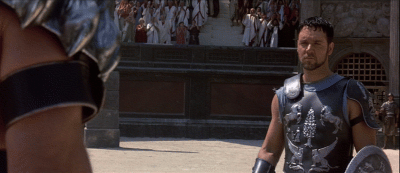
That's not to say that the Extended transfer looks bad – not at all. In fact, it's a visually very appealing transfer, and it's certainly on the high end of DVD transfers. But it's certainly not the improvement on the earlier transfer that I'd have expected, and when it comes to the fine details of the transfer, it falls short. After comparing a number of different shots from different scenes (two of which I've included here), I came to the conclusion that the Signature transfer wins out.
It's almost impossible to see any detail in these tiny screenshots, but here's one comparison between the two transfers. Here we see a frame from the earlier transfer:
And the same frame from the new Extended transfer. Note the difference in level of detail in Crowe's face and armor.
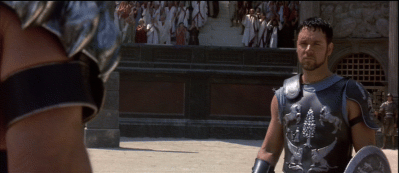
The difference is extremely noticeable in a larger image, although it's barely evident in this tiny shot.
Audio
The big news on this front is a disappointment: there's no DTS track for the films on the Extended Edition DVD. That's right: the awesome DTS 6.1 track from the Signature Series release has been dropped, leaving the Dolby 5.1 as the only English soundtrack. (The Dolby 2.0 has also been dropped.) Inexplicably, a French Dolby 5.1 has been added.
The Dolby 5.1 soundtrack offers a solid overall listening experience, though it's not up to par with the DTS from the earlier edition. The surround is handled extremely well, with extensive use of the side and rear channels to create a dramatic sense of being in the middle of the action. With Gladiator's spectacular battle set-pieces, the surround sound certainly adds to the thrills. The music is also handled well, with a nice immersive feel to it. However, the dialogue is not handled nearly as well; it usually feels slightly muffled, and doesn't stand out as well as it should against the background sound. In a comparison of the same scene with the Dolby 5.1 and the DTS from the earlier edition, the DTS definitely offers a crisper, cleaner presentation of the dialogue, as well as providing extra depth and richness to the track as a whole.
The Dolby 5.1 surround track gets four stars on the strength of the surround experience, despite the less than optimal handling of the dialogue. In a comparison with the DTS on the Signature transfer, though, it loses out in a major way: the Signature edition's DTS is hands-down superior to the 5.1 that's sadly the only option here.
Extras
Disc 1
For the Extended Edition, we get a whole slate of new special features, starting with a new commentary track on Disc 1. Here we get Ridley Scott and Russell Crowe discussing the film. The two reminisce about their experiences making the film, and we get some interesting tidbits of information. There's no discussion of the added scenes. Overall, it's not very information-dense, and I think that only real commentary enthusiasts will listen to the whole thing. The commentary track is only available for the Extended version of the film.
There's also a "historical and production trivia track" that plays in the form of subtitles. This can be played at the same time as the audio commentary, making a nice combination. The bits of information are, as you might expect, trivia, but moderately interesting just the same. This track is available for both the Extended and Theatrical versions.
Ridley Scott also provides a brief video introduction to the Extended Edition, which plays automatically when you select that version.
Disc 2
The documentary, which clocks in at a substantial three hours and 15 minutes, fills up all of Disc 2. This is an entirely new documentary, titled "Strength and Honor: Creating the World of Gladiator." Seven different sections are included, covering all aspects of the production; viewers can choose a "play all" option, or select the sections individually. The material covered includes story development, weapons, costume design, production journals, the character of Proximo, visual effects, and release and impact. The documentary is very nicely done, drawing in many different people who were involved in the making of the film; it's very much a real documentary rather than a promotional piece.
Disc 3
The balance of the special features are included on the third disc. There's some material of interest here, though nothing to compare to the documentary.
In the "Image and Design" section, there are several short featurettes. "Production Design Primer: Arthur Max" runs nine minutes, and gives an overview of the production design process; there's also a gallery of production design sketches. Several storyboard features are included as well. Storyboard artist Sylvain Despretz gives a 14-minute storyboarding demo; three scenes are also presented with multi-angle comparisons and optional commentaries from Despretz. Ten storyboarded scenes are also included in the storyboard archive.
Lastly in this section, there's a set of six costume design galleries, and three sets of photo galleries from the three main locations of the film.
The "Supplemental Archive" collects the rest of the special features. Four scenes are included in the "Abandoned sequences and deleted scenes" section. These are very incomplete, naturally enough (all the polished deleted scenes made it back into the film, after all). It opens with a seven-minute featurette on an alternate title sequence that was designed for the film, followed by the alternate title sequence itself. The "Blood Vision" scene is a mix of storyboards and outtakes, and has an optional commentary from Ridley Scott. "Rhino Fight" is a sequence that was planned but never filmed; we see storyboards and a CGI rhino test. It has an optional commentary with Sylvain Despretz (which is recommended; all these scenes are much more interesting with the commentary on). Lastly, one short deleted filmed scene, "Choose Your Weapon," is also included.
Another featurette, called "VFX Explorations: Germania and Rome," runs 23 minutes, is included here, along with a set of trailers and TV spots for the film.
Final thoughts
It's a tough call to give a recommendation for this DVD. As far as the film itself goes, I liked the extended cut slightly more than the theatrical cut, as the additional footage works well and gives a bit more depth and context to the story. But I have to consider the whole package here, and the truth is that the Extended Edition falls short of the earlier Signature Series edition for both video and sound quality. The difference in the video quality is very subtle, but it's still disappointing that the new transfer isn't quite as good as the one on its predecessor. The lack of the DTS track is the real deal-killer in my book. For a film with such a great soundtrack and such epic battle scenes, the DTS really makes a big difference in the overall experience. The Extended Edition's 5.1 track is very good, but it's hard to accept a step down in audio quality for a new edition.
Gladiator is a great film to own, and as the star ratings show, this is a solid presentation... but the earlier Signature Series edition offers a better presentation (and has plenty of special features, too). The Extended Edition is worth watching once, to see how the film plays with the additional footage, and it also has the excellent documentary on Disc II, which is certainly worth seeing. Get the Signature Series edition for your collection, and rent this one to check out the new material.
|


| Popular Reviews |
| Sponsored Links |
|
|
| Sponsored Links |
|
|
| Release List | Reviews | Shop | Newsletter | Forum | DVD Giveaways | Blu-Ray | Advertise |
|
Copyright 2024 DVDTalk.com All Rights Reserved. Legal Info, Privacy Policy, Terms of Use,
Manage Preferences,
Your Privacy Choices 
| |||||||