
| Reviews & Columns |
|
Reviews DVD TV on DVD Blu-ray 4K UHD International DVDs In Theaters Reviews by Studio Video Games Features Collector Series DVDs Easter Egg Database Interviews DVD Talk Radio Feature Articles Columns Anime Talk DVD Savant Horror DVDs The M.O.D. Squad Art House HD Talk Silent DVD
|
 DVD Talk Forum |
|
|
| Resources |
|
DVD Price Search Customer Service #'s RCE Info Links |
|
Columns
  


 
|
|
|
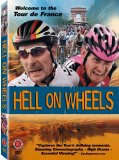
Hell on Wheels
If you've seen television footage of the Tour de France, particularly a mountain stage, you've seen the riders suffering: sweating, grimacing with pain as they push themselves to the limit, leaping off the front of the pack with a heroic effort, dropping back after giving their all for a teammate, facing danger in high-speed crashes. It looks tough and it is tough... particularly when you realize that the Tour consists of twenty-one stages over a grueling three weeks, and that most of the riders have been racing for months in other events on the racing calendar. What's it really like? The television race coverage displays the tactics, strengths, weaknesses, and heroic efforts of the riders to win the stages or take the coveted yellow jersey, but it doesn't show us what the riders do, think, and feel behind the scenes. That's what Hell on Wheels does: takes us past the surface and shows us the depth of courage and commitment that pro riders call up every single day on the job.
Hell on Wheels takes a specific, tight focus: one team, and more particularly a handful of riders on that team, during the 2003 Tour de France. The team is T-Mobile, the main riders are Erik Zabel and Rolf Aldag, and that year's Tour was one of the most exciting in a decade (as you can see in the race DVD). It's a great choice of emphasis; T-Mobile (formerly Telekom) is one of the great cycling teams currently on the circuit, and Erik Zabel is one of the all-time great riders for his phenomenal career of sprint wins, Classic victories, and multiple wins of the green points jersey in the Tour. What makes it perhaps more interesting, though, is that the 2003 Tour was not a great one for T-Mobile. Their lead rider Jan Ullrich had transferred and was riding for Bianchi during that Tour (though he would subsequently transfer back to T-Mobile), so they had no clear-cut candidate to challenge for the yellow jersey, and for the sprints Zabel had a frustrating lack of success coupled with injury. As a result, what we get is a great, revealing insight into a pro team without the glamor of victory and publicity hanging around it.
As a dedicated cycling fan, I immediately loved the in-depth, behind-the-scenes look at one of my favorite riders, Erik Zabel. Anyone who's followed pro cycling for any length of time knows that Zabel is not just a great rider, he's a truly amiable and all-around nice guy. He's cheerful and modest, never displaying the outsized ego that some winning riders develop, and I'm always ready to cheer him on to victory. But even if you've never heard the name of Zabel before watching this documentary, he's a perfect figure to follow, as it's very clear that he's a regular guy: a talented, fit, extremely tough guy, but a regular guy none the less. The names of Rolf Aldag and Andreas Klöden are likely to be less familiar to most viewers even than Zabel's, but they're important figures on the team as well, working to help Zabel succeed, and facing up to stress and disappointment with a bravery that any viewer will have to admire. We see less of Alexandre Vinokourov, but cycling fans will certainly enjoy seeing some behind-the-scenes material on this rider, who's one of the most exciting riders to watch in racing today.
The documentary film, directed by Pepe Danquart, tells its story by immersing the viewer in the Tour from start to finish. There's no narrator explaining things to the viewer; instead, we get the details from the participants, through a wealth of interviews. The riders, particularly Zabel and Aldag, candidly share their thoughts, reactions, hopes, and fears about the Tour, and talk about what it takes on a day to day basis to ride in the pro peloton. One of the things that makes Hell on Wheels engaging is that these interviews are never staged: instead, the camera follows the riders throughout their ordinary day and captures short interviews with them on the spot, whether they're getting a massage, having a hearty breakfast of pasta, or kicking back in the hotel room to unwind after a tough stage. The editing is very well done, as the rider's words are often used as a continuing voiceover while the camera captures what the riders are doing as they prepare for a stage, ride it, or settle down afterwards.
Not only does this approach make for a more lively and varied presentation, it allows viewers to get a unique insight into what the riders' daily lives are really like, and provides context for their anecdotes about racing. For instance, when Rolf Aldag is explaining why riders shave their legs, he's actually in the shower doing the shaving, and when a rider comments about the pain he's suffering after a crash, we see him bandaged up, trying to find a less uncomfortable position to get some sleep. Even when we don't have one of the riders addressing us directly, the behind-the-scenes approach captures the byplay of the riders and the overall atmosphere of a pro team. Little details can be revealing: for instance, hearing the team director alternate between German, French, and Italian when he's giving instructions over the team's radio really brings home the international character of this team (and pro racing in general).
Hell on Wheels also includes material that gives a perspective on the Tour de France and its place in French (and world) culture, which is appropriate considering that the 2003 Tour marked the race's centenary. Interwoven with the material on T-Mobile is footage of the early pioneers of the Tour, riding under conditions that were even more brutal and challenging in many ways than the modern race. We hear from a historian of the Tour as well as others commenting on what they feels is important about the Tour. This is interesting material, perhaps more so if you are not familiar with cycling history and culture at all, but I don't think it's quite as good as the main focus of the film on T-Mobile.
When all's said and done, Hell on Wheels succeeds admirably in capturing the feel of professional cycle racing, showing the extreme demands it puts on riders both physically and emotionally. We get to know the riders as human beings doing a difficult, often painful job that has its moments of pure excitement and that offers a continual challenge. There's always another breakaway to catch, another stage to race, another season to compete, another dream of glory to chase. The film shows some of the key moments in the 2003 Tour - Armstrong's fall, Beloki's accident, Hamilton's courage in finishing with a broken collarbone, Ullrich's challenge for the lead - but the focus always stays on T-Mobile, one team among many in the Tour, with its own goals for the race that don't include fighting for the overall lead. That's a smart choice, as it keeps the film doing what it does best, giving an intimate portrait of life behind the scenes.
The DVD
Video
Hell on Wheels is presented in an attractive anamorphic widescreen transfer, at its original 1.85:1 aspect ratio. Colors look good and the print is nicely clean and clear. There's some pixellation here, and longer-distance shots are not necessarily very sharp, but close-ups look very good, and overall the image is pleasing to the eye. If you're used to seeing cycling just from racing footage, it's interesting to see the difference in visual "feel" that we get here with the different type of cameras: overall, it has a richer and more filmlike feel to it.
The English subtitles are burned in. They're clear and easy to read.
Audio
The German soundtrack (with some portions in French) is always clear and distinct, and well balanced with the music and other sound effects in the track. Though it's just a 2.0 track, it has a nice fullness to it that goes well with the material. English subtitles (non-optional) are provided.
Extras
Just a few special features are included here. There's a seven-minute set of extra scenes, a photo gallery, a trailer for the film, and a set of trailers for other First Run Features films.
Final thoughts
Hell on Wheels is that rare documentary that can be fully enjoyed by both devoted fans and newcomers to the sport of cycling. Both will appreciate the way that the film captures the gritty feel of racing the Tour, showing what life is like for pro riders on a day-to-day basis, while fans will also get a kick out of the film's focus on one of cycling's great riders, Erik Zabel. Overall, Hell on Wheels has much the same flavor as the classic cycling documentary A Sunday in Hell (which covers the Paris-Roubaix race rather than the Tour de France), and viewers who enjoyed one of those will surely enjoy the other. I'll give Hell on Wheels a solid across-the-board "highly recommended" rating.
|



| Popular Reviews |
| Sponsored Links |
|
|
| Sponsored Links |
|
|
| Release List | Reviews | Shop | Newsletter | Forum | DVD Giveaways | Blu-Ray | Advertise |
|
Copyright 2024 DVDTalk.com All Rights Reserved. Legal Info, Privacy Policy, Terms of Use,
Manage Preferences,
Your Privacy Choices 
| |||||||