
| Reviews & Columns |
|
Reviews DVD TV on DVD Blu-ray 4K UHD International DVDs In Theaters Reviews by Studio Video Games Features Collector Series DVDs Easter Egg Database Interviews DVD Talk Radio Feature Articles Columns Anime Talk DVD Savant Horror DVDs The M.O.D. Squad Art House HD Talk Silent DVD
|
 DVD Talk Forum |
|
|
| Resources |
|
DVD Price Search Customer Service #'s RCE Info Links |
|
Columns
  


 
|
|
|
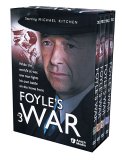
Foyle's War - Set 3
The British program Foyle's War is turning out to be one of the most consistently good mystery series that I've seen. Perhaps it's because each season has only four feature-length episodes, meaning that each can be carefully constructed and nicely polished. In any case, the third set of Foyle's War continues the trend in Set 1 and Set 2: this is a high-quality series on all counts.
Foyle's War is an interesting blend of historical fiction and traditional mystery. Set during World War II, the program is moving gradually through the war years, focusing on DCS Foyle's efforts to make a difference on the home front, even as the war is going badly elsewhere. The painstakingly accurate settings and stories transport us right into the middle of a tense and difficult situation, and give us a compelling glimpse of life under the constant dread of attack. Rationing, blackouts, air raids, requisitioning of houses, and bomb shelters are all part of the background to the stories here, and we get a sense of how the characters feel unsettled and fearful about the future. That's just the background, though: each episode tells an intriguing mystery story. Each one relates in some way to the war, some directly, others simply through the fact that the war effort pervades every aspect of English life at the moment, making the series overall very distinctive in its focus and flavor.
One of the most important ingredients in a mystery series is the character of the detective, and the performance by the actor in that role. I've found that the detective character exerts a powerful influence on the program as a whole. Even if the writing of the mystery plots is equal on other counts, the degree to which I like and am interested in the detective makes a big difference in how much I enjoy the program. If I dislike the detective (as in A Touch of Frost), think he or she is uninteresting (as in Hetty Wainthropp Investigates), or find the detective to be too bland (as in Midsomer Murders), then it's hard to really get hooked on the series. On the other hand, a great character (like David Suchet's Hercule Poirot) becomes much more than the "camera eye" for the audience: he becomes an important part of the story.
With that in mind, it's clear to me that Michael Kitchen's performance as Detective Chief Superintendent Foyle is absolutely central to the success of Foyle's War. Foyle is a complex character and an immensely likable one: he's highly ethical and devoted to the truth, but he also understands that there are many shades of gray in between the extremes of black and white. Foyle is also observant and brilliant... and a man of few words. That's a hard combination to play, but Kitchen handles it extremely well. His Foyle is understated but expressive, able to speak volumes with a single look or a short comment. By the time we've gotten to this third season, we know Foyle's assistant Milner, his driver Sam, and his son Andrew fairly well by now, and seeing how these characters interact with Foyle adds to the interest of the episodes as well.
The four episodes in Set 3 take place in 1941, and offer the same blend of complex stories and difficult ethical situations as the previous two sets. The set opens with the excellent "The French Drop," in which Foyle's investigation of a suspicious death puts him in the middle of a power struggle between two military intelligence agencies. This episode starts off with an intriguing situation and keeps the story unfolding nicely from start to finish. "Enemy Fire" is more of a traditional Agatha Christie-style mystery: about half of the episode sets up a situation leading to a murder, with a number of suspects all having both motive and opportunity for the deed. It's a bit slower to get started than "The French Drop" but is nonetheless quite entertaining. "They Fought in the Fields" puts Foyle and Milner right in the middle of war-related affairs as they capture a pair of German soldiers, while they also have to unravel a local murder case. The set wraps up with "A War of Nerves," as Foyle deals with an organized crime racket at the same time that major events are unfolding on the continent.
Throughout all four episodes, we get one of the greatest strengths of Foyle's War: the depiction of conflicts of interest and difficult situations at all levels. Foyle's relentless pursuit of the truth in his investigations often puts him at odds with the establishment and the rich and powerful, who have far less compunction about bending, breaking, or ignoring the law. Foyle's War offers no easy answers, but by giving us a sympathetic and interesting protagonist who struggles with these issues, the series makes for a thought-provoking viewing experience.
All the episodes are presented in their original 100-minute length, as aired on British television, not the cut versions that aired in the U.S.
The DVD
Foyle's War: Set 3 is a four-disc set, with each episode on its own DVD and the whole packaged in a glossy paperboard slipcase.
Video
Foyle's War appears in its original widescreen aspect ratio (1.85:1) and is anamorphically enhanced. The image quality is excellent, with warm, natural colors and a good handling of contrast even in quite dark scenes. There's not even a hint of edge enhancement even in challenging high-contrast shots, so while some of the shots seem a little bit soft, the overall level of detail is excellent.
Audio
The Dolby 2.0 soundtrack does a solid job of presenting the episodes. The dialogue is always clean and clear, and the lovely theme music for the series is balanced nicely with the rest of the track.
Extras
The first DVD, "The French Drop," has a 24-minute "The Making of Foyle's War" featurette that's reasonably interesting. Don't watch it until you've seen "Enemy Fire," though, since the featurette actually focuses on that episode and the clip at the beginning is a spoiler.
Each of the four DVDs also has a selection of text information: production notes, reflections from various cast members, historical background information, and cast filmographies.
Final thoughts
Foyle's War continues to excel. In Set 3, we get four more feature-length episodes of this acclaimed British mystery series, on a par with the excellent Set 1 and Set 2. Not only are the stories and characters compelling, but the depth of historical research that goes into each episode, set in England during World War II, means that we're also getting a lot of insight into an important period in modern history. With this high-quality content matched up with nice anamorphic widescreen transfers, it's easy to give Foyle's War: Set 3 a "highly recommended" rating.
|



| Popular Reviews |
| Sponsored Links |
|
|
| Sponsored Links |
|
|
| Release List | Reviews | Shop | Newsletter | Forum | DVD Giveaways | Blu-Ray | Advertise |
|
Copyright 2024 DVDTalk.com All Rights Reserved. Legal Info, Privacy Policy, Terms of Use,
Manage Preferences,
Your Privacy Choices 
| |||||||