
| Reviews & Columns |
|
Reviews DVD TV on DVD Blu-ray 4K UHD International DVDs In Theaters Reviews by Studio Video Games Features Collector Series DVDs Easter Egg Database Interviews DVD Talk Radio Feature Articles Columns Anime Talk DVD Savant Horror DVDs The M.O.D. Squad Art House HD Talk Silent DVD
|
 DVD Talk Forum |
|
|
| Resources |
|
DVD Price Search Customer Service #'s RCE Info Links |
|
Columns


 
|
|
|
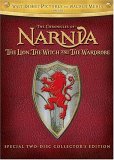
Chronicles of Narnia - The Lion, the Witch and the Wardrobe, The
CS Lewis' classic children's book The Lion, the Witch and the Wardrobe holds a special place in many readers' hearts, usually alongside Tolkien's The Lord of the Rings. The authors, in fact, were long-time friends who (as members of a literary group called the Inklings) even critiqued each others' work. The parallel between the two books continues in the fact that the narrative power and visual appeal of both these stories beg for them to be brought to the screen... and that the very nature of the stories made this difficult to do well. That is, until computer-generated animation came of age in moviemaking. Now we can have believable fauns, centaurs, giants, and lions inhabiting a gorgeous fantasy landscape; we can (if it's done well) have a Narnia (as we had a Middle Earth) that allows us to see it, at least to some degree, the way we have imagined it.
But while good CGI is essential for creating a successful Narnia, it's only a prerequisite. More importantly, the filmmakers also have to have a sense of what the book is really about, what it feels like, what the emotional tone of the story is. They have to understand that translating a book to film is not as simple as filming each scene as it's described in the original – that changes will have to be made in the details in order to get the overall picture right – while also respecting the integrity of the source. Again, The Lord of the Rings is in the vanguard here, as Peter Jackson's epic film rendition of Tolkien's masterwork showed what a faithful and exciting film of a classic novel could be.
The Lion, the Witch and the Wardrobe is comparable to The Lord of the Rings in that it has the same requirements for a successful film adaptation, and the success of Jackson's trilogy almost certainly served to encourage Andrew Adamson to tackle Lewis' famous book. After that, though, the two works (and the two films) are very different, and these differences make The Lion, the Witch and the Wardrobe quite challenging to adapt into a successful film.
One major difference is in the scale of the story. Yes, both The Lord of the Rings and The Lion, the Witch and the Wardrobe ultimately feature an epic battle to determine the fate of the entire world, but in Tolkien's novel, almost the entire story is on the epic scale. The literal fate of armies, nations, and the whole world hangs in the balance; the individual characters are important not so much in their own right, but rather as our entry into this larger-than-life world.
In contrast, Lewis' Narnia books work on a much more personal scale. The central issue in The Lion, the Witch and the Wardrobe is personal growth: all four of the children must learn how to take responsibility for themselves, each other, and the people around them; and Edmund in particular must learn how to be a better person. He's not a bad person at the start of the book, just a rather self-absorbed boy who wants attention and doesn't quite know how to get it in a positive way. That's what makes the story of sacrifice and redemption much more effective. If the White Witch had planned to kill Peter, who always steps up to take care of his younger brother and sisters, or Lucy, who is the youngest and also the sweetest and most innocent, we would have no trouble in thinking that a sacrifice might be necessary to save them. But Edmund? He's rather an obnoxious little twit who is willing to sell out his family for sweets and the promise of one-upping his elder brother. Do we really feel comfortable with Aslan interceding for him?
Here's where we see the first challenge in adapting the book. In the original story, we see inside Edmund's head; we know that he's not really a bad sort. It's not that he doesn't love his brother and sisters, it's that he tends to brood on what he feels are slights against him, and he resents being bossed around. He's not deliberately malicious – if he were, we'd really hate him – but rather just unthinking. He doesn't really consider the consequences of what he's doing, or reflect on how his actions may hurt other people. (In short, he's a rather typical person.) It's a challenge to bring that to the screen, but it's also central to the effectiveness of the story.
The difficulty in adapting The Lion, the Witch and the Wardrobe to the film format shows up here, as the filmmakers try to make the intensely personal elements of the book work out visually. The challenge begins with the casting of the children, and here I think the film works much better than I might have expected. The children seem realistic and also true to their counterparts in the original book. Peter is clearly a good and responsible person, but not a goody-two-shoes; Lucy is sweet and curious, even if she is cast here as significantly younger than I would have expected; Susan actually comes across as having a personality, so I'd say that the filmmakers improved on the book here; and Edmund is successful in the most challenging of the roles, as the young actor manages to take his character from being a snotty brat (but a realistic one) to being a decent boy.
The opening scenes of the book, featuring the children's evacuation from a London suffering from German bombings in World War II, are entirely new to the film, and I see them as an attempt to make some of the personal level of the story more accessible. In the book, we get a much clearer sense of the children's emotional responses to Narnia and Aslan, and so it makes sense for them to immediately participate. Since this reaction is difficult to capture on film, the approach the filmmakers have taken is to emphasize the children's reactions to the genuine horrors of war. We get a sense of how the children are fearful of war and aware of its human cost, and in the film, the children debate much more often, and more seriously, than they do in the book about whether or not to help out the people of Narnia and fight for Aslan. By the time they do commit to helping Narnia, we get a sense that it is the right thing to do.
The effect of Aslan himself is another challenge on the level of characterization. He is a mysterious and awful figure, in the older sense of "awe-full," inspiring awe and respect with a tinge of fear. In the book, Lewis takes pains to note the children's responses to even hearing of Aslan for the first time. Throughout the book, Aslan becomes better known to the children (and by extension the reader), but it's always very clear that, as one of the animals points out, he is "not a tame lion." It's important that we never become over-familiar with him, or think of him just as another rather impressive-looking talking animal. I'd say that in this regard, the film squeaks by; Aslan is a regal presence but not always as powerful a one as he is in the book. That's not a surprise, considering that Lewis creates Aslan's majesty through internal reactions by the characters rather than by outward appearances or actions by Aslan. To give credit where it's due, though, Aslan comes off much more effectively than I expected. His key scene at the Stone Table is the central scene in the story, and the film manages to capture most of what's important here: the sense of pity and horror, Aslan's sadness, the fearsomeness of the White Witch. Some of the material here does feel a bit rushed on-screen, and I think that the pacing should have been slowed down just a bit, but even so it's a reasonable handling of a tough scene.
So far I've been talking about how Lewis' world of Narnia is challenging as a film project because of its personal focus, rather than the epic focus in the very visual The Lord of the Rings. The other difference between the two projects is in their respective worlds. Tolkien's Middle Earth is an invention of whole cloth: Tolkien brought his fantasy world to life with not just its own varied natural and political geography, he created whole races and their cultures, languages, and histories, to a depth of detail that had not been seen before and has not been seen since. The Lord of the Rings takes place in a world that is fully internally consistent, one that has epic motifs that we can recognize from other myths and stories, but one that is clearly its own, individual, unique world.
In contrast, Lewis' Narnia - especially the Narnia of The Lion, the Witch and the Wardrobe - is a hodgepodge. We have a host of magical creatures from Greek myth, such as the fauns, dryads, centaurs, and minotaurs, but many of them seem to behave in a decidedly English fashion. One gets the feeling that Lewis himself would have been quite at home in Mr. Tumnus' tidy bachelor cave, with its toast and sardines. Other elements come from Norse mythology, like Maugrim, the wolf who is captain of the Secret Police. We have talking animals, more commonly seen in fairy tales and stories for very young children. The "medieval" world of castles and knights with swords is punctuated by elements from the modern day, like Tumnus carrying an umbrella. At one point, Father Christmas makes an appearance, even! And in contrast to the light tone that's suggested by the talking animals and incongruous elements of the setting, we have the White Witch and Aslan: two figures cut from the darker, more powerful fabric of myth.
There's no way to tidy up Narnia; the mismatched elements of its story are either part of its charm, if you enjoy the books, or something that will drive you crazy. (Incidentally, Tolkien fell into the latter category.) Faced with this problem, the filmmakers here have taken the approach of trying to bring Narnia closer to Middle Earth; to handle The Lion, the Witch and the Wardrobe in such a way that it takes on some of the characteristics of The Lord of the Rings. For the most part, the film follows Lewis' original book quite closely, but there are a few important areas in which the film diverges from the book.
To begin with, the fantasy world feels like it's been made a bit more consistent; the Beavers, for instance, are less anthropomorphized, with no sewing machines or snow boots, and the various beings in the Narnian army are presented with an attention to detail that is certainly not present in Lewis' book. More importantly, whenever it's possible, the filmmakers have nudged the atmosphere of the world toward the serious epic tone, away from the slightly comic tone that's sometimes hinted at in the book. The battle scenes are given more prominence and are more frightening. Father Christmas is very wisely presented in a completely serious way; he's presented like a mysterious wizard helping the children, a figure from folklore that fits in with the rest of the world, rather than as a stock figure inserted from our own culture. A comic scene with the Giant Rumblebuffin is left out, making the scene with the statues in the White Witch's castle more serious. The White Witch herself is a major strength in the film: she is frightening and impressive, beautiful and creepily cold, exactly as she ought to be.
These are all small tweaks. The larger changes come in the form of entire sequences that are added or significantly changed. The film contains significantly more action than the book does. The flight of the Beavers to get the children to safety is considerably extended, with the Secret Police bursting into the hut practically on their heels, along with a chase sequence over the frozen river, and a confrontation at the falls, that are completely new. In the original book, Lewis emphasized the ordinary discomforts of being on the run: being cold, hungry, tired, cranky, and so on; he presented the characters with threats, to be sure, but generally on a different level of urgency than the Hollywood chase scene. The added material in the film version isn't bad, but I wouldn't say that it really does that much to improve the story, either.
One area in which the film does improve on the original is in the battle and combat sequences. The one fight scene that's scripted exactly the way Lewis wrote it – Peter's fight with Maugrim – is pretty weak, as it is in the book. On the other hand, the battle scenes, which Lewis basically glosses over, are visualized here in an exciting way, so that we really get a sense that the forces of Narnia truly have a tough fight on their hands to get rid of the White Witch. There's a genuinely epic feel to these battles.
The third big challenge for the makers of this film is in its handling of religion. It's possible to read The Lion, the Witch and the Wardrobe and not have the slightest indication that it reflects Lewis' spiritual views; it's also possible to read it and see a direct and literal parallel between the story and key elements of Christianity. Which is right? In a sense, both and neither. Yes, The Lion, the Witch and the Wardrobe is fundamentally shaped by Lewis' Christian beliefs; he started out wanting to tell a good children's story with some key imaginative images in it (the faun with the umbrella was one of the earliest), but he also wanted to find a way to convey a meaning and an emotional experience that he felt was deadened in real life by the routines of Sunday-school instruction and ordinary expectations about what one "ought to feel" on certain topics.
My own reaction to the Christian element in The Lion, the Witch and the Wardrobe has changed over the years. As a child reader, I didn't notice any of it. When I re-read them as an adult, at first I was appalled. Was Lewis trying to pull a fast one on me, slipping in some propaganda into an innocent story? Later on, though, I realized that this was an overreaction and one that didn't give Lewis the respect he deserved. He's not trying to "sell" his worldview, in the sense of pushing it on the reader; instead, he's trying to share with the reader ideas and feelings that he believed were vitally important. By exploring these ideas in an imagined world, and thus inviting the reader to explore them along with him, Lewis is being true to the tradition of fantasy, which has long been a great vehicle for authors to work with interesting ideas. By staying true to the imagined world and not intruding with his authorial voice to push home a "message," Lewis is being fair to his readers as well as to himself.
How does the film version handle this delicate balancing act? Quite well, actually. Since it is largely faithful to the original book, what I've said about Lewis' approach holds true for the film as well. I'd say that it's a bit more understated in the film, in fact, which is a good idea; the story works much better when the viewer is given interesting things to think about but also given the freedom to think about them in whatever way he or she wants to.
I have two last points to make about the changes made to the film version of the story. US viewers may have noticed that the chief of the Secret Police is called Maugrim, rather than Fenris Ulf. In fact, the British editions do have the character named Maugrim, but for some odd reason, the US editors for the books decided to call the character Fenris Ulf instead. So in this case, the film is making a little nod toward real authenticity.
The film does one other thing that warms my heart for its authenticity. It starts off the Narnia series as it should be: with the first book that Lewis wrote, The Lion, the Witch and the Wardrobe. In the past few years, it has become a new fad to re-order the seven Narnia books in internal chronological order rather than publication order, thus placing The Magician's Nephew, the next-to-last book, in first place. This is a really, truly dreadful thing to do, because The Lion, the Witch and the Wardrobe is the book that introduces us to the world of Narnia, just as the four children are introduced to it. In The Magician's Nephew, many of the mysterious magical elements of Narnia are explained... but unless you've experienced the preceding five stories, you don't know why these particular elements are special and interesting. Furthermore, this ordering of the books spoils some of the events in The Lion, the Witch and the Wardrobe.
Why did we all get put into such a mess? The official word is that this is Lewis' preferred order, but in fact it is not – and as a scholar of literature who did her dissertation on the fantasy novel, including Lewis' novels, I've done the research and I know where the problem arose. Years after the books were all published, one of Lewis' young fans wrote a letter to him suggesting that it was a good idea to put the books in internal order. Lewis wrote back saying he thought that was a fine idea. (And it is – if you've already read the books and want to re-read them in a different light.) But I don't think we should consider this one offhand comment as an indication that Lewis genuinely thought it was the best order; in fact, while Lewis was alive, it stayed as just that, an option that readers could take for themselves. (My 1970 printing of the series has the spines numbered correctly!) Only in recent years has the fad for reordering them taken over, much to my dismay.
So I have to give a big thank-you to the filmmakers for proving my point, and the point of all the other devoted Narnia fans: the best way to start out experiencing Narnia is with this story, The Lion, the Witch and the Wardrobe!
The DVD
The packaging for The Lion, the Witch and the Wardrobe is quite nice. The two DVDs are in a single-wide plastic keepcase that's designed to look like the wardrobe. The keepcase fits inside a cardboard slipcase. Menus are attractive and easy to navigate, with skippable animated introductions.
Video
The Lion, the Witch and the Wardrobe is presented in its original widescreen aspect ratio of 2.35:1, and is anamorphically enhanced. The overall image quality is very solid, though not reference-quality. The image is clear and clean, with the print looking in perfect condition, as indeed it should. The contrast is handled well, which is particularly important since there are a number of low-light scenes throughout the film. Colors look a little bit muted in some scenes, but given that other scenes are very lively and bright, I'd say that this is a choice of the art direction. In any case, all the colors look natural and clean. The one criticism I'd have of the transfer is that it is a little bit on the soft side. I'd have hoped for a very crisp, detailed transfer, but here that's not quite the case. The close-up shots look superb in terms of crisp detail, but the longer-distance shots look a bit soft.
Audio
The audio quality here is excellent. Viewers have the choice of a solid Dolby 5.1 track or an outstanding DTS 5.1 track. Both offer a clean, engaging listening experience. The DTS is definitely the soundtrack of choice. We get a rich, full surround experience, with a nice depth and texture to the sound as well as crisp handling of the dialogue (for the most part: the dialogue in the London scenes at the start of the film seems to be slightly lower than it should be, compared to the other elements of the track). The full surround capacity of the track is used very effectively. The music and ambient effects are consistently spread around to give the viewer a feeling of being immersed in the environment of the film, and when there are action scenes, directional effects are used effectively as well.
French and Spanish dubbed tracks are also included, as are French and Spanish subtitles.
Extras
Viewers will be very pleased with the quality - not just the quantity - of the special features presented here. The material here is interesting and well presented.
The first DVD contains the film with its commentaries. Two complete audio commentaries are included. The first is with director Andrew Adamson and the four child actors: Georgie Henley, Skandar Keynes, William Moseley, and Anna Popplewell. As might be expected, the main content comes from Adamson, who offers some interesting thoughts on the film, while the kids interject with stories of their off-camera antics or what they thought about the different scenes. Much more interesting for an adult viewer is the second commentary, with Adamson joined this time by production designer Roger Ford and producer Mark Johnson. The conversation stays active throughout the film, with the participants offering many insights into the challenges of making the film on a technical level. A "Narnia Fun Facts" option allows viewers to watch the film with pop-up facts about the making of the film showing up on-screen.
On the first disc we also get a four-minute set of bloopers (moderately funny) and trailers for other films.
The bonus content really gets rolling on Disc 2. The first section, "Creating Narnia," contains the bulk of the worthwhile material. In the 38-minute featurette "Chronicles of a Director," Andrew Adamson reflects on the making of the film from start to finish. It's a solid piece with a lot of good information on the making of the film. "The Children's Magical Journey" (26 minutes) focuses on the reactions and experiences of the four child actors, and is reasonably interesting.
The most worthwhile feature is "Evolution of an Epic," which breaks down into several pieces. A four-minute piece called "From One Man's Mind" introduces the viewer to C.S. Lewis; I'd have liked this to be more substantial, but it does a nice job of briefly touching on the important aspects of Lewis' life and literary work. "Cinematic Storytellers" is a 55-minute piece that takes a look at many of the different aspects of bringing the film to life: costumes, the Weta and KNB creature shops, editing, photography, and so on. If you only have time to watch one featurette, this would be the one to choose, though the following one, "Creating Creatures," would be a good second choice. This 53-minute feature looks at the process of creating the various creatures of Narnia, but not just from the mechanical point of view: we also hear about the development of the characters' personalities, the ideas used to develop the creatures, and so on. Finally, this section wraps up with "Anatomy of a Scene: The Melting River" (11 minutes), which dissects the making of a particular action set-piece.
The other section on the second disc is "Creatures, Lands, and Legends," which seems to be more oriented toward the younger set; it doesn't have much material of interest for adult viewers. "Creatures of the World" (14 minutes) gives descriptions of the different creatures of Narnia, while "Explore Narnia" does the same for the important locations in the story. "Legends in Time" is a peculiar feature that takes viewers through a timeline of Narnia events, including from the other books. It's not recommended if you haven't read the other books (as it could spoil things) and it's pointless if you have.
One final "extra" is the inclusion of two postcard-sized pieces of Narnia concept art. I'm not usually a big fan of this sort of thing, but I have to say that the art that's chosen is quite nice: we get lovely watercolor concept paintings of Aslan and the White Witch.
Final thoughts
If you're a fan of the Chronicles of Narnia, you will assuredly like this film version of The Lion, the Witch and the Wardrobe. As a film adaptation of a children's book, it does a very nice job of being a film that's excellent for children and adults alike. It's not perfect, but hits almost all the notes right, and the result is a quite satisfying film. The DVD is quite solid as well, giving us a good video and excellent audio transfer, and a very nice set of special features. Overall, I'll give this a "highly recommended."
|



| Popular Reviews |
| Sponsored Links |
|
|
| Sponsored Links |
|
|
| Release List | Reviews | Shop | Newsletter | Forum | DVD Giveaways | Blu-Ray | Advertise |
|
Copyright 2024 DVDTalk.com All Rights Reserved. Legal Info, Privacy Policy, Terms of Use,
Manage Preferences,
Your Privacy Choices 
| |||||||