
| Reviews & Columns |
|
Reviews DVD TV on DVD Blu-ray 4K UHD International DVDs In Theaters Reviews by Studio Video Games Features Collector Series DVDs Easter Egg Database Interviews DVD Talk Radio Feature Articles Columns Anime Talk DVD Savant Horror DVDs The M.O.D. Squad Art House HD Talk Silent DVD
|
 DVD Talk Forum |
|
|
| Resources |
|
DVD Price Search Customer Service #'s RCE Info Links |
|
Columns
  


|
|
|
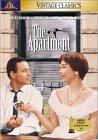
Apartment, The
Perhaps Billy Wilder's greatest romantic comedy, The Apartment was alternately savaged and praised by critics when it emerged in 1960. This story of a nice-guy rat in the big-business rat race succeeds on as many levels as a film can. Wilder retained his nasty streak of cynicism while evoking the heart-tugs of his mentor Ernst Lubitsch, and taught a generation of men that it aspiring to 'mensch' status might be a good idea, personal outlook-wise.
Who would dare malign cinema master Billy Wilder, you ask? Lots of critics. Andrew Sarris said he was 'too cynical to believe his own cynicism." Others mauled him for savaging poor Shirley MacLaine, and condemned her midnight Christmas Eve suicide attempt as the nadir of poor taste.
But oh, are they wrong ... The Apartment is a gem of construction, character development, and thematic clarity. Sure, C.C. Baxter starts out morally compromised. His only hope of getting ahead involves dirty business (would anyone be shocked by Baxter's gimmick today?), and C.C.'s hindsight explanation is that it snuck up on him. The view of the business world is as cold-blooded as anything in Double Indemnity; there's not a doubt that the my-way-or-the-highway mindset is not only accurate, but mild compared to how big companies run today. The same things sorts of things happen, but the added impersonality of ghoulish Human Resources departments would keep any of the duped aspirants from ever finding out exactly why the favored 'buddy boy' got his promotion.
Jack Lemmon is perfect, as he never was before or since - just experienced enough to not be a naive dolt, but not yet grating (The Out-of-Towners) or insufferably obvious (April Fools, Save the Tiger). Shirley MacLaine is adorable, whether showing her spunk in the elevator job, or trying to be discreet about her guilty philandering. And Fred MacMurray plays a heel as only he can, the father of My Three Sons with hardly an inflection altered - just a switch of morals. This trio is supported by what must be the best supporting cast in film history, led by Ray Walston as the sneering Mr. Dobisch, Jack Kruschen (so lousy in the same year's Angry Red Planet) as the wise Dr. Dreyfuss. Hope Holiday's Christmas Eve bar scene with Lemmon is unforgettable. Joan Shawlee and Joyce Jameson are loveable bimboes, and Edie Adams took time off selling cigars in provocative TV ads to play a doublecrossed secretary.
It is of course Wilder and Diamond's incredible screenplay that makes them all better than the sum of their talents. Everyone remembers the great bits of business, rendered so accurately in Joe LaShelle's grey-on-grey B&W Panavision: Baxter marching through endless rows of identical desks, a la The Crowd; straining spaghetti through a tennis racket; the forlorn Kubelik breaking down on Christmas Eve. Jokes and gags are orchestrated for maximum efficiency, and emotional touches that might elsewhere be cliches (such as the cracked hand-mirror) hit like slugs to the stomach. In this triangle of deceit, Baxter's and Kubelik's own weaknesses backfire on them with a you-asked-for-it vengeance; when irony strikes it's never some contrivance, but romantic logic that doesn't care whose heart is broken.
Perhaps the critics were shocked by the idea that the eager young guy actually didn't believe that goodness would triumph with out a little cheating. They might also then be repulsed by a heroine who had a low opinion of herself, always getting the fuzzy end of the lollypop like Marilyn Monroe in Some Like it Hot. Add this to an overall story that saw infidelity and sordidness go unchallenged by any higher morality, and you can understand why they were dismayed. Baxter and Kubelik are decent enough, but not above petty dishonesties to try and get through the lonely nights - what's so bad about that? America's never grown up enough to grow out of fairy tale mentality, where one good deed always results in an avalanche of reformed hearts and merry good will. The way the country is becoming more conservative, I wouldn't be surprised if groups started criticizing the 'low morals' of superior pictures like The Apartment all over again.
Wilder was often accused of brutalizing actresses in his movies - what with their frequent suicide attempts(Sunset Boulevard, Sabrina), even if only a joke in passing dialogue. Baxter even talks about killing himself with a .45 automatic. Here, the depths of depression are all too believable, as poor Fran shivers with tears, alone in 'some schmuck's apartment' with the feeling that she's let herself become a whore. There's a brilliant moment when she 'decides' to kill herself. So many real suicide attempts are described by their makers in the 2nd person - and we don't actually see Fran decide. Instead, a bottle of pills caught in a shaving mirror POV is just there, and, without a cut back to Kubelik, we see a hand reach in and take them, like it's somebody else's hand but ours too, as if we, or Fran, are not responsible.
'Cynical' Wilder manages a gloriously positive ending. Shirley MacLaine's dash through the streets, to Adolph Deutsch's unabashedly romantic music, has got to be her best moment on screen. But there's still reality for the lovers to reckon with. Sure, they're together and they're in love, but they don't have an jop between them. Wilder is famous for nailing a Soviet critic at a European festival, who praised him for making such an anti-American film,. The critic said that only in decadent America could such a story take place, and Wilder shot back that in Moscow it could never happen - because in Moscow there was no such thing as a lendable apartment! Perhaps this got Wilder's blood up for his cold-war joke-athon, One, Two, Three.
MGM's DVD of The Apartment is a nice package. The transfer of the film is far sharper than their old laserdisc. It's 16:9 enhanced, which brings out more details in the complicated wide shots that have ever been seen before. A nice original trailer is included. There's not even a paper insert for this multiple Academy-award winner, and the 16 chapter stops serve to make it impossible to find your way around the show .... the laser of this feature had almost 40.
On a scale of Excellent, Good, Fair, and Poor,
The Apartment rates:
Movie: Excellent
Video: Excellent
Sound: Excellent
Supplements: Trailer
Packaging: Amaray case
Reviewed: June 12, 2001
| |
|



| Popular Reviews |
| Sponsored Links |
|
|
| Sponsored Links |
|
|
| Release List | Reviews | Shop | Newsletter | Forum | DVD Giveaways | Blu-Ray | Advertise |
|
Copyright 2024 DVDTalk.com All Rights Reserved. Legal Info, Privacy Policy, Terms of Use,
Manage Preferences,
Your Privacy Choices 
| |||||||