
| Reviews & Columns |
|
Reviews DVD TV on DVD Blu-ray 4K UHD International DVDs In Theaters Reviews by Studio Video Games Features Collector Series DVDs Easter Egg Database Interviews DVD Talk Radio Feature Articles Columns Anime Talk DVD Savant Horror DVDs The M.O.D. Squad Art House HD Talk Silent DVD
|
 DVD Talk Forum |
|
|
| Resources |
|
DVD Price Search Customer Service #'s RCE Info Links |
|
Columns
  


 
|
|
|
Stargate SG-1: Season 8
Note: the content of this DVD set (and the review) is the same as the previously released Stargate SG-1 Season 8 set; the difference is that the packaging is different (and much improved). If you're already familiar with Season 8, go ahead and skip to the next section.
I admit, I had my doubts about Stargate SG-1: Season 8. I've been a big fan through seven seasons on DVD... could they keep it up? Would the show lapse into formula, unable to sustain the terrific forward momentum of the previous seasons' story arcs? Would the character dynamics falter now that Richard Dean Anderson was taking a smaller role? Especially since the arrival of the Season 8 package on my doorstep came after I'd had some disappointing encounters with sci-fi television, I was in a particularly critical frame of mind. But I should know better by now than to doubt Stargate SG-1 on its ability to consistently deliver a well-written, entertaining story, day in and day out. Once again, Stargate SG-1 has managed to deliver the goods and, in the case of Season 8, even step up the quality a notch.
Cue Jack O'Neill: "Told ya!"
There are a lot of great things about Stargate SG-1, but the one thing that stands out, especially this far into the series, is the quality of the writing. I don't know quite how they do it, but the fact of the matter is that Stargate's scripts are consistently excellent. The plots are engaging and tightly woven. The backstory is used consistently and effectively. Important events are set up in earlier episodes and then followed through in unexpected ways. The characters, who are portrayed as being extremely smart and creative people, behave accordingly, always thinking through the logical possibilities of a situation and making smart decisions; the writers never take the "easy out" of having the characters miss obvious connections or make convenient mistakes to keep the plot going.
What's more, the Stargate SG-1 writers have been learning as they've gone along. Writing excellent one-shot episodes is one thing, and Stargate was pretty good at that from the beginning. (It's important to not take that skill for granted, as a variety of otherwise potentially interesting shows, from Star Trek: Voyager to Andromeda, have been handicapped by a failure to consistently produce even "adventure of the week" stories.) The show's creators didn't rest on those laurels, though, but kept exploring new ways of keeping the story fresh and interesting. That meant using the backstory to create ongoing story arcs, following the path blazed out by Babylon 5 with its season-long arcs within a multi-year overall story. At first, these arcs were only moved forward in selected episodes from each season, but as Stargate SG-1 developed, those arcs kept getting more and more prominent. Now in Season 8, we have this emphasis at its best: most of the season's episodes contribute in some way to one (or more) of the ongoing plot threads, with only the occasional stand-alone episode.
I made the comparison to Babylon 5 in terms of story arcs, and I think it's an apt one. (I also think it's a quite conscious one for the show's writers; there are a number of interesting parallels to the B5 universe, such as Z'ha'dum and what happened to Sheridan, that appear in the later episodes of Season 8.) What's interesting to me as a fan of both shows is the way that Stargate takes B5's pioneering style of storytelling and moves it forward. I think that Stargate's use of ongoing plot threads developed over multiple episodes (and multiple seasons) is by now more sophisticated and more successful than what we saw in B5 as a whole. B5 rushed its final apocalyptic confrontation, resolving all of its most exciting plot threads simultaneously in an episode that didn't live up to its buildup (and that left the show feeling rather aimless for the rest of its run). In Season 8 of Stargate, there's the same sense of a buildup to an apocalyptic finale, but it's handled much better. The pacing is better, and (most importantly) the show's writers managed to create a satisfying resolution that still leaves a number of important cards on the table, or only temporarily removed from play. We have the sense of progress that's important to make the plot threads feel like they're meaningful, while giving us a clear reason to keep watching.
A few changes in casting appear in Season 8 (though nothing like what happens in Season 9). Richard Dean Anderson's character of O'Neill is sidelined slightly, though by no means as much as I'd expected. One thing that's not handled quite as well as it could be is the dialogue and overall character presentation of O'Neill; he's pushed a little too much toward the comic extreme, with pretty much every line being some sort of wise-crack. This was always an essential part of his character, but it dominates a bit too much in this season's episodes.
The episodes with the three-person SG-1 team of Carter, Daniel, and Teal'c work quite well, better in fact than I would have thought, and I think it was a wise choice to not bring on a new, fourth SG-1 member. In terms of the secondary characters, Dr. Fraiser is gone and the replacement remains an anonymous background character, but in contrast we see Walter and Siler get a few more lines and different scenes. General Hammond is no longer a regular recurring character, but he does get in some solid episodes with a more interesting part to play than the typical "hear reports and send SG-1 out" role of earlier seasons.
One of the most notable aspects of Season 8, for me, was how it showcased Amanda Tapping's acting talents in episodes like "Gemini," "Reckoning," and "Moebius." I've always liked the character of Samantha Carter, but it's a fairly "normal" character that doesn't obviously show off the actor's skills. In Season 8, Carter not only gets to play her regular role, but also appear as the "replicator Carter" and an alternate-reality version of herself, and she does a fantastic job of creating characters who have subtly different personalities than Carter, complete with different reactions, intonations, and body language. Some of the minor threads throughout the episodes also pick up on the unresolved issues in Carter's personal life; fortunately, these are handled effectively so that they never take over the episode, and give a satisfying insight into Carter's character without being overdone and becoming soap opera.
I generally like to point out episode highlights, after discussing the season as a whole, but it's a pleasantly difficult task when the season as a whole is so entertaining. The season premiere, "New Order" parts 1 and 2, picks right up on the cliffhanger at the end of Season 7, and gets things rolling in a big way. One key word: replicators. "Lockdown" starts out seeming like a generic filler episode; I know I groaned when I saw yet another "energy being," as that plot device has been worn down to the very limits already... but Stargate does things right and uses it to rejuvenate the Goa'uld plot arc in a big way.
The behind-the-scenes conspiracies on Earth also have their place in Season 8, and I think they're handled better here than in some of the other seasons, as they're a relatively small plot arc here rather than being too drawn out. "Affinity," "Covenant," "Endgame," and "Full Alert" are tightly connected and do a nice job of briskly developing and (mostly) resolving an interesting story. In fact, "Full Alert" has enough of a great story that it feels like it could have been made into a two-parter, but instead it is a fast-paced single episode. (It's worth noting that "Covenant" was written to appear before "Affinity," so some of the references make a bit more sense if you watch them in that order.)
The replicator threat gives Season 8 some of its best episodes. "Gemini" is an extremely well done episode, with a tightly plotted and exciting story. The two-part episode "The Reckoning" ties together the replicators with the Goa'uld threat, resulting in a very intense story that keeps escalating the stakes... but in combination with "Threads" manages to pull off a satisfying and intelligent conclusion.
As always, Stargate handles humor just right, playing things almost entirely straight but with the occasional comic episode. "Zero Hour" contributes to the overall story arc, with Ba'al playing an important role, but it's also a playful episode that has O'Neill dealing with the challenges of running Stargate Command (including a quite funny sub-plot involving an alien plant). "It's Good to Be King" is a light but fun episode that fills us in on what Harry Maybourne has been up to, while also providing an essential bit of story advancement for later in the season. Even in episodes that are completely serious, Stargate's habit of referencing other science fiction stories brings in a nice touch of self-referential humor, as in "Avatar" when Teal'c plugs into a machine that creates a virtual-reality world in his mind. (O'Neill: "Carter, all I heard was ‘Matrix', and I found those films quite confusing.") This episode, though it's one of the few that doesn't contribute much to the overall story arc, is actually quite fun to watch. It's clearly intended to drum up interest in the Stargate video game that was planned at that time (though it was later scrapped), and if you enjoy playing computer games, you'll appreciate the little references and stylistic touches in that episode, but more importantly, it's a well written and entertaining episode even in its own right.
There are only a few episodes that don't live up to the standard. "Sacrifices" is an OK episode if you are a Teal'c fan, as it deals with his relationship with his son, but I don't think it's one of the stronger episodes in the set. "Citizen Joe" is a clip show, so it hardly counts as a full episode. What's more troubling, in light of Season 9, is "Prometheus Unbound," which has Daniel meeting up with a strange warrior named Vala... played by Claudia Black in a clear reprise/parody of her Farscape character, Aeryn Sun. The episode feels completely pointless, and is badly paced, and could easily be forgotten as one of Stargate's less successful "parody of another television show" episodes, except for the fact that Vala returns in Season 9 as a recurring character. No thanks.
The season finale, the two-part "Moebius," is quite an interesting episode. It starts out having a very different feel from the preceding episodes, making it initially seem like an odd choice for a season finale. But as the story proceeds, it becomes more and more engaging. I won't spoil the plot, but I'll just say that SG-1 ends up revisiting characters, locations, and events from the very beginning of the story, back in Season 1's "Children of the Gods," along with having an exciting and entertaining story. You can tell that the actors were all having a very good time, and the episode is full of little touches and references that reward long-time fans of the show.
And in the end, the final scene of "Moebius" is a perfect stopping point not just for Season 8, but for the series as a whole. I would have loved to have seen Stargate SG-1 continue on in the same strong vein as this season, but it was not to be: several of the main actors would choose to be sidelined (Richard Dean Anderson and Amanda Tapping), and new actors would be brought on to replace them (Ben Browder and Claudia Black). Considering that one of the strengths of Stargate SG-1 is the dynamics of the SG-1 team, characters whom we have come to know and love, it's certain that it won't be the same, or anything close to it. Whether you enjoy the new direction of Season 9 or not, it's undeniable that Season 8 marks the end of the main run of the series, and I think that "Moebius" ends on exactly the right note for fans who've loved it and wouldn't want to see it in a different form.
The DVD
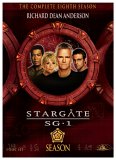
The one new feature of this release of Stargate SG-1: Season 8 is its packaging. The five DVDs contain exactly the same content as the earlier release, but this time they're packaged in just three ultra-slim plastic keepcases, inside a significantly slimmer paperboard slipcase. The result is that the overall set is less than one-third of the size of the earlier packaging. Considering the bulk of the earlier releases, that's a significant improvement. The overall packaging is just as stylish, and the DVDs retain the cute gate-themed art.
Video
The episodes here look really outstanding. All are presented in their original widescreen aspect ratio of 1.85:1, and are anamorphically enhanced. The image is crisp and sharp, with great colors and plenty of detail. Contrast is also handled well, and the picture is always clean and free of noise. I also didn't notice any edge enhancement, and both the CGI and live-action footage is equally attractive. All in all, these episodes look great.
Audio
The Dolby 5.1 track is an example of how great surround sound can add a lot to the enjoyment of a show. There are a lot of action sequences in Stargate, and they're given a great audio treatment, with excellent use of all the surround channels. With the rear and side channels used effectively, along with a nicely full overall sound, we can definitely feel that we're in the middle of a devastating space battle, or dealing with a jaffa patrol sneaking up from behind us. The only thing that's keeping the audio from an extra half star is that in a few scenes, I felt that the dialogue had a very slightly muffled quality to it. Overall, though, the dialogue is consistently clear and distinct, the music is well balanced, and of course the special effects sound appropriately special.
A dubbed French 2.0 soundtrack is also provided, along with English closed captions and French and Spanish subtitles.
Extras
The content of the DVDs is exactly the same as in the earlier set, which I confirmed by comparing the repackaged set to the earlier set in my collection.
Right off the bat, Stargate SG-1 Season 8 gets high marks for special features because it includes commentary tracks for all the episodes except "Threads," featuring a variety of different people involved with the making of the episodes.
Apart from that, we have some additional featurettes on each disc. Disc 1 has a 12-minute piece called "SG-1 Beyond the Gate: An Air Force Experience with Richard Dean Anderson," providing an interesting look at Stargate's relationship with the Air Force as they tried to create a realistic (but also entertaining) show using a real branch of the military. On Disc 2, there are two "Directors Series" featurettes with director Martin Wood: a 9-minute one on "Avatar" and an 8-minute one on "Covenant." There's a lot of plot summary and clips from the episodes here, with a few interesting insights into the making of the episodes tossed in. Disc 3 has another relatively fluffy featurette, "Super Soldier: The Making of a Monster" (14 minutes). It's too heavy on clips from the series, but does have some information on the ideas behind the creation of the Anubis drones for the series. Disc 4's featurette is "Beyond the Gate: A Convention Experience with Christopher Judge," (14 minutes) which is reasonably interesting. Finally, on Disc 5 we have a "Directors Series" segment with director Peter DeLuise on "Reckoning," which runs 16 minutes and offers an interesting behind-the-scenes look at the making of that episode.
Final thoughts
Stargate SG-1 Season 8 is a satisfying, well-made, and intelligent season of a science-fiction show that has been consistently entertaining right from the start. Season 8 is right up there with Seasons 4 and 5, which I consider to have been the high point of the show up until now; Season 8 jumps right into the action and delivers a set of exciting story arcs that develop throughout the entire season. If you haven't been following the show, you would miss out on a lot by jumping in at this late date, and instead you should go back and watch it from the beginning (it's worth it); for fans, Season 8 has all the things that have made the show so much fun all this time. And if you're not planning on following the show in Season 9 because of its dramatic changes in casting and story arcs (I, for one, am not), then Season 8 provides a satisfying conclusion in its finale. I haven't given the show a Collectors Series rating only because it doesn't necessarily work to its best effect considered by itself, but rather as part of the whole series up to this point; I've given it a strong "highly recommended," which Stargate SG-1 fans should interpret as "definitely go out and add this set to your collection."
This re-release is exactly the same as the earlier release, in terms of content; the only difference is the significantly more compact packaging, which is a big plus. If you already own the set, I'm not sure if this will be enough to make you trade up (I suppose it depends on how overflowing your shelves are, but for me, it's certainly worth considering), but if you haven't bought the set yet, I definitely suggest that you get the re-release version, as the packaging is a lot more manageable.
|



| Popular Reviews |
| Sponsored Links |
|
|
| Sponsored Links |
|
|
| Release List | Reviews | Shop | Newsletter | Forum | DVD Giveaways | Blu-Ray | Advertise |
|
Copyright 2024 DVDTalk.com All Rights Reserved. Legal Info, Privacy Policy, Terms of Use,
Manage Preferences,
Your Privacy Choices 
| |||||||