
| Reviews & Columns |
|
Reviews DVD TV on DVD Blu-ray 4K UHD International DVDs In Theaters Reviews by Studio Video Games Features Collector Series DVDs Easter Egg Database Interviews DVD Talk Radio Feature Articles Columns Anime Talk DVD Savant Horror DVDs The M.O.D. Squad Art House HD Talk Silent DVD
|
 DVD Talk Forum |
|
|
| Resources |
|
DVD Price Search Customer Service #'s RCE Info Links |
|
Columns
  



 
|
|
|
Rediscover Jacques Feyder
The French company Lobster Films has been responsible for some excellent DVD releases in the past couple of years and I always look forward to the films that they are involved with. They helped with the restoration of Criterion's release of Under the Roofs of Paris, were largely responsible for Kino's Slapstick Symposium series, and they were the force behind the excellent (and overlooked) Charley Bowers collection. Lobster has created yet another nice collection of silent movies, this time released through Image, with Rediscover Jacques Feyder: French Film Master.
I have to admit that I wasn't familiar with Feyder until I saw this collection and was pleasantly surprised to discover that the three films included in this set are all good movies. Each film is in a different genre, but all of them feature lovely settings, fine acting, and interesting stories. While I wouldn't consider any of these a masterpiece, they are all worth watching.
Queen of Atlantis (L'Atlantide, 1921):
This adventure film starts off with a strange mystery. A member of the French Foreign Legion, Lt. Saint-Avit (Georges Melchior), is found near death in the Sahara desert and brought back to a fort. In his delirium he raves about another officer, Capt. Morhange (Jean Angelo), who has been missing for years, and his rantings seem to imply that he killed Morhange. Eventually the Lieutenant makes a full recovery and declares that he's going back out into the desert and will never return. When one of his fellow officers presses him about what happened and why he's going off again, Saint Avit tells his story.
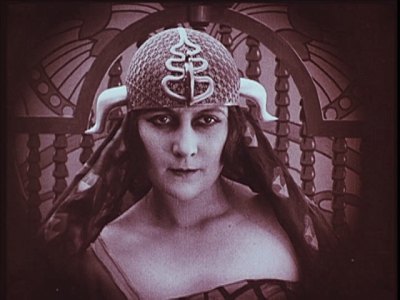
While crossing the desert, Saint-Avit encounters Capt. Morhange and the two decide to travel together. At an oasis they are attacked by bandits, drugged, and taken to the lost city of Atlantis. There they meet Queen Antinea (Stacia Napierkowska), a ruler so beautiful that men instantly fall in love with her. Surrounded but a lush forest which in turn is in the middle of an inhospitable desert, no one ever escapes and if they do they soon come crawling back so that they can see the Queen one more time. Antinea marries frequently, and when she tires of one of her lovers she has them killed and turned into statues that she places in her library. Can Saint-Avit and Morhange resist her charms? If they do, will they ever be able to escape?
 |
This was a classic turn of the century adventure in the spirit of H. Rider Haggard's She. It has all of the elements; a lost city, a beautiful and powerful evil woman, and intrepid explorers. I've often found these types of stories to drag in the beginning, but this film gets over that by having a mystery unfold right off the bat. Just how Saint-Avit got to the middle of the Sahara and why he killed his companion, if he did, jump start the film in a nice way. The film does drag a bit in the middle, it takes about an hour to get to the city of Atlantis, but once there things pick up a bit.
One of the interesting things about this picture is the way it's structured. Most of the story is told in one long flashback, and there are even flashbacks nestled inside the main flashback the same way the Arabian Nights put stories inside of stories. This can get confusing at times, especially since a couple of the actors look similar, but this is a minor problem. The biggest flaw with this type of storytelling is you know how it is going to end up, since Saint-Avit obviously lives. Once the mystery of the silver hammer and what happened to Morhange is revealed the rest of the film is a bit anticlimactic for that reason.
The acting was generally good. Feyder was able to get good performances from all of his actors with the exception of Stacia Napierkowska. She overacted a bit as Queen Antinea, and she was never all that sexy. I had a hard time swallowing that men would fall madly in love with her.
This movie was actually filmed in the Sahara desert just outside of Algiers. By all accounts it was a difficult shoot do to the desert conditions, and it was the most expensive French film made up to that time. The expense was worth it though. When it was released the production was met with critical and commercial success and ended up running for an entire year in Paris. Viewed through today's eyes, the movie is slow in parts and could be tightened up a bit, but it is still a good solid film.
Crainquebille (1922):
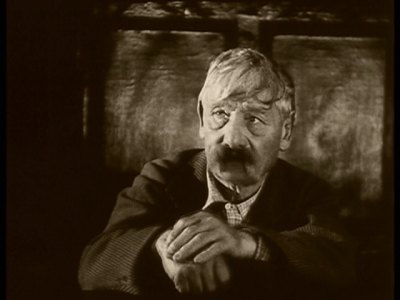 In early 20th Century Paris, and old man Jérôme Crainquebille (Maurice de Féraudy), pushes his cart through the streets in the morning selling vegetables, just as he's done everyday for the past 40 years. He is able to eek out a meager living, barely keeping body and soul together, but though he works hard he is content. On this day however he has a run in with the police. While blocking the street waiting for a customer to return with his payment, an officer tells Crainquebille to move along. While trying to explain that he'll only be a minute longer, the officer thinks that the old man has said "Kill the cops." Even though witnesses say that he's wrong, Crainquebille gets arrested.
The poor street peddler is chewed up by the legal system. His lawyer advises him to plead guilty, and when Crainquebille says that he doesn't know what he's done the lawyer only tells him that his attitude will get him nowhere. The trial is confusing and frightening for the old man. Not understanding what's going on, Crainquebille is found guilty and sentenced to a week in jail. Jail, as he soon finds out, is... rather nice. He has a warm bed, a clean floor, three meals a day, and even running water! He enjoys his time there and gets some much needed rest.
When he is released from jail however, Crainquebille discovers that things have changed. No one is willing to buy vegetables from him anymore; after all, he's a criminal. No longer able to make a living doing the only job he's known for his entire life, the man sinks slowly into debt. Soon he's kicked out of his apartment and spends all of his time drinking. When the local bar cuts him off because he hasn't paid his bill, Crainquebille thinks back to the time he's spent in jail and even tries to get arrested again, to no avail. With no money, friends, or job, it looks like the poor old man has no hope left in the world.
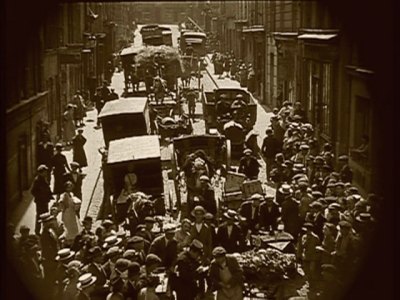 This was a very good film on several levels. The cinematography of 1920's Paris was excellent. The opening sequence had some wonderful imagery, comparing the vegetable peddler going through Paris in the early morning and the police wagon picking up prostitutes. The streets scenes were all interesting to watch, especially those that took place during the day when the avenues were crowded with people.
This films message works well without being too overbearing. Feyder, and writer Anatole France who wrote the novel that the movie was based on, warn about the dangers of bureaucracies and also comment on the conditions of the poor. The scene with the lawyer, where Crainquebille is just trying to understand why he's been arrested, was comically absurd. The trial scene was even more surrealistic, with Feyder using different lenses and camera angles to illustrate Crainquebille's confusion and fear. This was an excellent segment, one of the highlights of the movie. (The nightmare scene is also great.)
The only place where this movie falls down is at the end. [spoilers ahead] The conclusion is very reminiscent of the end of King Vidor's silent masterpiece The Crowd. The only problem is that none of Crainquebille's problems have been solved. Though he has passed an emotional crisis, the underlying problems are still there and nothing has changed. He's still destitute, has no job or prospects of one, and an alcoholic. Even if he has a better outlook on life, that's not enough to change his life around given the circumstances that he's in. [end of spoilers]
Even with a weak ending, this was a fascinating film to watch.
Faces of Children (Visages d'enfants, 1925):
This was easily the best film in the set; a quiet and touching film that is filled with authentic emotion. The mother of a young boy, Jean (Jean Forest), dies and this naturally has a deep impact on the child. He has loves her very much and her death doesn't change that. He still cherishes her picture and brings flowers to her grave every week. Things go from bad to worse however when his father, after a time of mourning, marries again. His new wife has a daughter, and Jean sees the new additions to the family as interlopers.
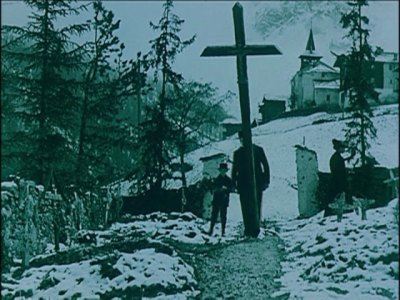 Even though his father's new wife isn't the typical mean stepmother, Jean has a hard time accepting her. However his relationship with her unfriendly daughter is even worse. When Jean plays a malicious trick on his step sister it ends badly, and the poor boy feels that the only way he can atone for it is by taking his own life.
This was a powerful film, much more so than the other two movies in this set. It really took me by surprise. While there is a lot of emotion, the film doesn't become melodramatic or heavy-handed. Feyder was able to create a film with heart without resorting to cheap theatrics as often occurred in the silent era.
One of the reasons the movie works so well is because the child actors give outstanding performances. They really put their heart and soul into the production, especially young Jean Forest. He seems to be living the role and give a performance well beyond his years.
This film was shot in the French Alps and the scenery was beautiful. All three of Feyder's films presented in this set have made great use of their settings and this one is no different. The mountains are the perfect background for this story, and could be construed as a metaphor for the way Jean feels.
These three films prove that Jacques Feyder was a talented director. While I wouldn't consider any of these forgotten masterpieces, the first two are solid films and the last one is very good.
The DVD:
These three films are presented on three DVDs which come in a clear double-width keepcase. When the case is opened one disc is on the left side and two discs, placed so they partially overlap, are on the right. There is a two sided cover with cast and crew information as well as stills on the back.
Audio:
All three films are accompanied by a very nice orchestral score that is scene specific. The music enhances the mood of the film without distracting from the images on the screen. I enjoyed all three scores and thought that they all worked well. These are recent recordings so audio defects such as hiss, distortion, and dropouts are not present. The first film has the original French intertitles and the other two come with English title cards. (Note: One intertitle card in Queen of Atlantis did not have a subtitle. This doesn't greatly affect the story though.)
Video:
These films were restored by collaboration between the Cinémathèque Française, the Netherlands Filmmuseum, the Cinémathèque Royale in Brussels, and Moscow's Gosfilmofond, and this group did a marvelous job. The set looks very good and there are only some minor problems mainly dealing with the way the discs were mastered. On the positive side the films are very clear with amazing detail. The restored image is crisp and has a decent amount of contrast. There are a few scenes where white areas bloom a little and where details are lost, but this is the exception rather than the rule. The films are also tinted and these colored scenes look just as good as the black and white segments.
On the down side, Image did not present us with a progressive transfer and interlacing is a problem. This occurs when two half-screens (one consisting of the odd numbered lines, the other even numbered ones) are shown at the same time. During abrupt cuts and scenes with fast motion this creates a double image that is distracting. See the example below where it appears that the man has four eyes.
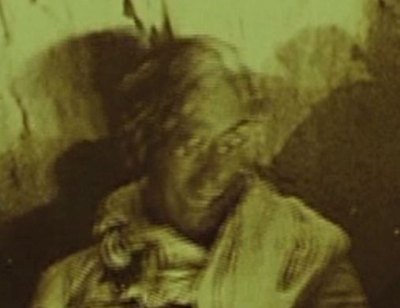
Even with this error (that would have been relatively easy to fix) the picture is better than I was expecting.
Extras:
I was very disappointed to discover that there weren't any extras at all. With a title like Rediscover Jacques Feyder: French Film Master, you would think that they would include a documentary about the director or at least a text piece giving details of his life and work. Nothing of the sort is found on any of the discs. Only the movies themselves are present.
Final Thoughts:
This was a very good set. I really enjoyed Faces of Children, and found the other two films to be good solid productions. It is a bit disappointing that there are no extras or even a text essay about Feyder included with the set, especially given the price which is a bit high for what it is. Even taking that into account though, I wouldn't have any trouble recommending this set to fans of early cinema.
|




| Popular Reviews |
| Sponsored Links |
|
|
| Sponsored Links |
|
|
| Release List | Reviews | Shop | Newsletter | Forum | DVD Giveaways | Blu-Ray | Advertise |
|
Copyright 2024 DVDTalk.com All Rights Reserved. Legal Info, Privacy Policy, Terms of Use,
Manage Preferences,
Your Privacy Choices 
| |||||||