
| Reviews & Columns |
|
Reviews DVD TV on DVD Blu-ray 4K UHD International DVDs In Theaters Reviews by Studio Video Games Features Collector Series DVDs Easter Egg Database Interviews DVD Talk Radio Feature Articles Columns Anime Talk DVD Savant Horror DVDs The M.O.D. Squad Art House HD Talk Silent DVD
|
 DVD Talk Forum |
|
|
| Resources |
|
DVD Price Search Customer Service #'s RCE Info Links |
|
Columns
  


 
|
|
|
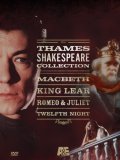
Thames Shakespeare Collection, The
There's a reason Shakespeare is known as "the Bard," with his work celebrated down the centuries. No one has exhibited quite the mastery of the English language as old Will - though many a phenomenal author has been inspired by his work - but more than that, Shakespeare was just flat-out a great storyteller. He wasn't above rifling existing histories, tales, and plays for ideas and plot outlines, but when he brought them to life, they became something much more than the sum of their parts. Shakespeare's plays are full of drama, intrigue, comedy, tragedy, violence, passion, revenge.... all infused with a keen insight into human nature. So it's no wonder that his plays have been performed and adapted more times than can possibly be counted. In the Thames Shakespeare Collection, we get four of Shakespeare's classic plays as produced by Britain's Thames Television. The four plays, Macbeth, King Lear, Romeo & Juliet, and Twelfth Night, are a bit uneven in the performance quality, but overall this collection offers a solid treatment of Shakespeare's work.
Macbeth is the first play in the set; this 1978 television production is a straightforward rendition of the Royal Shakespeare Company's 1976 stage play. The leading actors are stellar: Sir Ian McKellen is Macbeth and Dame Judi Dench is Lady Macbeth. Their performances are very strong, bringing these tormented characters to vivid life. Overall, though, this rendition of Macbeth doesn't work very well as a modern, filmed performance, though I can see that it would have been effective on stage. The play is done in an extremely minimalistic way, to the point that there are no sets to speak of: the actors perform in front of a black background, with just the occasional piece of furniture in the scene. Costumes are half-modern and half-archaic, giving an oddly anachronistic feel to the story, and the props are sometimes a bit surreal-looking. I found the total minimalism to be actually a bit distracting, especially in the scenes with the less stellar actors: while McKellen and Dench can carry a scene with the audience's total attention focused on them alone, that absorbing focus highlights any weaknesses in the other performances. The porter's scene is very weird, for instance, and ends up having a grating effect. I suspect that some of the reason I was disenchanted by this version of Macbeth is that the play is actually one of my favorites, and I didn't care for some of the choices that were made of what to cut for the filmed version. For instance, several early scenes that are important in establishing Macbeth's character prior to meeting the witches are left out, shifting the overall moral trajectory of the play. Still, it's certainly an original rendition that has its strong points.
King Lear has a slightly more traditional feel. This 1974 production has fairly elaborate sets and costumes, which in my view help to establish the scenes more effectively. For this story of family and political intrigue, murder, madness, and betrayal, the performances are strong across the board: most notably, we get Patrick Magee in the title role, but the supporting cast is quite solid. The pacing is handled well, compressing the play into two and a half hours without feeling rushed. The tone is kept appropriately dark and foreboding throughout, with key scenes presented quite effectively. (The eye-gouging scene is actually quite gruesome and effective, which just goes to show that you don't need CGI when your script-writer knows how to write spine-chilling dialogue.) While I found that the cinematography was a bit too claustrophobic at times (too many tight close-ups), it wasn't too distracting.
Romeo & Juliet is one of the most well known of Shakespeare's plays, but it's never been one of my favorites. This 1976 production has its strengths, but overall it's not a version that changed my tepid appreciation of the play. The acting is consistently a bit over-the-top, which I found a bit distracting. There's a lot of enthusiasm from the cast members, though, and one of the strengths of this version is certainly the youth of its cast: finally, we have a Romeo and a Juliet who seem to be appropriately young (Juliet is specifically noted in the play as being 14... not the 18 or mid-20s that our modern sensibilities would prefer). Costumes and sets are well done, creating a reasonably natural-looking world that allows us to follow the story and suspend our disbelief.
The set wraps up with Twelfth Night, the latest of the productions (1988). Here, the claim to fame is that it was directed for the stage by Kenneth Branagh (though it's noted as "directed for television by Paul Kafno"), and justifiably: Branagh's talents as a director are on display in this solidly crafted rendition of Shakespeare's rich comedy of romance and mistaken identity. Here, we get fairly stylized sets and costumes, but the minimalism works well here in a way that it didn't in Macbeth, perhaps because it's minimalistic enough to be dramatic while not so much as to be distracting. (I have to admit that the musical score is quite cheesy, though.) What really works best is that the acting is excellent: across the board, the cast clearly knows the heart and meaning of the lines from Shakespeare, and they deliver believable, compelling performances. While I ordinarily prefer Shakespeare's tragedies and histories to his comedies, Twelfth Night certainly shows that he's a master of all genres.
The DVD
The Thames Shakespeare Collection is a four-DVD set, with each play on its own disc with its own plastic keepcase, packaged in a rather drab paperboard slipcase.
Video
All four of the plays appear in their original 1.33:1 aspect ratio, as they were produced for television. The image quality varies. Macbeth looks the worst, with low contrast, a very grainy feel, and distinct halos on bright objects. King Lear fares much better: close-ups look excellent, with crisp details, and the other shots look reasonably good as well. The longer-distance shots are softer, with some edge enhancement and a few colored halos, but overall the color is vibrant here. Romeo & Juliet falls in between those two in terms of image quality: the image is fairly soft, and is grainy with poor contrast in dimly lit scenes, but closeups look good. Some edge enhancement and a few flaws crop up as well. Twelfth Night looks good overall, with a reasonably clean picture and good colors.
Audio
The soundtracks are all fairly straightforward stereo tracks, but the quality varies. Macbeth again comes up short, with a flat, muffled sound. King Lear sounds clear for the most part, but Romeo & Juliet also suffers from a flat, muffled, rather tinny sound. Twelfth Night is generally clean and clear, though at times it does have a slightly muffled sound.
Extras
I'm quite impressed with the special features that appear here: each disc has a substantial bonus piece that was made relatively recently, looking back with perspective on the making of the program, as well as a couple of minor extras.
Macbeth's special features start off with a 4-minute introduction to the play by Ian McKellen. The real star is the 33-minute mini-documentary "The Scottish Play: An Explanation with Ian McKellen": this interesting piece gives a lot of insight into the adaptation of the play. We also get a timeline of William Shakespeare's life and plays, and biographies/filmographies of Ian McKellen and Judi Dench.
King Lear gives us an interesting retrospective with actor Patrick Mower in "Edmund... A Pivotal Role," a 28-minute piece looking back 30 years on Mower's involvement in the play. We also get a short but interesting set of production notes from producer/director Tony Davenall, and a set of biographies and credits.
Romeo & Juliet offers a set of cast biographies as well, but of much more interest is "Romeo & Juliet: A Family Feud," a 20-minute retrospective interview with actors Christopher Neame (Romeo) and David Robb (Tybalt).
Twelfth Night has a very interesting 21-minute interview with Kenneth Branagh, the play's director, called "Inside an Illyrian Winter." There's also a timeline of Shakespeare's life and plays.
Final thoughts
The Thames Shakespeare Collection offers viewers renditions of four classic plays: Macbeth, King Lear, Romeo & Juliet, and Twelfth Night. As a fan of Shakespeare's work, of course I found these television versions to be interesting (if not perfect), so I'd give this set a solid recommendation to anyone who's likewise an enthusiast of the Bard's work. Those who are looking for an introduction to Shakespeare would do better to get a more recent version, as the 1970s flavor and sometimes minimalistic style may act as a barrier. The overall appeal of this collection is boosted by the excellent selection of informative special features, so that I'll give it a solid "recommended" rating overall.
|



| Popular Reviews |
| Sponsored Links |
|
|
| Sponsored Links |
|
|
| Release List | Reviews | Shop | Newsletter | Forum | DVD Giveaways | Blu-Ray | Advertise |
|
Copyright 2024 DVDTalk.com All Rights Reserved. Legal Info, Privacy Policy, Terms of Use,
Manage Preferences,
Your Privacy Choices 
| |||||||