
| Reviews & Columns |
|
Reviews DVD TV on DVD Blu-ray 4K UHD International DVDs In Theaters Reviews by Studio Video Games Features Collector Series DVDs Easter Egg Database Interviews DVD Talk Radio Feature Articles Columns Anime Talk DVD Savant Horror DVDs The M.O.D. Squad Art House HD Talk Silent DVD
|
 DVD Talk Forum |
|
|
| Resources |
|
DVD Price Search Customer Service #'s RCE Info Links |
|
Columns
  


 
|
|
|
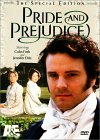
Pride and Prejudice: The Special Edition
A few years back the works of Jane Austen received a Shakespeare-sized revival among movie development types, resulting in the releases of Sense and Sensibility, Persuasion, Emma, and the Emma-based Clueless. The finest production to surface during this time, however, was BBC's adaptation of Austen's Pride and Prejudice (1995). This monumental production incorporated the finest of Austen's prose, situations, and character without any of the casting pitfalls and truncation that hurt some of the other releases.
At 300 minutes, Pride and Prejudice, was originally broadcast as a mini-series and the full running time helps the characters and their complex personalities and lives develop slowly over time. Directed by Simon Langton and adapted by Andrew Davies, the story, one of Austen's most enduring, covers a broad range of human emotions, from sadness to suspicion to joy. The main character, Elizabeth Bennet, is perhaps the most beloved female literary figure from her era. Her pluck, vivacity, and ability to hold to her ideals in a less-than-totally-free society mark her as both perfectly indicative of her times and thoroughly modern. A certain pressure falls on Elizabeth and her four sisters since their family has no real wealth (they're sort of the poor-rich) and marrying into a solid family will be the only way to ensure the security of the Bennets' relatively modest lifestyle. A lot of this pressure falls to the oldest Bennet daughter, Jane. Her relationship with Elizabeth, the next oldest, is one of the sweetest in the film. Elizabeth, far more suspicious than her older sister, takes refuge in Jane's optimism and openness. Their scenes together shimmer with humor and humanity.
This is due, in no small part, to the extraordinary performances from the two women playing them. Jennifer Ehle delivers an enormous portrayal as Elizabeth. She communicates the complexities of her famous role with expertise and warmth. It's no wonder that Lizzie Bennet is such a touchstone of modern culture. As played by Ehle, she is one of the funniest, most vibrant, alive personalities ever committed to film. Susannah Harker is fantastic as Jane. She combines the quiet sweetness of her role with the gravity of someone who feels the pressure to succeed. In fact, the Elizabeth-Jane relationship is only one of dozens of rich, complex situations in the film and the entire cast does astonishing work.
The main story, so to speak, is the development of the relationship between Lizzie and Mr. Darcy, played by Colin Firth. Darcy begins the film looking like a brooding snob (the title refers to his apparent inability to flow with polite society) but the more Lizzie learns about him the more her opinions change, and not always in a positive direction. Firth starts the film playing Darcy like a deeper David Boreanaz of Angel and subtly helps change him throughout so that as he begins to look different to Lizzie, we see the changes too.
Other notable performances are given by Alison Steadman and Benjamin Whitrow as the Bennet parents, an odd couple that each continue to contradict themselves and demonstrate personal conflicts beyond typical supporting characters, Julia Sawalha as the youngest Bennet daughter, Lydia, an uncontrollable flirt and, ultimately, a devastating embarrassment to a family trapped in such a structured society, Adrian Lukis as Wickham, a young soldier whose stories of growing up with Darcy start Lizzie on her journey towards the truth, and Barbara Leigh-Hunt as the haughty Lady Catherine de Bourgh, an ultra-judgemental member of the ruling class whose opinions are as biting as her nose is permanently upturned.
Special mention needs to be made of David Bamber, whose Mr. Collins, a Bennet cousin and heir to the Bennet homestead, sets his sights on marrying Lizzie. His version of this sniveling, sweaty cleric is one of the most convincing, consistent, and specific performances in recent memory. Only interested in discussing his wealthy patron Lady Catherine de Bourgh, Mr. Collins is not a character easily forgotten.
It's a testament to the talent pool of British theater that such a fine cast can be assembled, down to the smallest roles. Similarly, the technical arts are also expertly represented. The locations and sets feel totally authentic and the costumes are so textured and detailed that you can almost feel the stitching. The cinematography is achingly beautiful but not overly ornate. We appreciate the scenery when the characters do, as when Lizzie goes sightseeing in the country, but we also have to peer through darkness at other times.
This film has been described as flawless and that's not wrong. The only "flaw" is that it eventually ends. While the story comes to a satisfying and appropriate conclusion, it's a shame that it can't just go on forever.
VIDEO:
This is A&E's second attempt at releasing Pride and Prejudice on DVD (regardless of the "First time on DVD!" boasts of the advertising material) and is an improvement in several ways (the episodes now flow from one to the other without closing credits every hour, the retail price has been slashed nearly in half), but other changes are more questionable. The video quality on this second release is a weirdly complicated matter. First off, it is wide-screen anamorphic for the first time, which is fine, but originally the film was broadcast full-screen. Still, the compositions are beautiful. The color, however, has been largely desaturated so that, instead of the warm, golden hue of the broadcast, the current release is much higher contrast, at times almost monochromatic. It seems inconceivable that this would have gone unnoticed. It rarely looks bad but it just doesn't feel right. The second disc feels a little better than the first. The higher contrast brings out a little extra grain but for the most part the image is crisp and clean. It isn't a bad transfer but I'd like to hear an explanation for the appearance (or, rather, disappearance) of the colors. The first release, by all accounts, included a much lower quality transfer but the colors were warmer. Some fans are keeping both versions, although I think that this new version stands on its own.
AUDIO:
The Dolby Digital 2.0 is simple, but fine. Carl Davis' score is lively and dynamic and the rest of the production emphasizes dialog over flash.
EXTRAS:
A half-hour "making of" featurette is the only extra. It is a very interesting piece that discusses the adaptation of the material, the casting process, the locations and costumes, and more. The only regret is that more members of the outstanding cast aren't highlighted. A text biography of Jane Austen and some other information are also included.
FINAL THOUGHTS:
Simply put, BBC's production of Pride and Prejudice is a modern classic - one of the finest literary adaptations ever done. A&E seems to be having a tough time getting the film right on DVD, however, with their second flawed attempt. Still, the price is right and the movie is so good that it transcends the problems here. It's unlikely that a third version will get released. As a rental Pride and Prejudice is fine, a couple nights of wonderful entertainment. But really this is a film that belongs in a permanent collection. At 300 minutes it commands a good deal of time and whether spread out over a series of viewings or watched all at once, Pride and Prejudice is as engrossing and enjoyable as a film can be.
|



| Popular Reviews |
| Sponsored Links |
|
|
| Sponsored Links |
|
|
| Release List | Reviews | Shop | Newsletter | Forum | DVD Giveaways | Blu-Ray | Advertise |
|
Copyright 2024 DVDTalk.com All Rights Reserved. Legal Info, Privacy Policy, Terms of Use,
Manage Preferences,
Your Privacy Choices 
| |||||||