
| Reviews & Columns |
|
Reviews DVD TV on DVD Blu-ray 4K UHD International DVDs In Theaters Reviews by Studio Video Games Features Collector Series DVDs Easter Egg Database Interviews DVD Talk Radio Feature Articles Columns Anime Talk DVD Savant Horror DVDs The M.O.D. Squad Art House HD Talk Silent DVD
|
 DVD Talk Forum |
|
|
| Resources |
|
DVD Price Search Customer Service #'s RCE Info Links |
|
Columns
  


 
|
|
|
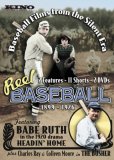
Reel Baseball
Without any big name films or even stars that are well remembered today, Kino's two-disc set of films about America's favorite pastime, Reel Baseball, might have flown under a lot of people's radar. That's too bad because this set is one of the best compilations of silent films released in years. The set boasts a wide variety of films, comedies, dramas, cartoons, feature movies, and short subjects. The pictures are almost universally enjoyable and the image quality is excellent for movies this old. The set has movies with John Bunny, the first international comedy film star, John Gilbert, Colleen Moore, and Charles Ray, not to mention Babe Ruth, along with directors Francis Ford (John's brother) and Edwin S. Porter. Not being a baseball fan, I have to admit that I didn't have high expectations for this collection, but it turned out to be one of my favorite releases, silent or talkie, for this year.
This two disc set contains 13 movies all together including two feature films.
Disc One:
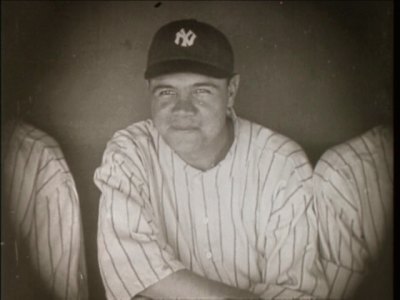 Headin' Home (1920): Who better to lead off a set of baseball movies that the Sultan of Swat? This 1920 biopic pretends to tell the story of Babe Ruth. Of course it's heavily fictionalized, showing Ruth living at home with his dear ol' mother and sister and whittling baseball bats from trees he chopped down himself. (In reality, Ruth's parents sent him to an orphanage when he was seven and rarely saw him after that.) This film, told by an old-timer in the stands watching Babe play, shows the Babe back in his hometown of Haverlock before he was discovered. He is a baseball enthusiast, but just couldn't get the hang of the game. He loved it, but wasn't any good. Even during the big game against Haverlock's rivals, the Highlanders, "Nobody paid no more attention to Babe than to a No Smoking sign." Things look desperate in the bottom of the ninth with the score tied, and the hapless Babe Ruth up to bat...
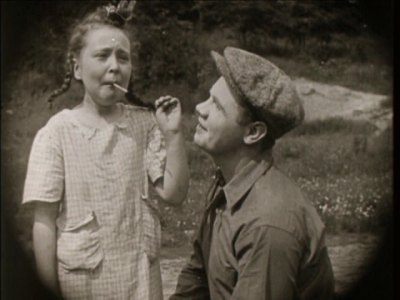 This is a fairly standard drama for the day, but it is still a lot of fun. Ruth actually does a pretty good job in the film. While it's obvious that he's not a professional actor, he manages to hold his own in the movie and just watching him on the screen is a treat. The interesting thing about this film is the date, 1920. That was Ruth's first season with the Yankees, years before he held the all time home run record, hit 60 hommers during the 1927 season, or made the famous called shot. Even back when he was a star (the Yankee's paid $100,000 for his contract and extended a $350,000 loan) but it is fun watching this knowing that that George Herman Ruth would reach even greater heights.
This disc also has a Babe Ruth Kinogram that runs about a minute. In it the slugger and his wife visit a man who makes pottery, and as the famous ball player takes his turn on the pottery wheel.
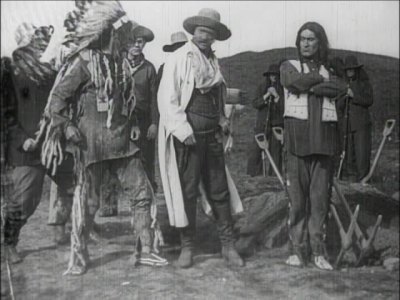 His Last Game (1909): This is an interesting one reel short. With one game left in the season, the pitcher from the local team, an American Indian, is approached by some gamblers and urged to throw the game. When he refuses, things get tough and the pitcher ends up shooting the two gamblers. Sentenced to death, pitcher gets a reprieve to play the final game of the season, and while he does, a judge learns of the extenuating circumstances of the deaths and orders a reprieve. Will the letter granting the pitcher his life arrive in time?
The Ball Player and the Bandit (1912): This is another interesting one reel film directed by Francis Ford, John Ford's elder brother. Harry is the star pitcher for his college team but when his uncle suffers some financial difficulty the money for tuition is no longer available. The uncle arranges a job for Harry out west where he works as the paymaster for a ranch. He earns the respect of the ranch hands after besting one in a fight, along with the affection of the owner's daughter. When Harry gets stuck up bringing the payroll back from town however, his baseball skills come in handy.
Disc Two:
The Busher (1919): Even if this film wasn't good, it would be worth watching just for the stars and personalities associated with it. The film was produced by Thomas H. Ince, who along with D. W. Griffith and Mack Sennett formed Triangle Studios in 1915. Four years later Ince had his partners buy him out and set up his own studio where he made many types of films but was most famous for the westerns he produced. A significant player in Hollywood, Ince's career was tragically cut short in 1924. He accepted an invitation to go on a cruse aboard William Randolph Hearst's yacht one weekend along with Charlie Chaplin, Louella Parsons, author Elinor Glyn and others. The weekend was cut short and Ince rushed to a hospital. He was soon returned to his home where he died. The cause of 42-year old Ince's demise a heart attack, while Hearst's papers said it was acute indigestion. The rumor that has circulated ever since was that Heart caught Chaplin in bed with Marion Davies, Hearst's mistress. Chaplin ran onto the deck, followed by Hearst who had a gun. Hearst shot and missed the comic, hitting Ince instead. This theory was the subject of Peter Bogdanovich's 2001 movie The Cat's Meow.
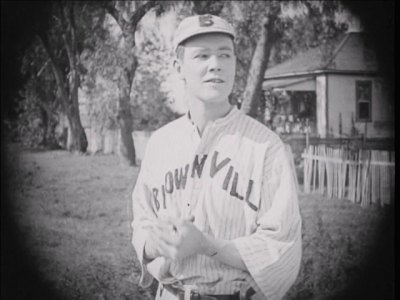 The entertaining and fun 55-minute movie features a trio of stars. The hero is played by Charles Ray, an actor who gained stardom in the 1917 King Vidor picture The Crowd. In that film he played a country boy who goes to the city with big dreams of striking it rich, only to fail miserably. That was followed by several other films (The Busher included) where he played kind-hearted rural lads, most of them successes. Growing tired of the same role, he broke from Thomas Ince who had produced most of his features and set up his own studio to make his own pictures with roles that weren't in the same mold. He plowed all of his money into The Courtship of Myles Standish, which failed miserably and left him penniless. Eventually he returned to Ince's studio, but with the executive's death in 1924, Ray found himself nearly unemployable and working for poverty row studios.
John Gilbert (billed as Jack) plays his romantic rival. In a few years Gilbert would be the biggest movie star in the world. He stared in King Vidor's classic WWI drama The Big Parade (1925), and was hand-picked by Lillian Gish to appear opposite her in La Boheme (1926). He had a well publicized affair with Greta Garbo, and even planned to marry her. She got cold feet at the last minute and left John at the altar, something that he never really recovered from. Things started to go downhill from there. Gilbert started drinking and to make matters worse he punched studio head Louis B. Mayer at a party when the exec made a disparaging remake about Garbo. Mayer had it out for him from then on, and it is rumored that the powerful mogul purposely had Gilbert's voice tampered with in his first talkie (His Glorious Night (1929) the premier of this movie was parodied in Singin' in the Rain) in order to ruin the star's career.
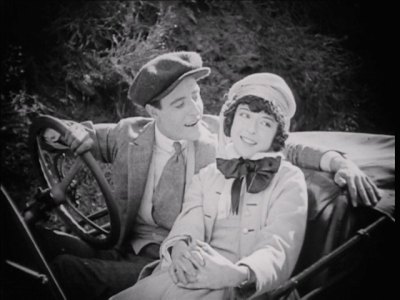 Their romantic interest is Colleen Moore, who arrived in Hollywood in 1917 and was immediately put into films thanks to a relative who worked with D. W. Griffith. Moore had the staring role in 1918's Little Orphan Annie, but bigger things were in store for her. In 1923 she landed the role in Flaming Youth (unfortunatley now a lost film.) She recreated herself for the part, bobbing her hair, wearing unbuckled galoshes, and playing the role with a light, carefree attitude. The film was a hit as so was Moore. The galoshes she wore 'flapped' around as she danced and people started calling Colleen and the women who imitated her style 'flappers'. In the next few years her star continued to rise and in 1927 she was the biggest box-office draw in Hollywood. Unlike her tragic co-stars, Colleen didn't spend her money. She invested it. In 1934, tired of the life of an actress, she retired and was able to live quite comfortably on the money she had made. She even wrote two books on investing and married not one, but two stock brokers.
The movie itself? It's the story of a bush-league pitcher Ben Harding, (Ray) who is in love with the local beauty Mazie (Moore) but is in competition for her affection with the rich banker's son Jim (Gilbert.) When a professional baseball team, the Pink Socks, become stuck in town due to a broken train, Ray unknowingly asks the gentlemen if they'd be interested in playing a game of ball. They choose up sides, and Ben becomes the star of the game, striking out the Pink Sock's star hitter. This earns him a shot at the big leagues, but when he travels to the big city, he finds that he doesn't have what it takes. Ben returns home in disgrace. He's still the best pitcher in the area. So when talent scouts for the majors attend the big grudge match between Ben's team and their rivals, he just might earn a second chance at being a star.
This is a light and amusing drama and the cast is wonderful. Ray does a fine job as the country bumpkin, and it's easy to see why he was so popular in this role. Moore and Gilbert are also good, but they don't shine in their smaller roles like Ray does.
Casey at the Bat (1899): This is a fragment of a film that I suppose is loosely based on the famous poem. It only runs a half a minute and features some baseball players piling on an umpire who made a bad call.
 How the Office Boy Saw the Ball Game (1906): This is another fragment which runs for five minutes. The Edison short directed by Edwin S. Porter tells a simple story. The office boy is a big baseball fan and gets a stenographer to forge a letter from his mother saying that his grandmother has died. Excused for the afternoon, the lad climbs a telephone pole and watches a ball game with a small telescope. The game, shown through a circular matte to illustrate what the office boy is seeing, is an actual game between NY and Pittsburg. This version of the short is arranged in a rather odd way. There is a scene missing where the stenographer faints after the office boy's simple plot worked and gets escorted home by another office worker. Later in the film there is a scene where the boss, having decided to attend the game himself, yells at the stenographer and the office employee. At the end of the reel whoever edited this version places the scene where the boss finds two of his workers at the game and becoming irate. As presented, this doesn't make a lot of sense. Even so the film is easy enough to follow since the highlight is the baseball game itself.
Hearts and Diamonds (1914): Who was the first comedian to become a movie star? Before Keaton and Lloyd, before even Chaplin and Arbuckle, John Bunny was an international sensation. The rotund man teamed up with the bean-pole thin Flora Finch in many of his shorts and the pair's movies were popularly referred to as Bunnyfinches and did very well for Vitagraph. The actor was only in the movies for five years. The stage actor started by getting $5 for a small part in a film in 1910. By 1913 he was making $1000/week. He died of liver disease in 1915 and in his obituary in the New York Times predicted that "The name John Bunny will always be linked to the movies." Alas that was not to be the case. Today he is nearly totally forgotten, even among silent movie buffs. A good part of that is due to the rarity of his films. Though by some accounts he made over 250 shorts over his five year movie career, only a handful of them exist today. (Another one of his films, Her Crowning Glory (1911), is available in the excellent Treasures from American Film Archives collection.)
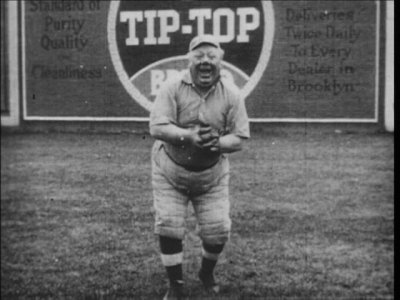 Luckily this collection contains a rare 'Bunnyfinch.' In Hearts and Diamonds John Bunny is an old widower, Tupper, who sets his sights on a rich widow Rachel Whipple (Flora Finch) who is coming to town to check on her investments. Figuring that the widow would be more attracted to a bachelor, Tupper sends his daughters off to a relative and sets about wooing Whipple. While at a ball game the lady quips "I simply adore base ball players" (sic) and that gives Tupper an idea. He sets out to recruit a team so that he can play on it too.
The interesting thing about this comedy is that there isn't a lot of slapstick. Bunny was overweight and not athletically inclined like Roscoe Arbuckle so his films relied on situational comedy more than prat-falls. Bunny is certainly exuberant in his role, and it is easy to see how film goers in the early part of the last century would become enamored of the actor. It is interesting to note that one intertitle card reads "Bunny makes a star play" giving the actor's name, not his character's. While some of the comedy doesn't work quite as well today as it once did, this film is still a highlight of the set.
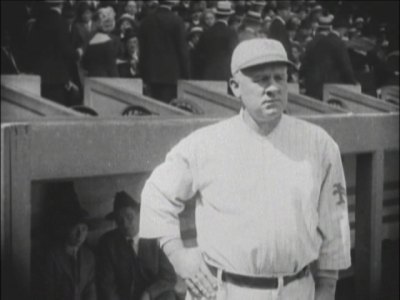 One Touch of Nature (excerpt 1917): The manager for the NY Giants, John J. McGraw, gets top billing in this comedy/drama. McGraw hires a new ball player, Bill Cosgrove, who tears up the field in the early innings, but that all changes when his rich father shows up. The elder Cosgrove, who has had a rocky relationship with his son since he married against his will, doesn't wave at Bill when he goes up to bat and that throws the younger man off his game. It looks like the Giants will lose the game when it's the bottom of the ninth and Cosgrove gets one last chance at bat. This is a fun film that recalls the innocence of an earlier day. This is only the ending section of a longer movie, but it plays well as it is. The plot is easy to follow and it doesn't seem like anything is missing.
Felix Saves the Day (1922): A Felix the Cat cartoon, in which the mischievous cat has to win a baseball game for his team. The neat thing about this short is the mixture of live action footage and animation. A great cartoon.
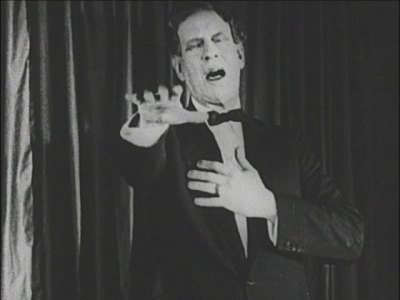 Casey at the Bat (1922): This is an early experiment in synchronized sound. It features De Wolf Hopper reciting Ernest Thayer's famous poem. The melodramatic and over-the-top performance is hard to hear in parts due to the primitive recording technology, but viewers can still follow the narrative. Hopper became famous for this recitation. A record he made of his performance even reached #3 on the Billboard charts.
Butter Fingers (1925): A Keystone comedy staring Billy Bevan. Bevan is the star pitcher for the local baseball team, but when he's threatened by an opposing team's tough guy he promises to lose the big game. That's not as easy as it seems in a Mack Sennett comedy however. The film is filled with the wild antics and crazy gags that made Keystone famous.
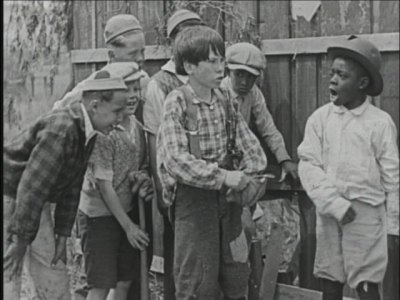 Happy Days (1926): This short is based on the newspaper comic strip Winnie Winkle and features Ethlyn Gibson as the title character. Ten Winkle shorts were made, all staring Gibson, between 1926 and 1928, and this is the second installment of the series. Though the comic strip portrayed the trials and tribulations of a working woman, this short plays more like an Our Gang rip-off. The Rinky Dinks, a group of kids who hang out in a home-made fort complete with a dog-powered automatic door are challenged to a baseball game by a rival team. In a seemingly unrelated story-line Winnie gets the afternoon off and takes her ward to his dancing lessons. Once there, someone slips a frog down the effeminate instructor's back with predictable results.
The DVD:
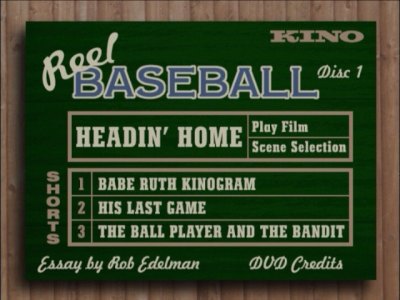
Audio:
The accompaniment was performed by David Drazin, David Knudtson, and Ben Model. All of the audio tracks were piano or organ scores and they were scene specific and generally fit the titles well. David Drazin's score to The Busher was the best score on the disc. It is very good and lively, with the music complimenting the action on screen very well. The other scores were fine.
Video:
The video quality varies, naturally, but all of the films look very good especially when their age is taken into account. The masters look like they came from both 35 mm and 16 mm prints, and though all of the movies had some print damage it was always within acceptable limits. The shorts generally were a little rougher than the two features. The De Wolf Hopper Casey at the Bat short was lacking contrast and had washed out details, but that was the exception rather than the rule. Overall the contrast and detail were both very good, and the print defects, while present, were never distraction.
Extras:
The only extra in an interesting essay by Rob Edelman.
Final Thoughts:
This is just a fun set and actually easier to watch than most two disc sets. Kino's Slapstick Symposium series, while very good, get a little old when you watch them straight through. That's not the case with this set. I screened it over two days and could have done it in one if I only had the time. The mixture of styles and lengths works very well and each movie has something to recommend it. With a retail price of only $29.99, this is a steal. Highly Recommended.
|



| Popular Reviews |
| Sponsored Links |
|
|
| Sponsored Links |
|
|
| Release List | Reviews | Shop | Newsletter | Forum | DVD Giveaways | Blu-Ray | Advertise |
|
Copyright 2024 DVDTalk.com All Rights Reserved. Legal Info, Privacy Policy, Terms of Use,
Manage Preferences,
Your Privacy Choices 
| |||||||