
| Reviews & Columns |
|
Reviews DVD TV on DVD Blu-ray 4K UHD International DVDs In Theaters Reviews by Studio Video Games Features Collector Series DVDs Easter Egg Database Interviews DVD Talk Radio Feature Articles Columns Anime Talk DVD Savant Horror DVDs The M.O.D. Squad Art House HD Talk Silent DVD
|
 DVD Talk Forum |
|
|
| Resources |
|
DVD Price Search Customer Service #'s RCE Info Links |
|
Columns
  


 
|
|
|
Lost World - 1960 & 1925 versions, The
When it comes to the movies, dinosaurs have always been big (no pun intended.) From Winsor McCay's Gertie the Dinosaur (1914) to the Jurassic Park blockbusters the prehistoric creatures have always been box office gold. Now Fox has released a pair of dino movies on a really nice set. The Lost World presents the 1960 Irwin Allen spectacle in a nicely restored version and includes the original 1925 film as a bonus. While the earlier movie is easily the most entertaining, both films have their moments. One other interesting thing about this set is that the 1925 film may be the 1997 Eastman House restoration that has never been released to home video.
While the 1960 movie is the headliner of this set, I've decided to review them in chronological order.
1925 film:
The original version of The Lost World has gone through a lot and has a rather interesting history. When it was released in 1925 it ran about 10 reels, making the run time about 105 minutes (depending on the projection speed.) In 1929 sound films were all the rage. First National pulled the film from release and destroyed all the prints (film stock was very flammable back then and a safety hazard) saving only one negative. The mythical 'last negative' was never heard from again. That same year they licensed the rights to Kodascope Libraries and allowed them to make a 5 reel 16mm abridgement of the film. This ran 55 minutes and was shown at churches, schools, and the like. This version, along with a trailer, was the only film footage that was passed down over the years. The George Eastman House (GEH) cobbled together a print of the film with existing stills and text used to fill in the missing bits but that edit and the Kodascope release were the only versions to survive. The rest of this classic was lost.
 Or so everyone thought. In 1991 a small stock footage company located in New York discovered some stop-motion dinosaur footage in their collection. This turned out to be alternate unused takes to The Lost World, about 8 minutes worth. The following year a near complete copy was discovered in the Filmovy Archiv in the Czech Republic.
In 1996, GEH started on restoring this film using the new Czech material as well as other bits and pieces from several other film archives. This new edition was screened a couple of times, but oddly enough no commercial release was forth coming. David Shepard of Film Preservation Associates tried to license this restoration for home video release, but GEH wasn't interested. So he, along with Serge Bromberg of Lobster Films in France undertook their own restoration. This was completed in 1998.
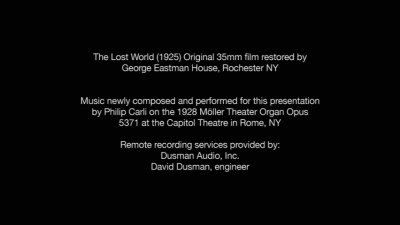 So, which version is included on this set? Could this be the all but unseen Eastman House restoration? It looks like it at first glance. The opening titles state that the film is from the George Eastman House which is clear enough, right? Well yes and no. The Eastman House screen startled me when it first appeared since the essay inserted with the DVD discusses how David Shepard restored the film. It says in part "Shepard was able to use the print [found in the Czech Republic]...to piece together a new cut of The Lost World for DVD." So I was expecting to find the Shepard/Bromberg restoration (which runs 93 minutes) on the disc. Okay, someone messed up with the insert. It happens. The run time bothers me though. The version on this DVD clocks in at 76 minutes, far short of the 100 minutes that the Eastman version is said to run. In 1991 and again in 1997 Lumivision released the early GEH restoration on laserdisc and DVD respectively. These versions ran only 64 minutes however, much shorter than the film included on this disc. Oddly enough there is no copyright listed on this restoration, aside from the original 1925 title, that might help pin down when this was pieced together.
 One of the main critiques of the GEH restoration was that available scenes weren't included when they first screened it in 1997. In answer to this Ed Stratmann, who was in charge of the restoration, said that it was a work print that had been screened, and that the restoration was still a work in progress. If that is so, I find it odd that they cut nearly 25 additional minutes.
It is obvious that this bonus disc is not a copy of an already released version of the film. The extras and musical accompaniment don't match up with any other discs, and the run times are off. By process of elimination this looks like it is the GEH restoration. I do find it odd however that GEH would license their version to Fox for what basically amounts to an extra. With all of the people clamoring over the years to see this edit, I'm surprised that they didn't sell the rights to Image or Kino. I've contacted Fox and George Eastman House to see if I can get a definitive answer from them.
Update: (9/25/07) While I haven't heard from either Fox or GEH, I did receive an e-mail from Art Pierce of the Capitol Theatre in Rome, New York where the musical accompaniment for this edtion was recorded. He related that the film was run at 24 fps, per GEH's instructions, while Philip Carli performed on the theater's organ. I'm a little embarased to admit that I assumed that if this was the GEH restoration it would be run at 18 fps as it was originaly screened. At this faster speed, the 100 minute film would be over in just 75 minutes. At almost the same time as I heard from Mr. Pierce, Ben Simon from Animated News & Views wrote hypothesising the same thing. He's also written up a good review of the disc which you can check out here. It appears that there is little doubt that this is the much sought after Eastman restoration.
As for the film itself, it is very good. I have always enjoyed this version better than the 1960 Irwin Allen production, and this edit is no exception.
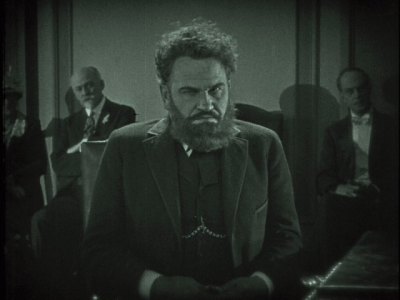
 The movie starts with Professor Challenger (Wallace Beery) giving a talk in London about his recent trip to the Amazon. He claims that while there he saw living dinosaurs. To quell the laughs of the unbelievers he arranges another expedition to the deep interior of unexplored South America to both prove his claims and to rescue a fellow explorer Maple White.
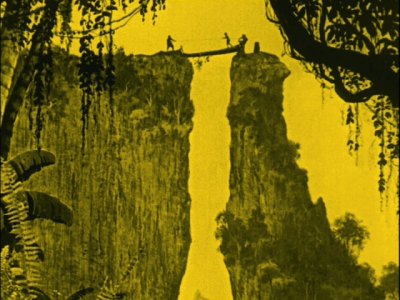
Agreeing to go with Challenger are big-game hunter Lord John Roxton (Lewis Stone), a skeptical scientist Summerly (Arthur Hoyt), a newspaper reporter Edward Malone (Lloyd Hughes) who is trying to impress the woman he loves, and Paula White (Bessie Love), daughter of the missing scientist. They set out for the Amazon and eventually reach and scale a tall plateau. On its top they discover that Challenger was right: dinosaurs do still walk the earth. Of course seeing them and living to tell about it are two different things.
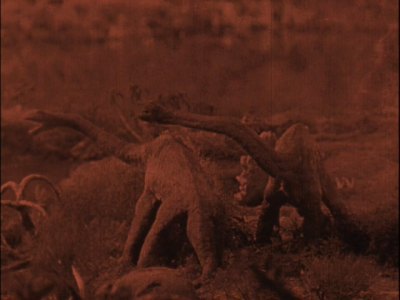 This adaptation follows the book pretty closely at the beginning, it's only when we're well past the half-way point when liberties are taken. Still, it's an exciting and fun-filled movie with an all-star cast who really do a great job.
Of course the main attraction is the special effects by Willis H. O'Brien. O'Brien would go on to bring King Kong to life but he honed his stop motion skills with this film. While the motion is a bit jerky, the dinosaurs look and move realistically. The special effects really steal the show away from the human actors and are the most memorable, and impressive part of the film.
This edit of the movie, unfortunately, feels like there's something missing. While there aren't any glaring plot holes or inconsistencies, there are a lot of shots that end too early and abrupt cuts. Some of the scenes feel a little odd too. The climax of the film has more shots of the crowd's reaction than of the dinosaur itself and that reminds viewers that they are seeing a reconstruction. Granted this is a quality effort, and better than the 63 minute version which was the only thing available for years, but it still isn't as good as the Shepard/Bromberg restoration.
The 1960 version:

After working on The Lost World (1925), Willis O'Brien went on to work on the special effects, most notably the stop-motion animation, for King Kong (1933) and Son of Kong (1933.) In 1949 he and his protégé, Ray Harryhausen, did the stop motion work for Mighty Joe Young and O'Brien won an Oscar for his work. Despite the critical acclaim, O'Brien had trouble finding work after Young, which was a financial failure. He found work here and there on such pictures as The Black Scorpion (1957) and The Giant Behemoth (1959) but steady employment was hard to come by.
 For years he had been thinking about a remake of The Lost World and created many drawings and layouts for the film. He pitched the idea to either 20th Century Fox, Irwin Allen, or both but however was in the meeting agreed and work began on a remake. Irwin Allen's production company made the film with Allen writing, directing, and producing the film. The movie had a respectable budget, but Allen didn't spend it as wisely as he could have. In what must have been a heart-breaking moment for O'Brien, Allen ditched his stop-motion dinosaurs. This was a tragic mistake.
The plot was updated, and more liberties were taken with the story, but at its heart Sir Arthur Conan Doyle's novel still lurks. Professor Challenger (Claude Rains (The Invisible Man)) arrives back in London after an exploration of the Amazon and announces to the Zoological Institute that there are still dinosaurs living in South America. Greeted with laughter he proposes a return trip, and agrees to take hunter Lord John Roxton (Michael Rennie (The Day the Earth Stood Still)), doubting scientist Professor Summerlee (Richard Haydn), and reporter Ed Malone (David Hedison, who would end up playing Capt. Lee Crane on Allen's Voyage to the Bottom of the Sea.) Once in the Amazon it turns out that Roxton's girlfriend (who is half his age) Jennifer Holmes (future Bond-girl Jill St. John) has shown up with her matching pink luggage set and and her brother David (Ray Stricklyn). After all, they want to go on an adventure too. Throwing caution and common sense out the window party allows the two novices to join them.
 They hire a helicopter pilot, Manuel Gomez (Fernando Lamas), and for reasons that are never explained also take along the guy who bought the supplies that the party will need, Costa (Jay Novello), a greedy coward who's every act ensures that he'll end up dead before the final reel.
Together they climb in one of the most spacious helicopters ever designed, and fly off Professor Challenger's plateau. They find a landing space and set up camp, but that night a loud beast starts advancing towards them. Hiding in the jungle, the explorers can't see what the creature is, but when they return to their camp they discover that the helicopter has been destroyed along with their only radio. Now they are trapped at the top of an unscaleable plateau that is filled with dinosaurs and, they soon discover, hostile natives. If that wasn't bad enough, one of the members of the party is trying to kill them.
Though the movie is filled with skilled actors and a ripping plot, the movie just doesn't work nearly as well as it should. A large part of the problem can be traced back to Allen's script. It's melodramatic and corny, and the dialog is painfully bad in parts. At one point, after the party has been captured, Challenger tells his comrades "The invasion of privacy gives man the right to kill, and we are the invaders." Run that by me again Professor.
 Now I'm a big fan of Irwin Allen's TV shows (if you doubt me, check out my review of Land of the Giants where I sing his praises.) At this point in his career however, he hadn't yet discovered how to get to the action quickly, something he TV shows would be noted for. The story is fairly ponderous at the beginning, and even when they get to the land of the dinosaurs, it's a case of too little too late. Things do pick up in the last 20 minutes of the film. Luckily this last section does have that ol' Allen charm and he throws in all of the excitement that was missing from the first hour of the film. There are man eating dinosaurs, hostile Indians, lakes of lava, diamonds the size of your fist, and precarious ledges. It's would have been easy to ignore the other missteps that this film takes if had been as exciting as the conclusion.
Speaking of missteps, one of the biggest is the dinosaur special effects. Instead of Willis O'Brien's often amazing stop-action creatures, Irwin Allen decided in favor of using live reptiles as dinosaurs. To make matters worse, these lizards and baby alligators had horns and fins glued onto them to (unsuccessfully) disguise their origins and make them appear more like thunder lizards. This doesn't work at all, and I really can't see anyone in 1960 being impressed. When I was in first grade (1968) the most popular library books (among the boys) were those with lots of pictures of dinosaurs. Even at that age we all knew their names, which ones were herbivores and which were carnivores. I can't see any of my classmates even remotely believing that an iguana with fins was a brontosaurus (as it's claimed in the movie. Hell, the brontosaurus (as we called the Apatosaurus back then) didn't even have fins!)
The acting isn't nearly as good as you would expect looking at the all-star cast. You could almost see in the star's eyes that they thought the script was horrid and were just doing it for the paycheck. Claude Rains grumbles and bellows well enough, but there's no heart in his role, and Michael Rennie just walks through the picture never showing much emotion even when he relates the secret hidden in his past.
I'm being a bit harsh on the film, it isn't horrible. There are some very good parts, the chase scene at the end for example. It's just not as good as it could be, and that's the biggest tragedy.
The DVD:
Audio:
1960 Version: This film comes with a rather unusual audio option: a 4.0 mix. From what I could discover, the film was originally released in mono so I'm not sure why this wasn't remixed in 5.1. The subwoofer channel would have been nice when the dinosaurs roared, as they often did. There's also a stereo mix, but the original mono isn't present.
The 4.0 track sounded pretty good, though there was some distortion. When the monsters would bellow, the sound would occasionally crack just a bit. The dynamic range was also very limited, as one would expect for a film from 1960. The highs are clipped and lows don't have much force. That's too bad because the background music by Paul Sawtell and Bert Shefter is very good but could sound much better.
1925 Version: This film is accompanied by an organ score which was composed and performed by Philip Carli. The score sounds very good and Carli is a proficient organist, but the music didn't movie me like the best silent film compositions do. The audio is clean and clear and there are no defects worth noting.
Video:
1960 Version: The 2.35:1 widescreen image has been restored and looks pretty good. The colors are bright and vivid, they've been boosted a bit, and really fit the Irwin Allen spectacle. One problem however is that some of the skin tones are a bit artificial looking at times. Michael Raine looks particularly pasty when talking to the blind man near the end, for example. This isn't as bad as some discs that I've seen and never becomes distracting. The level of detail is excellent and the blacks are nice and deep. On the digital side of things the disc also looks pretty good. Blocking is absent and aliasing is rare, but there is a lot of mosquito noise in the picture, especially in the shots of the sky. Overall this is a very nice looking movie.
1925 Version: This film was reconstructed from several sources so the image quality does vary a bit over the course of the film, though overall it looks excellent. There are some fine hair-line scratches, a bit of dirt and other print defects, but these are relatively few and many of the more egregious flaws have been digitally removed. There are some missing frames here and there and due to the patchwork nature of the restoration some of the shots are too short. (The scene where the brontosaurus pokes his head through a window at the end is an example of this. Viewers barely see the dinosaur head before it cuts to the reactions of the men inside the room. The first part of this scene was longer in the original cut, but alas the footage no longer exists.
The first thing that strikes viewers is the excellent level of detail. The texture of the dinosaur's skin can easily be discerned and the backgrounds are not unduly soft. The picture has a sharp contrast and neither blacks nor whites are too intense. Grain and other film related artifacts aren't a problem and digital defects are very minimal. The movie has been tinted using the edited Kodascope version as a guide, and it looks just wonderful.
Extras:
Included on the first disc, along with the 1960 feature are a couple of interesting bonus items. First off is a three minute promotional film (in black and white) Footprints on the Sands of Time. This has clips from the movie and tells viewers how exciting it will be. Next is a minute long newsreel clip that shows a group of school kids going to the premier of the film. This was cute and worth a spin. There's also a theatrical trailer, a reproduction of a comic book (that is too small to read and even if it wasn't it's on a reel and the pages zip by too quickly to even look at all the panels, much less read them), and image galleries for stills, a press book and production illustrations.
The second disc of this two disc set contains the 1925 version of The Lost World as well as a trailer for the film, and seven minutes of outtakes. The unused footage is all stop motion animation of the dinosaurs. It's great that they included this along with the feature.
Final Thoughts:
The original version is a great and fun film and the remake, while flawed, has its moments. Both movies look very good for their age and are pleasing to the eye. Together this makes a really nice set that is Recommended.
|




| Popular Reviews |
| Sponsored Links |
|
|
| Sponsored Links |
|
|
| Release List | Reviews | Shop | Newsletter | Forum | DVD Giveaways | Blu-Ray | Advertise |
|
Copyright 2024 DVDTalk.com All Rights Reserved. Legal Info, Privacy Policy, Terms of Use,
Manage Preferences,
Your Privacy Choices 
| |||||||