
| Reviews & Columns |
|
Reviews DVD TV on DVD Blu-ray 4K UHD International DVDs In Theaters Reviews by Studio Video Games Features Collector Series DVDs Easter Egg Database Interviews DVD Talk Radio Feature Articles Columns Anime Talk DVD Savant Horror DVDs The M.O.D. Squad Art House HD Talk Silent DVD
|
 DVD Talk Forum |
|
|
| Resources |
|
DVD Price Search Customer Service #'s RCE Info Links |
|
Columns
  



 
|
|
|
Valentino Collection, The
The Films:
The Young Rajah (1922): This is a lost film, with only fragments still existing. As the opening text piece states, this isn't a restoration but a compilation. Production stills, parts from two trailers, and a section the of the film from that still exists as a 16 mm reduction print, were pieced together along with "newly created photographic inserts", letters the characters receive that help advance the plot, to reproduce the movie. There are extra titles inserted to fill in the holes in the story which were taken from Paramount's editing logs.
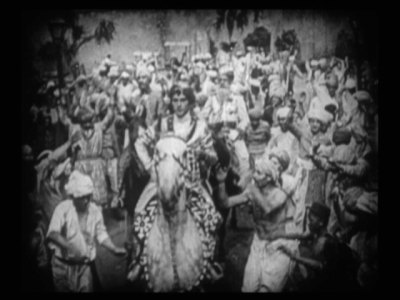 Amos Judd (Rudolph Valentino) grew up on a farm in Connecticut. Unbeknownst to the young man however, he isn't just a simple farmer. He's really the heir to the kingdom of India, and was taken away to the US when a usurper took his father's throne. As the royal highness, he has psychic abilities that let him see into the future, a family trait that was granted to him by the God Krishna.
Armed only with 'several hundred thousand dollars' worth of rubies that arrived with him from India, Amos goes off to Harvard where he's the start of the crew team. Getting into a fight with someone who didn't make the team one night, Judd's mystic abilities cause him to duck just in time and his attacker perishes.
Amos then falls in love with Molly Cabot (Wanda Hawley), but things don't go smoothly between the two. Though Molly loves Amos, she can't be with him since he's not white. To make matters worse, the usurper discovers that Amos is the rightful ruler of the throne and sends assassins to murder the young man.
Made right after Blood and Sand and only a year after his biggest picture, The Sheik, it's really hard to judge this as a film, since there is only the last third of it still exists. The first section of the movie flies by quickly, and viewers can't help but realize that they're missing a lot. The fight scene near the beginning is told through still and naturally wasn't very exciting, especially when a title card had to explain that the villain fighting Valentino lunges at him with a chair, misses, and falls out an open window to his death. The narrative is very choppy and speeds up or slows down depending on how much film is available.
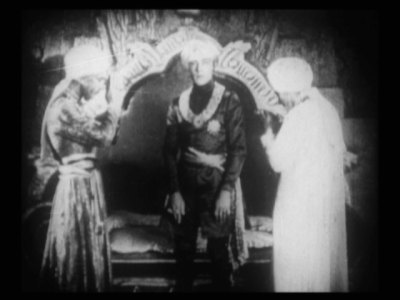 Having said that, the creators did a very good job with what they had. Viewers can get a taste of how this movie must have played back in 1922, but only a taste. As presented here, the movie comes across as a bit silly. The writing seems sloppy (the usurper in India just happens to get an American paper from Cambridge, Massachusetts which describes the fatal fight Amos had, and by that account deduces that the man in question can see the future, and therefore is the young prince) and the ability to see the future comes across as hokey. That would probably still be the case if the full movie were available, but of some of the early India scenes along with the spectacle of the ball (with costumes designed by Valentino's wife at the time, Natacha Rambova) would have made the movie much more pleasing to watch and the absurd aspects of the plot wouldn't have been emphasized as they are here.
There are some interesting aspects to the film however, especially the way race is treated. In 1922 American wasn't a place of tolerance when it came to race relations, but this film puts forth the proposition that skin color is only superficial. At one point Molly states "I couldn't marry a man that was not of my own people, no matter how much I - I loved him." She's torn by this however and deep down knows that it isn't the right thing to do. In another section Amos preaches religious tolerance too. When Molly asks him why he has a Bible, the Torah, and a Koran all opened he says that they are many roads leading to one God. A very progressive outlook for 1922.
A/V: The still images look great, nice and clear with a lot of detail. The existing film however is pretty rough. The contrast is fairly poor and the image is very soft. There's only so much that restoration can do, and while the people at Flicker Films in association with TCM tried don't expect a video quality on par with other prominent DVD releases.
The score was composed and performed by Jon C. Miralis and he does his usual wonderful job. The piano music is scene specific and does a good job of matching the mood of the film.
Stolen Moments (1920/ reedited in 1922): There's a bit of history to this film. In 1919, before he was a big star, Valentino married Jean Acker, which was a big mistake. Acker was an actress under contract at Metro and lesbian. She was Nazimova's lover, but was also involved with another actress, Grace Darmond. Needless to say, things got a bit sticky and Jean was worried that her career would be ruined if word got out. When Valentino proposed after knowing her for only a few months, she saw a solution to her problem and accepted.
Valentino apparently didn't know his wife was a homosexual, but when she locked him out of their hotel on their wedding night, he must have suspected that something was wrong. He tried to talk to her, but nothing he said made any difference. Heartbroken he left Hollywood and headed east where he made a couple of pictures. Stolen Moments is one of them, made for Select Pictures. It was a six reel feature and Valentino had a supporting role as the villain.
The year after this movie was released, Valentino hit it big. The Four Horsemen of the Apocalypse (1921) made him a star and The Sheik (1921) made him a super-star and household name. Select Pictures realized that it had gold in its vaults. They took the six reel film and edited it down to three reels, cutting out as much as they could while leaving in all of Valentino's scenes. They then changed the billing and released it as a Valentino picture. This shortened version is the only one that still survives, and only as 16mm reduction prints.
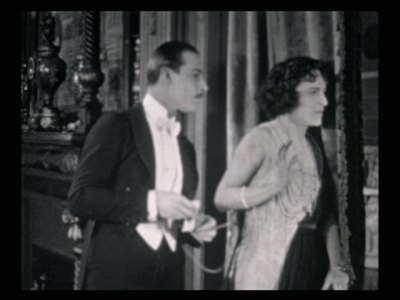 Valentino plays a wonderfully sinister rogue in this film; Jose Dalmarez, a famous author from Brazil. (He even wears a mustache, so you know that he's just no good.) When he moves in next to Vera Blaine (Marguerite Namara), the woman falls in love with the dashing and exotic writer. She writes him love letters and encourages her. When she mentions marriage, he laughs, saying that their love is above such quaint notions as marriage. Crushed, she leaves and marries Hugh Conway (Albert L. Barrett).
Time passes and Jose returns. Running into Vera again, he wonders out loud what her husband would think of her old love letters. He's willing to give them to her, but only if she'll sleep with him. When she says no, she scratches his face and flees with the love notes, but when he turns up dead soon after, poor Vera is the prime suspect.
This was a good, if slightly melodramatic film. Valentino was great as the reprehensible cad Jose. He was villainous without being over the top. Marguerite Namara, who was originally the star of the movie, over acted and looked too old to be playing a young thing after 25 year old Italian. She looks like she has 10-15 years on him, and that made it a bit hard to swallow.
Given that this is a condensation of a movie originally twice as long, the film flows pretty well. There are some abrupt scene changes and it's not hard to tell that some events took place during Jose's absence that were excised, but overall this abbreviation works pretty well and it's a lot of fun to see Valentino play the villain.
A/V: The image is windowboxed with an aspect ratio of 1.27:1 and comes from a 16mm reduction print. Because of that the details aren't crisp and the image is fairly soft. The contrast is acceptable but not outstanding. Highlights are sometimes washed out but this isn't a huge problem. The soundtrack was another fine piano score written and performed by Jon C. Miralis.
A Society Sensation (1918/ reedited in 1924): This is the earliest film in the collection and another example of a film cut down to emphasize Valentino's part after he became famous. Originally running five reels, this version was cut down to only two, and like Stolen Moments, it's not too hard to see where the cuts were made.
 Margaret (Carmel Myers) is the daughter of a seaman, Captain Harry Fairfax, and the rightful Duchess of Deerford. At least that's what the Captain thinks. He doesn't have any proof that they are royalty, but he has a lawyer working on it. In the mean time he sends Margaret off to become a society lady.
While staying with a rich matron, Margaret sees a swimmer in trouble and goes to his rescue. It turns out that she saves Richard Bradley (Rudolph Valentino), the heir to a fortune. The two quickly fall in love, but when Margaret discovers that her father was wrong and that they aren't royalty, she runs away knowing that they can never marry. But things never end that simply, especially in a romance film.
This is fine for what it is, a short melodrama, but it really doesn't stand out from all the similar romance movies made at the same time. Valentino does a good job as a romantic lead, though he really doesn't have much screen time. The director certainly knew what to do with Rudolph however and introduces him into the picture by having him walk out of the ocean in a bathing suit. Even today he looks pretty good.
The film also features an early appearance of Zazu Pitts (who Valentino catches as she swoons in one scene.) Her role is almost nonexistent in this edit, but it was probably much longer in the original version. Poor Zazu, it must have seemed to her at times that she was destined for the cutting room floor. (She also stared in Erich von Stroheim's Greed, a film famous for its initial length of 42 reels (9 hours). It was eventually cut down to 10 reels and released that way.)
A/V: This film is also windowboxed to 1.27:1 and looks pretty good. There are a lot of scratches and dirt on the film, but the contrast is very good and the level of detail is decent. The movie is accompanied on the organ by Bob Mitchell.
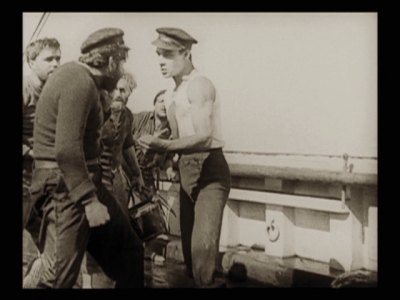 Moran of the Lady Letty (1922): This film features Valentino at the height of his fame. It was released right after The Sheik and is a rip-roaring sea adventure based on a book by Frank Norris (who also wrote the book that Greed was based on). Moran Sternersen (Dorothy Dalton) is the only daughter of a sea captain and has grown up on her father's ship, the "Lady Letty," since her mother's death. Though she's still young she's a tough sea dog, and the exact opposite of Ramon Laredo (Rudolph Valentino), a rich and pampered young man.
While trying to get to a yacht, Ramon gets lost by the docks and is shanghaied. He wakes up on the "The Heart of China" an outlaw vessel commanded by Captain 'Slippery' Kitchell (Walter Long). Kitchell is disgusted with how soft Ramon is, but working on the ship soon toughens him up.
One afternoon Kitchell sights the Lady Letty cruising slowly. Boarding her, the pirates discover that the crew has all been killed by coal gas. Everyone save Moran. Ramon brings her aboard the "China" and tries to hide the fact that she's a woman, but Kitchell soon finds out and wants to have his way with her. It's up to Ramon to protect the young woman.
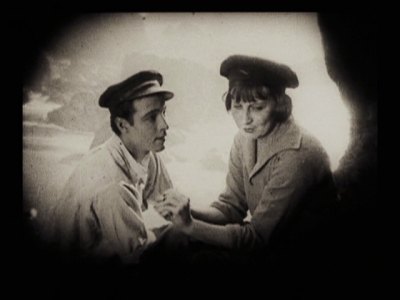 This was a pretty good action flick. The whole idea behind the film was to toughen up Valentino's image, and he does come across as a two-fisted brawler by the film's end. He's gets into a lot of fights, and few of the shirts that he wears have sleeves so his impressive physique is often showcased. A fast paced film, the action zips quickly along and makes up for the less than intriguing plot. The best film in the set, it is a lot of fun and well worth watching.
A/V: Also with a 1.27:1 aspect ratio, this tinted movie looks pretty good. Dirt and scratches are present but minimal, and the level of detail is pretty good. Highlights tend to be washed out in bright areas, especially on faces, and some details are lost in dark areas but these aren't fatal flaws. Overall this is a solid though not spectacular print. The music for this movie was composed by Robert Israel who also performs on piano and is accompanied by Vit Muzik on the violin. It sounds like an odd combination but the mix works very well and adds a lot to the viewing of the film.
The DVD:
These films come on a two DVD set housed in a single width clear keepcase with an extra 'page' to hold the second disc.
Extras:
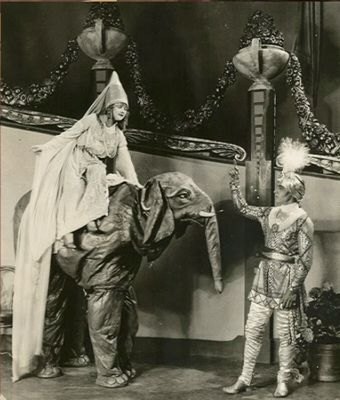 This set is filled with some really great extras, though most of them are only accessible via an unnecessarily unwieldy menu system. To start off, each film is accompanied by a gallery of production stills and promotional items and the first disc has a sample of the unrestored footage from The Young Rajah and Stolen Moments as well. It is interesting to note that some of the stills in The Young Rajah section were not used in that reconstruction, including a shot of Wanda Hawley riding an elephant - an elephant that was really two guys in a costume. It looks really dumb.
Also on disc one is Valentino in Memoriam, a collection of songs, stills, text pieces, and shorts concerning the actor's death and legacy. There's a wealth of information here most of which is quite interesting. I particularly enjoyed hearing the songs, especially "We Will Meet at the End of the Trail" written (or at least attributed) to Jean Acker. Smarmy though they were it was great to finally hear these songs that are often mentioned in Valentino biographies. Another highlight is Rudolph Valentino, a 10-minute overview of the star's films which was produced in 1941 by Astor pictures. Another unique rarity is Round About Hollywood, a two-strip Technicolor tour though the land of movie stars and moguls. There's also an audio interview with Ditra Flame, the "Lady in Black" who visited Valentino's grave every year on the anniversary of his death.
Disc two is just as packed. There is a video tour of Valentino's Beverly Hills home, several slideshows including images of Valentino's pets and earlier living quarters and text biographies of 21 people who were active in the star's life.
The most exciting bonuses on this disc however are the rare shorts that are included. A Trip Through Paramountown (1922) features Valentino on the set of Blood and Sand as well as appearances by Wallace Reid, Bebe Daniels, Gloria Swanson, Harrison Ford (no, not that one) and both Cecil B. and William DeMille. Screen Snapshots has a look at Valentino behind the scenes of The Sheik, and Bearded Valentino show's the star with a goatee that he grew while on vacation in Europe. Character Studies, which has appeared elsewhere but for the life of me I can't recall where, is a short where a makeup artist 'impersonates' various stars (who really appear as themselves) including Valentino, Buster Keaton, Douglas Fairbanks, and more. Rounding out the second disc is a trailer for When Love Grows Cold and a newsreel featuring Valentino and cowboy star Roy Stewart.
In addition to the bonus materials on the discs, there is a 12-page booklet with an essay about these films and Valentino by Emily W. Leider, promotional and production pictures, notes about the transfers, and a list of the discs contents. All in all this set has some great extras.
Final Thoughts:
This is a very nice set with some solid movies and outstanding bonus items. The only real complaint is that these aren't Valentino's best works. None of these films show the raw sex appeal that he had in films like Four Horsemen or The Sheik. Valentino fans will be delighted at this set and though three of the four films are either heavily edited this is the best that is likely to ever surface. The set gets a strong recommendation.
|



| Popular Reviews |
| Sponsored Links |
|
|
| Sponsored Links |
|
|
| Release List | Reviews | Shop | Newsletter | Forum | DVD Giveaways | Blu-Ray | Advertise |
|
Copyright 2024 DVDTalk.com All Rights Reserved. Legal Info, Privacy Policy, Terms of Use,
Manage Preferences,
Your Privacy Choices 
| |||||||